
Interview: Blue lights, blue skies

Mandy Langfield spoke with Corporal Mike Calhoun from Riverside County Sheriff’s Department about his career, and the shift from pilot to TFO
First of all, just to give a bit of context, what fleet does the Department operate, and how many people are employed in the Aviation Unit?
We operate five Airbus AS350 B3 / H125 helicopters that perform law enforcement patrol operations and backup hoist rescue duties to our primary search and rescue (SAR) helicopter, an Airbus H145 D2. We [took] delivery of our sixth H125 in December 2024. We have 36 personnel, including tactical flight officers (TFOs), pilots, emergency medical technicians (EMTs) / paramedics, mechanics, and support staff.
What are the primary roles and responsibilities of the Aviation Unit?
We provide 24/7 helicopter air support for the men and women of law enforcement in Riverside County and beyond. The patrol side provides a tactical airborne platform from which very experienced deputies can provide tactical insight and investigative methods using technology such as infrared camera and night vision goggles (NVGs) to help lessen the risk of harm to officers and increase the likelihood of apprehension of wanted persons.
Where did you do your initial flight training, and what first attracted you to working in airborne law enforcement?
I have frequently said that I wanted to be a helicopter pilot so bad that I became a Deputy Sheriff in southern California to do it! I was always fascinated by the capabilities and complexities of helicopters and thought it to be one of the most challenging and difficult machines to operate. I obtained my private helicopter certificate at Western Helicopters, located at the now-closed Rialto airport, in 2005 while I was a patrol deputy.
You’ve held the roles of Chief Pilot and TFO before; which do you enjoy the most, and which is the most challenging?
Both positions had quite a learning curve when I began each position. I really enjoyed the difficulty and complexity of being a TFO; I also enjoy, still to this day, instructing and teaching fellow unit pilots in mountain search and rescue operations, both day and aided at night with NVGs. I have always thought being a good Chief Pilot should be exhausting and it certainly was for me! Being the Chief Pilot was more demanding for me and carried a tremendous responsibility in properly training newly certificated commercial helicopter pilots through our vast
I also enjoy, still to this day, instructing and teaching fellow unit pilots in mountain search and rescue operations, both day and aided at night with NVGs
mission profile.

Do you think that TFOs are given sufficient training for their complex and varied role in the helicopter, and how has this changed over the years?
I can say for certain that TFO training and selection has become much more intentional and thoughtful now than [it was] in 2007 when I tested and trained. I have seen many more law enforcement units develop smart selection and training programs out there. One great development over the last few years is the Hangar Z Podcast, which showcases and highlights the people and equipment of airborne law enforcement, fire, and military operations. The demands on our law enforcement officers are growing more and more every year, and likewise the demands and requirements needed to train new TFOs are just as evident. The crime frequency, pace and intensity developing below the aircrew today require tremendous talent and task mastery to be effective, and units today are using creative ways to select and invest more time in skill development.
Do you work and/or train with other law enforcement departments to ensure that knowledge and experiences are being shared across disciplines and teams?
We host an annual safety fly-in where we invite all law enforcement, fire, and helicopter air ambulance agencies from southern California. Lately, many military units have attended with aircraft as well. We have had a guest speaker or two give a presentation on safety-related topics. This year I moderated a panel of industry experts and we discussed various topics relating to the various public safety operations, and audience participation led to some great sharing of ideas, equipment selection, and training. We are helping a neighbor agency with their training and gear selection for a rescue helicopter they will be acquiring, since we have operated the same one for four years now.
What technology are you making use of to train your flight crews? Do you find virtual reality (VR) and other programs useful, or are live training exercises and scenarios always the most effective?
I have always been blessed to have the privilege to train almost as much as we want in live flight training. We train almost daily on the SAR side given the vast mission profile we have, and in very challenging terrain, temperatures, and altitudes. We are instrument flight rules (IFR) on the rescue side, and I found the ICARUS instrument meteorological conditions (IMC) trainer to be a very valuable and more effective simulator than just the old-fashioned foggles.
Are you making use of drones in aerial policing duties, or do you have plans to do so in the future?
We do have a large and active drone program that our department implements almost daily. Our special weapons and tactics (SWAT) team has several drone operators and they utilize them on their operations almost every callout. Nearly every one of our patrol stations has a qualified drone operator and the use of them is more and more frequent. It is a valuable asset for sure.
We do have a large and active drone program that our department implements almost daily

What are the unique aspects of California that make it more challenging for you as a law enforcement team to operate in?
We operate in a county that is 7,200 square miles with a population of 2.2 million. Most of that population is densely located in the western one-fourth of the county. Our airborne patrol operations cover a very high call volume and cover calls for service over densely packed residential neighborhoods, as well as rural areas that may take 30 minutes or more to respond to.
On our rescue side we have some very diverse geography, from below sea level to a mountain peak over 10,800ft above mean sea level (MSL) with frequented hiking trails. Temperatures in parts of our rescue areas can range from over 120°F [49°C] in the summer to well below freezing and snow and icy conditions in the winter.
What do you enjoy most about your current role with the Aviation Unit?
The thing I most enjoy is working with the crew I have now. I work with some really good hoist operators and rescue specialists, and my partner co-pilot is just the best at his craft. Unit cohesion is something that is a rare art and when you have it such as we do, it makes your job safer, let alone more proficient. Getting to enjoy my team in the SAR mission set makes it all the better. I really love the SAR mission, with its complexities and challenges both day and night.
January 2025
Issue
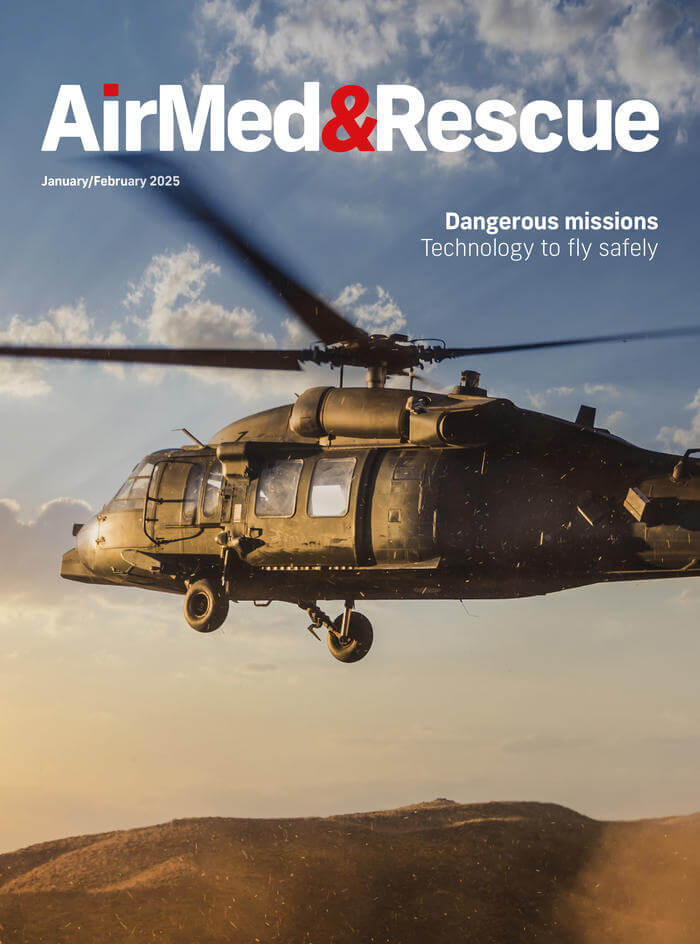
In our combined January/February edition, explore how islanders get emergency medical aid; find out about the way technology is being used to improve safety through increased situational awareness; discover all about hoist systems used in special missions; and see what is coming to the world of aviation in new platforms, technology and equipment; plus more of our regular content.
Mandy Langfield
Mandy Langfield is a Director of Palladium Media Partners and former Publishing Director at Voyageur Group. She has written extensively on international travel and health insurance, medical assistance provision, and air medical transportation. She was Editor of AirMed&Rescue from December 2017 until April 2021. Her favourite helicopter is the Chinook, having grown up near an RAF training ground.