
Interview: Collaboration outweighs confrontation

Talking with Tiffany Taylor, Senior Policy Director, United Aerial Firefighters Association, Mandy Langfield discovers the challenges and future facing the aerial firefighting community
What is your professional background, and how did you come to your current role with UAFA?
My career began in federal contracting, procuring training simulators for the US Department of Defense. I loved the idea of solving problems and making positive outcomes, whether for the end user or the program manager. Over time, I moved to the US Forest Service, where I became engaged in contracts which supported the forests and wildfire response.
I eventually moved to positions in the US Department of Agriculture (USDA) overseeing all its agencies’ contracts and advising the Secretary. However, high-level leadership often takes you away from what you love to do. So, when the opportunity arose to help form UAFA, I saw it as a chance to get my hands dirty again, setting up a new organization and advocating for sound business practices from a different perspective.
What does your role involve, and how does your governmental background and experience help with your responsibilities?
Right now, with only two of us at UAFA, I do a little bit of everything! I write articles to show UAFA’s position on topics important to our members or provide plain language explanations on agency actions. I also spend a lot of time reviewing pending contract solicitations, legislation and agency regulations for opportunities to advance the industry’s needs. The best part is when I get to talk to our members about their experiences with the contracting process so I can see the pressure points and explain the likely rationale from the government’s perspective or look for solutions for the future. My experience on both sides of the table gives me a unique perspective. I understand how government works and can bridge the gap between industry, decision-makers and policymakers.

UAFA is a relatively young organization; what is the story of its evolution, and how have its first years of operation been?
UAFA is just over a year old, but its mission was drafted by people who have been in the aerial firefighting community for decades. As UAFA continues to expand, we strive to enhance the effectiveness, efficiency, and safety of the aerial firefighting community by providing a collaborative platform for all types of aerial firefighting companies. We have over 80 members, which includes dozens of companies who provide aerial firefighting services, companies who support them, and partners that range from the National Wildfire Suppression Association to the Nevada Cattlemen’s Association.
We strive to enhance the effectiveness, efficiency, and safety of the aerial firefighting community by providing a collaborative platform for all types of aerial firefighting companies
What do you think is the most important and challenging aspect of aerial firefighting (AFF) in the USA at the moment?
The current challenge lies in striking a balance between beneficial fire management and suppression. Everyone seems to think it’s an either-or scenario. UAFA wholeheartedly supports the focus on beneficial fire and home hardening practices, but it recognizes the ongoing need for suppression to safeguard homes, communities, and public health. Maintaining a strong aerial firefighting force is like paying for insurance – a crucial investment even when the risk seems low. Just as we wouldn’t skip home insurance because fires are uncommon, we can’t afford to neglect aerial firefighting capabilities in hopes of never needing them. Proactive preparedness is essential to minimize future devastation.
One of the main topics of conversation at the Aerial Fire Fighting North America conference (AFFNA) was how private AFF operators can engage more effectively with the government to talk about the way in which they are contracted. What, for you, were the most important takeaways that private operators can follow to change the way in which AFF contracts are run?
The main takeaway is that collaboration outweighs confrontation. Our shared objective is to support ground crews and protect lives and property. Here’s how operators can enhance engagement:
- Open communication: look for opportunities to engage in transparent dialogue with government agencies. This can be as part of ‘industry days’ or one-off conversations, as long as there isn’t an active procurement. Discuss industry challenges, including supply chain disruptions, employee retention, and the risks operators face of maintaining readiness without guaranteed work. Be mindful not to sound overly negative
- Show empathy: recognize that land management staff never thought they would spend most of their time managing aircraft contracts worth hundreds of thousands of dollars. Many work under suboptimal conditions, lacking expertise, resources, and authority
- Present data: quantify the value of aerial firefighting. Although initial costs may appear high, providing data on all the cost elements strengthens the case for justifying these expenses.
The main takeaway is that collaboration outweighs confrontation
Investment in new technologies is another vital topic for AFF operators. What can be done by professional organizations such as UAFA to encourage the adoption of new technologies to improve safety and efficiency in the industry?
UAFA actively promotes innovative technologies in aerial firefighting, especially ones that our members identify as beneficial. By advocating for sensible government policies and leveraging members’ decades of experience, we try to drive positive change in a risk-adverse environment.

Do you think there is scope for growth in the AFF industry in North America? How can operators adapt to build their current capacity and ensure they are ready for future challenges, whether this is the increasing frequency and severity of wildfires, or a need for assets to travel to different hemispheres for seasonal work?
The traditional growth model for aerial firefighting faces significant challenges. Unsustainably low contract rates combined with a lack of readily available, purpose-built aircraft discourage investment. This is further compounded by a reactive approach from federal agencies who only engage services when fires erupt. Until this ‘call-when-needed’ mentality shifts, aerial firefighting remains an extremely risky business to be in and the agencies will risk not having modern aircraft, if any.
However, the industry boasts tremendous potential for expansion beyond traditional avenues. The demand for aerial firefighting resources is surging worldwide, with even US states seeking to manage their own fleets. By challenging the current model, operators can tap into this expanding global market. This not only extends their operational seasons, helping to retain their pilots and mechanics, it also bolsters cash flow.
As older aircraft are modified for use as AFF assets, and new aircraft (including drones) are being purpose-built for the AFF industry, what role is UAFA going to play in helping with the certification process for these aircraft?
UAFA recognizes the current challenges in federal certification and inspection for AFF aircraft. Land management agencies are not aviation specialists and shouldn’t shoulder that burden. The government views AFF as a commercial service for most aircraft types. This suggests a solution: leveraging established commercial certifications as the industry standard, accepted by the government. UAFA sees a clear role for itself in this future. We envision UAFA either becoming a certifying body or working closely to develop one. For uncrewed aerial systems (UAS), a blank slate presents a unique opportunity to develop a streamlined pilot and equipment certification program, and UAFA is ready to partner with Vertical Aviation International to incorporate aerial firefighting.
We envision UAFA either becoming a certifying body or working closely to develop one
What are your hopes for how UAFA’s role will evolve in the future?
I hope to see land management agencies view UAFA as a trusted resource, readily seeking our expertise. We want to be the go-to source for information on what the aerial firefighting industry can deliver. We aim to bridge the gap by communicating the industry’s vision and goals for the future of aerial firefighting. We’ll be a voice for the industry, advocating for solutions to overcome obstacles and enhance our collective effectiveness.
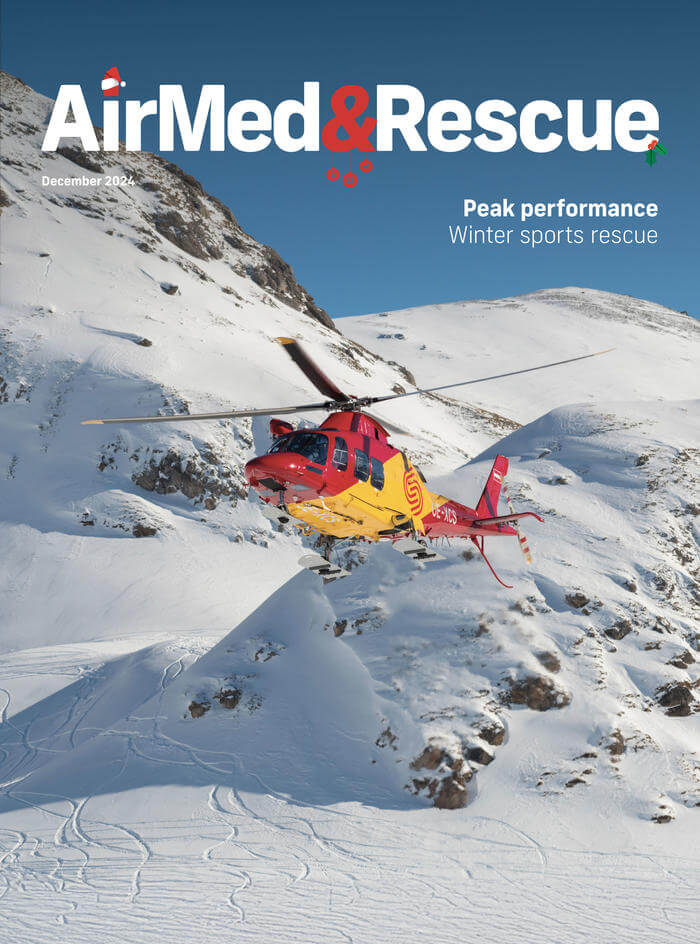
December 2024
Issue
In the December edition, discover what goes into saving people that get into trouble on the ski slopes; find out about drones that are being used for search and rescue; learn about the treatment options for people with fractures; and see what has been happening this year in the realm of avionics development; plus more of our regular content.
Mandy Langfield
Mandy Langfield is a Director of Palladium Media Partners and former Publishing Director at Voyageur Group. She has written extensively on international travel and health insurance, medical assistance provision, and air medical transportation. She was Editor of AirMed&Rescue from December 2017 until April 2021. Her favourite helicopter is the Chinook, having grown up near an RAF training ground.