
Interview: The building blocks of a career in aviation

Dr Kodey Bogart AvD, CEO of KB Aviation Solutions, relates to Jon Adams how from her initial introduction to aviation, her career has grown and evolved across various different roles, each complementing and building on the previous ones, and how she is inspiring the next generation to engage with the vertical lift community
You’ve been in aviation for almost your whole career – what got you interested in helicopters in the first place?
I was in the military at the time I went on a morale flight; they allowed the different squads in our unit to go up in an aircraft that just happened to be a Black Hawk, which could hold the most of us at a time and allowed us to still see outside and enjoy the flight. I went up and I sat in the crew chief seat, then I did it like five more times. I couldn’t believe they let me go that many times. I absolutely loved it.
I’m the type of person who likes to be busy and when I was looking at the pilots flying, they were just in constant fluid motion. I loved that. I actually have a picture of that very moment – my smile is so big that my eyes are basically closed.
How long was it from that morale flight before you started your own flight training and then went on to become a Black Hawk medevac pilot during the Iraq war?
About five years. I was in the military roughly a year and a half to two years, and I was enlisted for seven years before I went to flight school in 2004.
I went off to my officer candidate school and then flight school. Just shortly after I got out of flight school my unit was heading into Iraq.
How did the work that you did in Iraq forge your attitude towards aviation? And did you learn important lessons there that you wouldn’t have learned otherwise?
There were lessons I definitely learned there. I hope all aviators get to go through an experience, but the things that stand out the most to me, especially as I gain more experience in my career, is that teamwork is essential.
Communication can make or break a relationship, especially when you’re in a multi-crew environment. Us two pilots ran with two crew chiefs and one medic, so there’s five of us on an aircraft and it’s important to communicate, even sometimes the most mundane things that you think wouldn’t be important.
Communication can make or break a relationship, especially when you’re in a multi-crew environment
I had one mission and I was not happy with something the pilot-in-command (PIC) did. When we landed, my commander came out and I was like, ‘Listen, I am not flying again in this crew and with this person until we can all sit down and talk it out.’ To be able to say that in a war zone and that no-one was mad at me was super important, not even the PIC who I was frustrated with at the time. To make things safer, we needed to pause and to talk about it. I don’t know if a lot of young aviators, especially military aviators, get that opportunity to have such good leadership who don’t mind you taking the pause and saying, hey, this is a safety issue for me because whatever occurred wasn’t right. Whether I was wrong or he was wrong doesn’t matter. There was some sort of frustration or miscommunication that needed to be handled, and it was done appropriately. I think we went on a flight later that day, I remember ending it in hugs.
Teamwork and the truly just culture of safety are the two things that really helped forge my career in aviation from there.
You’re currently an aviation safety consultant. What else is it about safety that is so important to you? What is it that attracts you to it and gives you the desire to share all that learning?
I’ve always been the type of person who’s a bit of a book nerd; not novels, but I love regulations. I loved them in the military, I love reading the black and white and really talking through things.
I knew I could make a difference or a greater impact from the safety role, especially at a flight school where flight instructors, who’re just coming fresh out of their CFI training, haven’t had that same ingrained culture that I received when I was in the military. That gave me a sense of a strong purpose. Couple that with regulations, and actually wanting to help people really was a driving force.
I do lean back on my time in the military because safety was driven into us during flight school. Then, of course, moving into the Iraq war and having the great leadership and mentorship that I had, they instilled a lot of that in me, too. I think it was just a really natural progression from me to move into safety advocacy.
You have just been awarded your doctorate in aviation. What prompted you to pursue this stage in your education?
I was the first person to have a bachelor’s degree on my side of the family. I was the first to move into a master’s program, and now a doctoral program. So, I think a sense of personal accomplishment and growth and to set the standard for my own children, not that they have to do the same things, but I want to show them that they can. Having three children in the house and a full-time job is not easy.
I’m also very blessed to have a support structure through my husband, and our kids are very good, so that helps.
Once I finished my bachelor’s, I looked at my husband and I was like, ‘Well, I’m already in the routine of work and school, and everything, our processes around the house are already in order, so let’s continue this,’ and he’s like, ‘OK.’ When I’d finished my master’s, I looked at him and I said, ‘Hey, we’re already in the routine...’ That’s kind of how that worked for me as far as the doctorate specifically.
I do expert witness work, so a lot of them like the credentials to go with it. That was kind of the driving force for that, not a necessity, but for my dissertation and my study topic, it became such a passion, so I’m very glad I took that road.
And now that’s complete, what’s next? If you’ve still got the home structure for it, are you going to do something else with your time or are you going to take a little break from studying?
I [jokingly] tell my husband that I’m going to completely quit aviation and we’re just going to go and have a small farm somewhere. That’s not true, but that would sound amazing to me. I am going to continue with the expert witness work and I love my safety consulting business. I love the clients that I work with and, through my dissertation, I think I can help a lot of those maintenance repair organizations improve their culture.
I have moonlighted at the Florida Institute of Technology previously as an adjunct professor; if another professor has to step out for whatever reason, if they have to travel or they become I’ll, I’m happy to step into their aviation safety class and take a lecture for the day.
I’m just not good at sitting still, so I think there’s a little part of me that I might try to do a foreign language class. I live in Florida, so Spanish makes complete sense to do. My kids do Spanish in school, so I think that would be fun. The sky’s the limit on that one, or not the limit, if you will.

Tell me a bit about your role as Board President of the Space Coast Women in Aviation Alliance and the work that the Alliance does to support and advocate for women in aviation.
I started the Space Coast Women in Aviation Alliance probably three or four years ago. It started out as a ‘ladies who lunch’ [club]; I wanted to get women together who actually support women. My mentor is a man and he’s awesome, he and I talk on the regular over the past 20 years, but I had never found women who are super supportive. I don’t know if women are just more competitive towards one another or were vying for the same roles or I don’t know what, but I wanted to surround myself with strong women who genuinely cared about each other. I live in the Space Coast of Florida and there are numerous aviation companies, numerous aerospace companies, and that number is consistently growing. So why not get these women together and say, how can I support you? What are your endeavors? What are your goals? Do you have a hard meeting this week that you’re stressed about and maybe you want to run it past me and we can bounce ideas? Maybe you want to call me after and complain and cry about it? I just wanted women who really supported each other. So we meet roughly every other month for our social and go through that.
I wanted to surround myself with strong women who genuinely cared about each other. I live in the Space Coast of Florida and there are numerous aviation companies, numerous aerospace companies, and that number is consistently growing. So why not get these women together
On the other months, our secondary goal is we want to mentor younger kids in aviation – obviously more driven towards girls because there’s just not a lot in aviation at this moment – but any kids, and show them and give them mentorship. How are things going for you? Where are you going in your academics? Can I help you with something?
In addition, for your 10- to 15-year-olds, to show them there’s so much, so why not take advantage of that and go visit this control tower, go visit this robotics company, go to this aerospace/aviation company, and show them? I firmly believe that if kids can see it, smell it and touch it, you’ll have an advocate for aviation forever.
There’s so many jobs in aviation, you know: interior design, making flight helmets, etc. It’s not just about being a pilot or maintainer.
What should women who are interested in getting into aviation do to begin their journey into flying?
I think the first step is not being intimidated, to put yourself out there and go ask questions and meet people. There are great methods to do that, whether it’s, for example, the Space Coast Women in Aviation Alliance, Women in Aviation International, Whirly-Girls; there are tons of organizations out there that can at least get you networking and talking, and finding potential mentors for you, whom you can ask direct questions.
So don’t be afraid to go to your local airport and, if there’s a flight school, just go and ask them questions. Or of an aerospace company, ask, ‘Hey, do you ever give tours of your facility?’ They might not but, you know what, that person might know someone else who could do that or guide you to a different facility where that could happen.
Here in Brevard County, there’re safety symposiums, there’re career fairs; just attending those and seeing what’s out there and what you have an interest in can help.
As an inspirational role model, with numerous medals and awards, who are your personal role models?
I tend to look at the frontline workers, the people that are doing the job, who are still navigating their path in aviation. They may have young children at home or they’re going to school. And they’re at their job from whatever time to whatever time on whatever shift. I look up to those people because I know it’s hard, and I love to see them continue to do it anyway.
I do have my mentor. His name’s Gary Glover. He’s been a great mentor to me for 20 years. He’s the one who told me about a research study so I could become a pilot in the in the military. And whenever I have challenges or questions or concerns about some safety events, we’ll talk about different things. Having a confidant in him has been really priceless. He’s a mentor and a friend.
From a personal aspect, my husband, and not only because he’s a great friend, but he’s in finance, not in aviation. So he really listens and he’s smart about aviation and he has just a different perspective than me. I get really wound around the gears and uptight about things, but he has no expectations and he just gives me a different angle sometimes. Then I’m like, ‘OK, I didn’t think about it that way,’ so he just recalibrates me.
You write the successful series of children’s books Helo Girls, which have so far covered aerial firefighting, law enforcement, and most recently air ambulance operations. Can you tell me a little about the series, why you write it, why it’s divided into different special missions, and what’s next?
I just love helicopters. I do. I love the way they smell, the way they sound, every facet of them. And I wanted to have my children share that experience, to give them some sort of feel of that.
And it takes me a while to fall asleep, so I tell myself these stories to kind of put myself to sleep, and it got to a point where I just really enjoyed it more, then I would talk to my littlest guy about it. One day, I just spoke to my husband and we talked about what it would look like to do the book series.
As far as highlighting the different missions, I mean helicopters are so versatile, right? They can do so many things. I really wanted to cover public service, so firefighting, law enforcement, air ambulance – I really wanted to cover those sectors first. I think they resonate a lot with kids.
I really wanted to cover public service, so firefighting, law enforcement, air ambulance – I really wanted to cover those sectors first. I think they resonate a lot with kids
If we look at the fires that happened in California, for example, early in 2025, [the books are] a great tool for parents to read to the kids to make these events not so scary and not so daunting for them, [to let them know that] there are people out there who are protecting our homes and our communities. The same with law enforcement. Having flown law enforcement, it’s the po-po, right? They’re coming out to get you, like you must be a bad guy, but it’s not always like that. They’re doing so much good, when it comes to search and rescue, looking for the elderly, or maybe missing children. I don’t want kids to be afraid of it, and I want them to understand and to share the joy of the helicopter and then see themselves in it.
The series does feature all girls, but it’s not about the girl, it’s about the mission; it just happens to be a female pilot. It’s about the mission and it’s about doing it.
My safety advocacy has to be in there, so they do a pre-flight brief and talk about the crew and they talk about the mission. And then correlation at the end of the book, during the debrief: was our mission successful, what went right, what didn’t go right?
I’ll be moving on to book four in the next couple months. I have about 20 titles in my head. So I think a book a year, they’re a lot of fun. Again, there’s so many things that helicopters can do and I’d really like to hit all of them.
Is there anything else you’d like our readers to know?
I just really want to tell everybody, it’s not just for the little ladies out there, that if there’s something you want to do, just take that one step towards it and you might really be amazed at what you find.
If there’s something you want to do, just take that one step towards it and you might really be amazed at what you find
When I look at my career and everyone’s always like, ‘Kodey, you’ve done so much,’ but to me it’s all the same thing. It’s like when my son watches Minecraft because that movie came out not too long ago and it’s building blocks. My non-aviation career was a building block for my aviation career and aviation led to this and led to safety and it led to now where the books are. I feel like I’ve had a lot of pivots or moves, but it’s all been in the same direction.
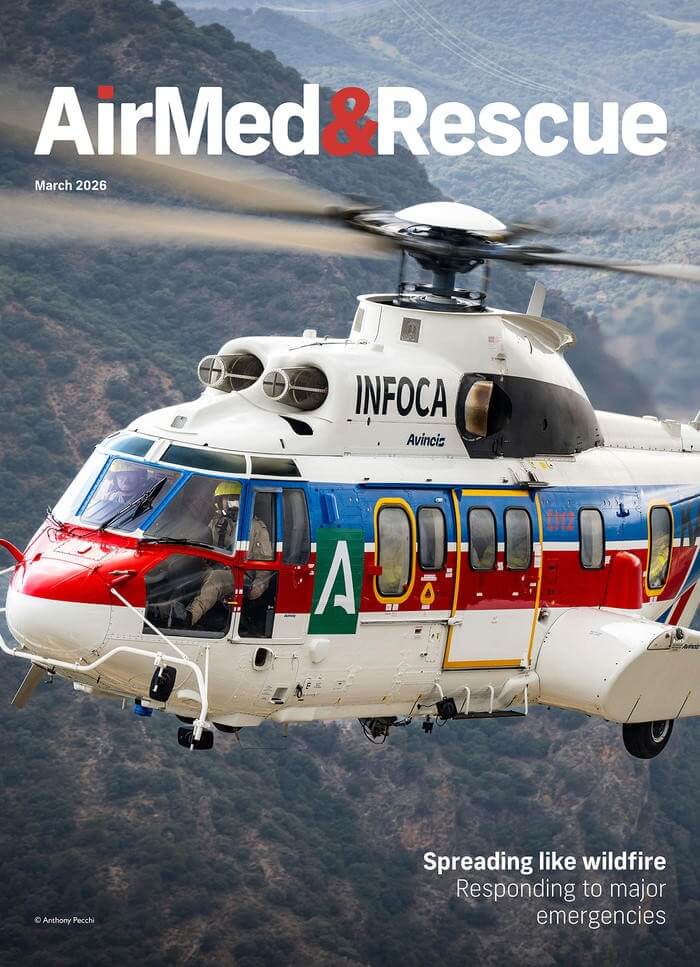
March 2026
Issue
This edition is bursting at the seams with articles from all corners of the special missions sector. We have features on the California wildfires that ravaged the state last year, what the cost–benefit analysis looks like for single-engine rotorcraft and autorotations, how the mission dictates the modification needed to the platform, and what can be done to further prevent the problems associated with inadvertent entry into instrument meteorological conditions.
Jon Adams
Jon is the Editor of AirMed&Rescue. He was previously Editor for Clinical Medicine and Future Healthcare Journal at the Royal College of Physicians before coming to AirMed&Rescue in November 2022. His favorite helicopter is the Army Air Corps Lynx that he saw his father fly while growing up on Army bases.