
Interview: The spearhead of emergency medicine in Norway

Halvard Stave, Head of the Helicopter Section at Oslo University Hospital – the largest HEMS department in Norway – discusses with Mandy Langfield his route into air medicine, what makes Norwegian HEMS unique, and his hopes for the future of the service
What is your background in pre-hospital emergency medicine, and what drew you to working in air medicine?
During medical school, I was deeply involved in mountain medicine and took part in several expeditions where emergency care – and especially improvisation in challenging outdoor conditions – was essential. That experience
was probably the main reason I wanted to move out of the hospital and into a more team-based environment, where we practice medicine under constantly changing circumstances. I started working on the Oslo emergency response car in 2008 and joined the helicopter emergency medical service (HEMS) in 2012. We have a high volume of critically ill and injured patients, which makes for a steep learning curve and provides rapid, valuable experience in pre-hospital emergency medicine.
What is your current role with the Norwegian HEMS, and what are your primary responsibilities within this role?
I am the Head of the Helicopter Section at the largest HEMS department in Norway, which is part of Oslo University Hospital. We operate two helicopters: one primarily dedicated to primary emergency missions, and another mainly focused on intensive care transfers. Our team consists of 16 consultant anesthesiologists who take shifts on the helicopters. The department also includes sections for search and rescue helicopters, fixed-wing air ambulance, and the physician-staffed rapid response car.
My main responsibility is to foster a strong and engaging environment for teamwork and medical development
My main responsibility is to foster a strong and engaging environment for teamwork and medical development. Our ambition is to be among the leading HEMS organizations in the world, and it is my job to create the conditions that allow our highly dedicated staff to make that happen.
What makes working for Norwegian HEMS unique compared with other HEMS providers?
I do not have in-depth knowledge of other HEMS operators, but I do know what works well in Norway. It is a large country with a scattered population, and there is broad consensus – both politically and among the public – that we should have a strong, publicly funded air ambulance service. The Norwegian HEMS represents the spearhead of emergency medicine in the country, and those who work within the service have both the opportunity and the responsibility to influence the development of the field.
For individual physicians, working in Norwegian HEMS provides a unique opportunity to develop broad clinical competence. One moment we may be treating patients with severe trauma or cardiac arrest, and the next we may be transporting extremely premature infants in incubators or transferring patients on inhaled nitric oxide or extracorporeal membrane oxygenation (ECMO) support.
How does the geography of Norway affect the operations and logistics of air medical services in the country?
Norway has bases located in the mountains, along the coast, and in densely populated areas, which results in a wide variation in mission profiles. Many bases have long flight times to hospitals, meaning crews often have extended responsibility for patient care. Cold temperatures, rain, and rapidly changing weather conditions pose challenges related to visibility minima and icing. In many cases, we must make a comprehensive assessment based on both the weather conditions and the patient’s situation and then decide on the most appropriate mode of transport.
Regular clinical work in a hospital – preferably at a university hospital – is the best way to keep skills and knowledge up to date
Do you think that training in a hospital setting prepares crew adequately for what they must do in a pre-hospital setting when working on the emergency helicopter service? How can crew keep their skills up to date and relevant for the procedures they are tasked with?
Regular clinical work in a hospital – preferably at a university hospital – is the best way to keep skills and knowledge up to date. Those involved in intensive care transports should work regularly in an ICU, and those handling transports of premature or newborn infants should work or periodically train in a neonatal unit.
In addition, all crewmembers must practice performing procedures in a pre-hospital environment, and team collaboration should remain a central focus during all debriefings and CRM (crew resource management) training sessions.
How do you see the role of technology developing – and improving – training for air medical crews?
Training manikins are becoming increasingly advanced, allowing for much more realistic simulation-based training. Artificial intelligence is starting to assist our ultrasound systems and will soon provide real-time feedback during patient assessments. Flight simulators are also improving rapidly, and entire crews – including physicians – are beginning to take advantage of them.
In short, technology is evolving quickly, and if the ambition is to operate a world-class HEMS service, we must continuously adopt and integrate the relevant parts of this technological development.
Technology is evolving quickly, and if the ambition is to operate a world-class HEMS service, we must continuously adopt and integrate the relevant parts of this technological development
Standards of care and best practice for certain procedures, such as airway management, vary a lot between HEMS providers; why do you think this is, and could it/should it be standardized?
I believe HEMS providers adapt their algorithms based on their patient population, the frequency of specific procedures, and the competence level of their crews. In addition, many pre-hospital procedures are influenced by the protocols physicians use in their hospital practice. The principle of ‘Train as you fight, fight as you train’ applies well here, and, for that reason, I do not believe in either national or international standardization of such procedures.
What do you find to be the most challenging part of your role with Norwegian HEMS?
Interestingly, my answer to this question somewhat contradicts what I said previously. I find the work of standardizing the HEMS service – particularly in terms of which patient groups we should respond to – quite challenging. Neither the dispatch centers nor the base crews currently have sufficiently robust national procedures to identify the optimal mission profile. Under-triage is the most concerning, as it means some patients may not receive optimal care, but over-triage undoubtedly reduces the overall preparedness and availability of the HEMS service.
By 2050, I hope we will have a robust, unified helicopter fleet with full de-icing capability
What are your hopes for the future of air medical services in the Nordic region?
By 2050, I hope we will have a robust, unified helicopter fleet with full de-icing capability. Cooperation with the SAR helicopters will be even better than it is today, and HEMS helicopters will be equipped with rescue hoists for use during missions in challenging environments. There will still be a strong emphasis on maintaining high medical competence among HEMS physicians, and this expertise must continue to be adapted to each base’s mission profile.
In addition, we must ensure national coordination and funding of HEMS bases, as well as hospital and remote helicopter landing sites, to secure equal access to high-quality pre-hospital emergency care across the country.
January 2026
Issue
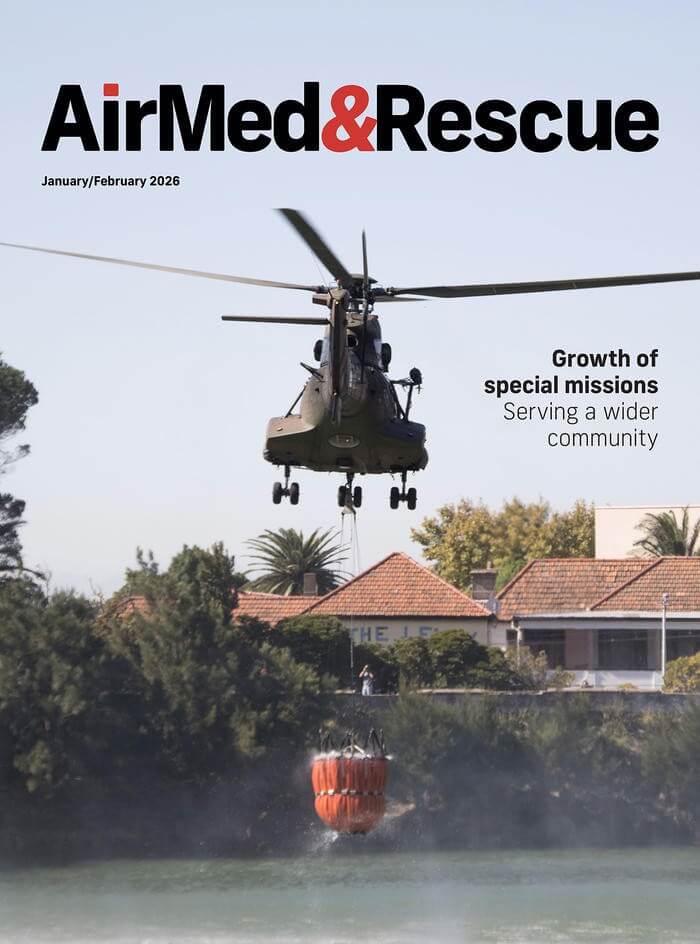
A new year and a new edition, and with it comes articles relating to special missions from all across the globe. We have features that look into the special missions in the Middle East and Africa; the benefits and differences associated with leasing helicopters; and the way that aerial firefighting is conducted at night.
Mandy Langfield
Mandy Langfield is a Director of Palladium Media Partners and former Publishing Director at Voyageur Group. She has written extensively on international travel and health insurance, medical assistance provision, and air medical transportation. She was Editor of AirMed&Rescue from December 2017 until April 2021. Her favourite helicopter is the Chinook, having grown up near an RAF training ground.