
Interview: Essential air support for frontline policing across Scotland

Police Scotland’s Air Support Unit (ASU) operates one helicopter and three drone hubs covering the whole of Scotland. Inspector Stevie Pollock explains in detail to Mandy Langfield how the department operates, and describes a typical day in the life of the Unit
First of all, let’s start with aerial assets – which aircraft does the department operate? And the size of the team – how many members of the ASU are there currently?
Police Scotland operates one helicopter covering all of Scotland. The primary aircraft is an H135 T3 (G-POLS), with a backup H135 T2+ (G-PSHU) which stands in during periods of maintenance. We generally only operate one helicopter at a time; however, we have the ability to deploy both simultaneously to support major operations/events.
The Police Scotland ASU operates a mixed-asset model, with the helicopter based in Glasgow, and three drone hubs located in Edinburgh, Dundee and Glasgow. The drones complement the service we provide with the helicopter, providing localized air support around the country.
The ASU team is comprised of one Inspector, one Sergeant, six Constable air observers and eight non-dedicated air observers who cover for annual leave, training courses etc.
Each drone hub has two constables trained to fly the DJI M30T and DJI Mavic Mini 2 drones, with six non-dedicated drone operators who cover for annual leave etc.
The Police Scotland ASU works in partnership with Babcock; can you explain a bit about how this works in reality? Who supplies which function?
In reality, we are one big team working together to deliver essential air support to frontline policing across Scotland.
Since the establishment of the Air Support Unit in legacy Strathclyde Police in 1992, the police helicopter has always been provided by a civilian contractor. Babcock holds the current contract and provides the aircraft, pilots, engineers, hangar facilities and office accommodation, and takes responsibility for all maintenance, aircraft certification, compliance with the Civil Aviation Authority (CAA), and pilot training.
Police Scotland provide experienced police officers who work as air observers alongside the pilot.
Regardless of an individual’s role within the ASU, whether they work for Police Scotland or Babcock, they are very much part of a unique policing team.

What are the roles of the police officers in the helicopter if they’re not doing any actual flying?
A standard police crew configuration is one pilot (front right seat), one police air observer (front left seat) and one police air observer in the rear (rear right seat). The front observer operates the MX-10 camera and assists the pilot with checklists, whilst the rear observer operates the mission management system, and handles navigation and communications.
In simple terms, the pilot gets us to our task safely, with the observers navigating to the task location, operating the police role equipment as determined by the job, communicating with police officers on the ground, conducting effective searches with the forward-looking infrared (FLIR) camera and obtaining aerial photographs/video. On occasion, we may need to land the aircraft and assist with providing initial first aid to a casualty or even detaining a suspect.
What pieces of equipment are used most often by police officers on board the helicopter?
The Police Scotland helicopter carries a selection of specialist police role equipment to assist us in our role.
The onboard camera is arguably the most valuable piece of equipment. We currently operate the L3Harris WESCAM MX-10. This is a compact dual-sensor camera, with the thermal image capability being the most effective tool in conducting searches for missing people or suspects.
Working alongside the camera is our AIMS mission management system. This integrates our MX-10 by geo-spatially overlaying the video output onto a moving map. It provides augmented reality functionality by overlaying tactical data and street information on the video window and effectively reduces the cognitive burden of the air observer performing the navigator role.
Any imagery from the MX-10 can also be ‘downlinked’ to our control rooms via a series of ground-based receivers. This gives the Area Control Rooms a live feed of the incident from the helicopter, providing enhanced situational awareness for police commanders.
For night operations, we utilize a TrakkaBeam searchlight which we use to illuminate large areas at night, to identify the location of something of interest and to assist during nighttime landings.
We use the searchlight in conjunction with night vision goggles (NVG). All our pilots and observers are trained in night vision imaging systems (NVIS) operations, which are an excellent aid to search but come into their own when used for ad hoc landings at night
We use the searchlight in conjunction with night vision goggles (NVG). All our pilots and observers are trained in night vision imaging systems (NVIS) operations, which are an excellent aid to search but come into their own when used for ad hoc landings at night.
All our police air observers are trained to use the role equipment to its fullest, ensuring the crew has maximum effectiveness on task.
What’s the best route for someone looking to get into airborne police forces?
Within Police Scotland, any officer interested in air support must have completed their two-year probationary period. We don’t currently recruit directly to the ASU for the police observer role, instead recruiting from our pool of non-dedicated observers. These are officers based within other police departments who are trained in the observer role, crewing the helicopter during periods of annual leave etc. When we need to recruit more non-dedicated observers, we advertise within those departments. Successful applicants are then invited for an evaluation week to assess their suitability for training.
What sort of training would a new recruit into the ASU undergo, and for how long, before they are sent up in the helicopter?
Candidates undergo a week-long evaluation where suitability to join the department is assessed against different aspects of the air observer role. Candidates thereafter undertake a four-week course following a national syllabus, which is conducted in-house in conjunction with our aviation service provider. In addition, some specialist training is provided externally, e.g. firefighting and helicopter underwater escape training.
During the four-week course, a candidate will expect to complete 15–20 hours’ flying, culminating in a day and night assessment flight
During the four-week course, a candidate will expect to complete 15–20 hours’ flying, culminating in a day and night assessment flight.
Is the ASU making use of drones in its regular police work? If so, how are they making the force more effective? Do you see the use of drones increasing in the future?
As mentioned earlier, the Police Scotland ASU operates a mixed asset model, with three drone hubs providing localized air support around the country.
Drones are a cleaner, greener and more cost-effective way of providing certain elements of police air support. For example, drones are being used to good effect for planned events and operations to monitor large crowds (football/concerts), for crime scene imagery and reconstruction, and missing person searches.
Our drones have very capable dual-sensor cameras and can securely stream our footage across the 4G network, providing the same situational awareness to Area Control Rooms.
With current technological and regulatory limitations, drones will not replace the police helicopter, but they work well together to provide Police Scotland with a unique and effective air support operating model. Over time, as technology advances, as batteries last longer and as regulation changes, our use of drones will likely evolve.
Coordination of aerial and ground assets is key to seamless partnerships with other organizations like the coast guard and mountain rescue; what forms of communication do you rely on most?
Our helicopter is fitted with both airwave and VHF radios, which allow us to communicate with our colleagues in Police Scotland but also partner agencies such as Coastguard and Mountain Rescue Team (MRT). We are also able to make phone calls from the aircraft, so we are very well connected.
Could you describe a typical ‘day in the life’ of the ASU team?
The morning starts with the pilot briefing, which covers weather, aircraft serviceability, crew currency, air traffic restrictions, emergencies and fitness to fly. Any pre-planned tasking or training is discussed and then the aircraft is prepared for the day’s flying.
The morning starts with the pilot briefing, which covers weather, aircraft serviceability, crew currency, air traffic restrictions, emergencies and fitness to fly. Any pre-planned tasking or training is discussed and then the aircraft is prepared for the day’s flying
The pilot and engineering team conduct morning ground runs and aircraft checks, whilst the police crew check and prepare the police role equipment for the day ahead.
The crew thereafter attend any planned or spontaneous incidents as required throughout Scotland. Tasks can come in a variety of ways. Pre-planned jobs are usually arranged via email or phone call, and the crew monitor a variety of police radios whilst on the ground, self-deploying when they overhear an incident where they might be of assistance. Any police officer can request air support, and, when the call comes, the crew review the task, assess the weather, discuss fuel planning with the duty pilot, and establish operational parameters with the officers requesting our services.
From receiving a call, the crew can be airborne within a couple of minutes
July 2025
Issue
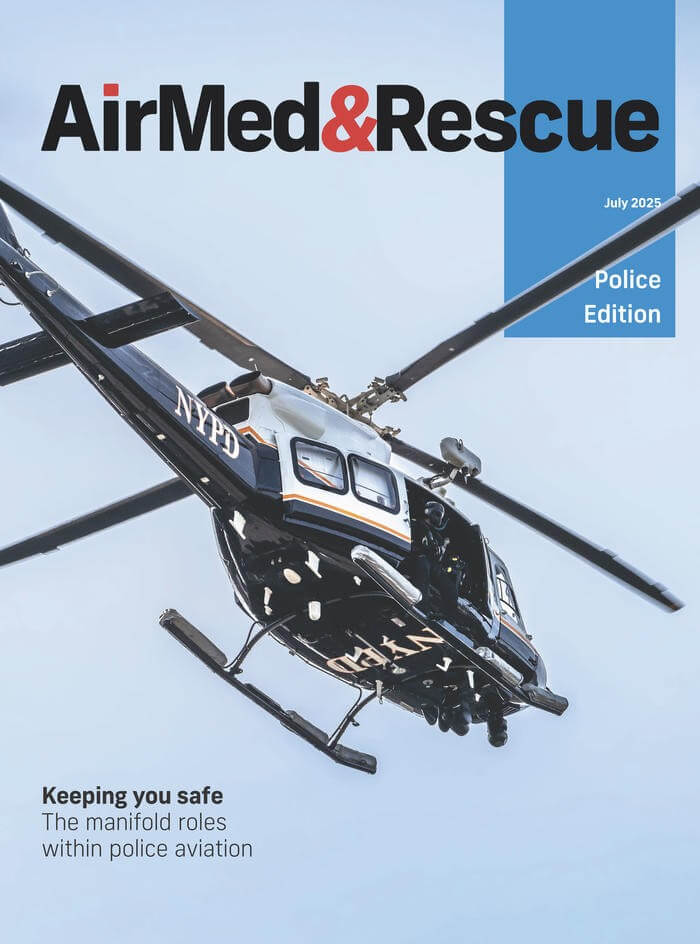
Our July edition highlights police aviation with features on how sensor technology is being used, the other aspects of policing beyond law enforcement, and the challenges of border control. We also have an interview with a police inspector, a gallery from the US Customs and Border Protection, and a provider profile of the US Park Police. Additional features include recruitment and retention, and manikins for special missions and medical training; plus we have more of our regular content.
Mandy Langfield
Mandy Langfield is a Director of Palladium Media Partners and former Publishing Director at Voyageur Group. She has written extensively on international travel and health insurance, medical assistance provision, and air medical transportation. She was Editor of AirMed&Rescue from December 2017 until April 2021. Her favourite helicopter is the Chinook, having grown up near an RAF training ground.