
Interview: James Koens, CEO and owner of Sentinel Aviation

A veteran’s approach: James Koens discusses with Mandy Langfield the rewards of providing a pathway into helicopter rescue and emergency medical services for those with little to no previous experience
Let’s start with your background in the Australian Army; what rank are you, and what roles did you play while you were enrolled?
I joined the Australian Army Reserves whilst completing high school after a desire to want something more. Shortly after completing schooling, I transferred to the full-time Army, becoming an armoured fighting vehicle crewman deploying to Afghanistan at the height of the war in 2010–11.
After returning, I continued to pursue advancement within armoured vehicles and progressed on to becoming a vehicle commander. Later I was posted to the Army Recruit Training Centre, where I spent the following 18 months training Army recruits’ fundamental warfighting skills. This was my first formal instructional experience.
It was during this time I applied for a transfer to Army aviation and was successful in becoming an Aircrewman (Crew Chief) on Black Hawk helicopters based out of Sydney, Australia. After deploying to Vanuatu on a humanitarian aid mission in 2015 post Cyclone Pam, I was selected to join the special operations aviation squadron and specialised in counterterrorism.
I then pursued my next goal of becoming an Aircrew Officer on board an ambulance rescue helicopter based in Sydney. I spent the next eight years working in the helicopter emergency medical services (HEMS) field, progressing on to becoming an instructor training aircrew officers, doctors, paramedics, and eventually developing a specialist rescue swimmer course for special forces soldiers.
During this time, I concurrently completed my fixed- and rotary-wing pilots’ licenses before eventually becoming a full-time AW139 pilot in 2023.
Now, I own an operator, Sentinel Aviation, bringing together all these experiences under the one banner.
What did your time in the military teach you about different training methods?
My time instructing in the military taught me the majority of what I know today. It was a unique environment where I was fortunate to explore almost every teaching avenue possible, from classroom instruction and life skills to days-long simulated battle scenarios and bayonet fighting. It taught me the value of patience and professionalism, to never be quick to judge someone’s abilities, and to never underestimate the importance of quality and thorough instruction. After all, most of these recruits would go on to also deploy to Afghanistan.
How important is the veteran community when it comes to working in the aviation industry in Australia?
The veteran community for some time has been a mainstay in the Australian aviation landscape (if not globally). Military aviation often provides a highly trained and skilled recruitment pipeline into the civilian aviation industry. If nothing else, the military has provided ‘off the shelf’ crew with the qualifications and experience required to meet some of the more complex flying roles. At Sentinel Aviation we are looking to provide greater opportunities for the industry to recruit from a wider pool of applicants by providing those not with a military background the minimum training and qualifications required, specifically in the rescue helicopter rear crew environment.
You started Sentinel Aviation in 2014; what made you want to start your own business with a focus on training?
Initially I started teaching first aid. I was still in the Army and noticed my colleagues that were leaving the Army for civilian HEMS jobs were having to attain their first aid qualifications as it was a prerequisite for most of these jobs. I knew it was something I could deliver and at a fraction of the cost. I wanted to make their transition from military to civilian life just that little bit easier. So, the business was born.
I enjoy teaching and imparting knowledge on to the next generation of aircrew
I enjoy teaching and imparting knowledge on to the next generation of aircrew. Through consultation with industry managers and recruiters we recognized that there was a lack of quality training courses for those with little to no experience trying to get into the industry, so we developed and now provide nationally certified training for those wishing to become rescue crew officers (RCOs) and rescue swimmers in the helicopter rescue and HEMS sectors.

How long did it take you to get from the initial idea to having your first course participants?
From the first phone call I made with a few industry managers faced with this dilemma to day one of our first course was three months. In this time, I also deployed to Canada for five weeks after a request from government during their catastrophic wildfire season. I had an amazing team back home working to build the lesson content and ensure compliance with the national standards. We established strong bonds with helicopter providers and educational institutes to ensure the course was industry leading and relevant. What makes it all worth it is that within a month after completing their training, two of our students received job offers, and a third is currently undergoing recruitment, having recently completed her fitness test!
What makes it all worth it is that within a month after completing their training, two of our students received job offers, and a third is currently undergoing recruitment, having recently completed her fitness test
You say the courses are nationally accredited – what does external validation of your courses mean for those taking the courses, and for potential employers seeking new recruits?
It is simply imperative; one does not go without the other. In a small industry with little turnover, if you don’t have the validation of external agencies or the industry, it will not work. We aim to do two things which are mutually exclusive and just as important as the other: we select, train, and certify RCOs to meet national certification standards; secondly, we ensure they are industry ready and employable. If we don’t provide the industry what they’re missing, then our course and our students aren’t validated. As much as we want to see people achieve their dream, we must ensure we support the industry by meeting their needs.
We talk about the benefits of simulation training a lot in AirMed&Rescue. What balance do you put on simulation versus real-life training with a helicopter in flight?
The keyword is ‘balance’. Having worked in organizations that have exceptional simulation devices, and in others that do not, it is difficult to have one approach. Rear-crew training is still somewhat of a neglected ‘trade’: unlike pilot training, where millions of dollars are invested in full-flight simulators, rear crew don’t always have these luxuries. However, if nothing else, you can’t beat repetition. Much like aerobatic pilots do, our students will ‘chair fly’ to rehearse their procedures using the helicopter whilst it’s on the ground. Maybe someday Sentinel Aviation will be able to invest in exceptional simulation devices too!
We have a close relationship with many chief aircrew officers and recruiters around the country; it is through these relationships we constantly keep our ‘finger on the pulse’ to ensure what we are training and the regulatory controls we adhere to are current and relevant
How are you ensuring that your courses always offer the latest training techniques and regulatory controls to maintain currency for the course attendees?
I refer to my comments on being industry relevant. We have a close relationship with many chief aircrew officers and recruiters around the country; it is through these relationships we constantly keep our ‘finger on the pulse’ to ensure what we are training and the regulatory controls we adhere to are current and relevant. Our instructors are part-time, allowing them to fly operationally to stay current.

There’s little doubt that search and rescue (SAR) remains a male-dominated issue. How do you think more women can be encouraged into the SAR community? What’s your experience of training men and women in terms of numbers?
There is no doubt at all, if piloting in general is male-dominated then the rescue crew sector is exponentially more male-dominated. Whilst we have had females on our courses we continue to raise awareness of this sector. We have recently partnered with Women in Aviation International (WAI) to develop a scholarship that would see the cost of training significantly reduced, assistance with career coaching and mentoring, and the awareness of this sector increased for woman seeking to pursue a career in helicopter rescue. We ensure gender is never a determining factor in our selection and training, and always seek to encourage more diversity in all industries.
We have recently partnered with Women in Aviation International (WAI) to develop a scholarship that would see the cost of training significantly reduced, assistance with career coaching and mentoring, and the awareness of this sector increased for woman seeking to pursue a career in helicopter rescue
What are your hopes for the future of training for rear air crew? Do you think that more training opportunities are still needed?
Yes, more training is still required. We are still in the phase of demonstrating to industry that this is an approach that should be supported. More and more each day we are getting great interest from industry. Our students are our biggest advocates – getting out there and demonstrating that someone with no experience can be trained and certified to an industry-ready standard in an efficient amount of time is possible, and it should be considered a prerequisite. My hope is that more standardization and quality training is introduced into the industry, and no longer is the national certification a ‘nice to have’ during the recruitment phase, but a mandatory requirement.
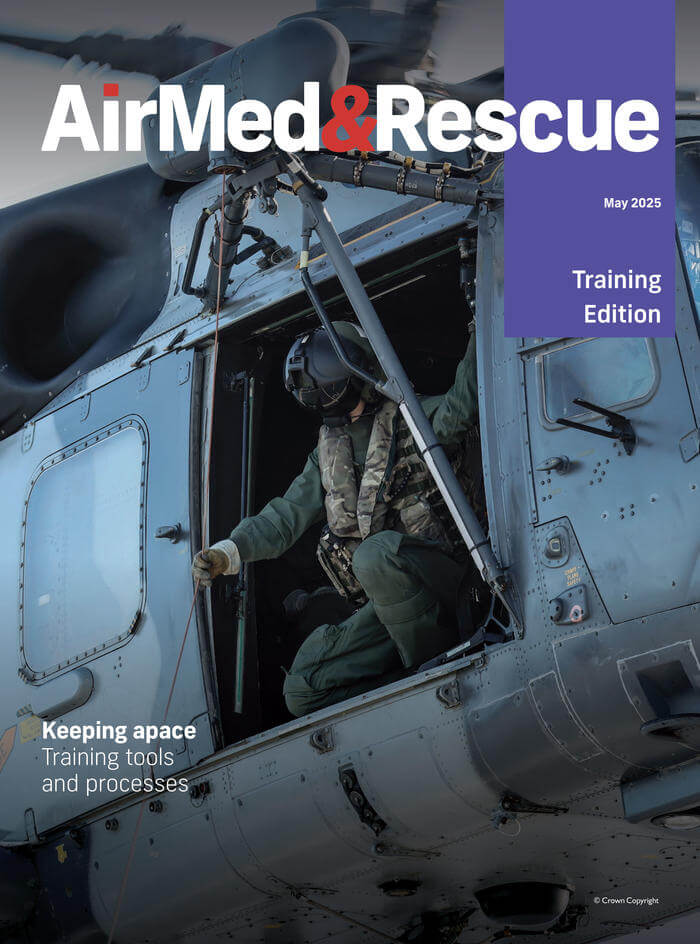
May 2025
Issue
Our May edition is full of articles centered around training, with features covering pilot training, winch and rear-crew training, and air medical training; as well as a feature in the trend towards longer-range air ambulance transfers; plus we have more of our regular content, with lots of articles highlighting different aspects of training, from startle and surprise management to simulation centers and everything in between.
Mandy Langfield
Mandy Langfield is a Director of Palladium Media Partners and former Publishing Director at Voyageur Group. She has written extensively on international travel and health insurance, medical assistance provision, and air medical transportation. She was Editor of AirMed&Rescue from December 2017 until April 2021. Her favourite helicopter is the Chinook, having grown up near an RAF training ground.