
Interview: Fighting fires faster and more accurately

Todd O’Hara, Chief Product and Sales Officer at TracPlus, explains how aerial firefighting agencies are using software to optimize their resources, and why data can be not just useful, but lifesaving
First of all, can you share some of your professional career history to give a bit of context?
To give you a bit of background, I’m currently the Chief Product and Sales Officer at TracPlus. I’ve spent the past 15-plus years working across the military, aviation, and startup sectors, with a focus on emerging tech and biomaterials.
Before joining TracPlus in 2020, I held several roles that helped shape my perspective on product and growth strategy, including serving as Chief Marketing Officer and earlier as Sales and Marketing Manager at Spidertracks, a company recognized for its trusted aircraft tracking and fleet management solutions.
And now about TracPlus – what are the company’s core offerings, and what is your role in the company?
TracPlus is the leading provider of mission-critical intelligence for aerial firefighting operations. The company serves the leading aerial firefighting agencies and operators, including Australia’s National Aerial Firefighting Centre (NAFC), Fire and Emergency New Zealand (FENZ), and Europe’s Avincis, providing them with unmatched operational insight that drives better mission outcomes when lives and property are at stake. Our key offerings include real-time tracking, operational insights, and advanced analytics, all integrated into one platform to help agencies and operators deploy resources more efficiently, enhance safety, and achieve better outcomes.
At TracPlus, I lead the sales and product development of critical safety solutions that safeguard people and communities in over 140 countries, crafting accessible and practical solutions to complex problems.
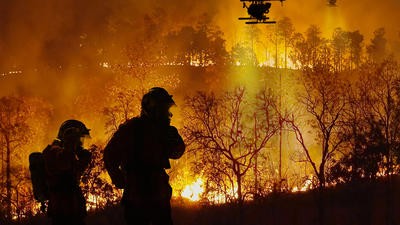
Can you share some details with us about the California Department of Forestry and Fire Protection’s Aviation Tracking and Information System (CATIS)? What does it do, who is it designed for, what was the development process?
CAL FIRE recently partnered with TracPlus to launch CATIS (CAL FIRE Aviation Tracking and Information System), powered by our newly released FireFlyte platform. This cloud-based enterprise software was developed to replace the agency’s aging internal legacy system. With CATIS, CAL FIRE can now access critical information faster, deploy aircraft more efficiently, and generate mission insights and analytics with greater speed and accuracy.
What difference will CATIS make to the safety and efficiency of aerial firefighting operations?
CATIS replaces CAL FIRE’s legacy Aviation Information Management System with a more flexible and scalable platform that streamlines data entry, enhances situational awareness, and supports smarter resource deployment. It provides a more comprehensive and real-time operational picture of firefighting efforts. The ultimate goal is to create better outcomes for communities and people on the ground by making firefighting operations more efficient and effective.
The ultimate goal is to create better outcomes for communities and people on the ground by making firefighting operations more efficient and effective
What else is TracPlus working on at the moment?
TracPlus is in a real growth phase. One of the biggest milestones has been the launch of FireFlyte, our new enterprise software platform designed specifically for aerial firefighting agencies and operators. It helps teams make smarter decisions by transforming raw operational data into actionable insights across four key areas: aerial firefighting, safety and risk management, operations, and finance.
This launch was a significant milestone for us. We evolved from our roots as a hardware tracking provider to a software-as-a-service (SaaS) first company focused on delivering operational intelligence at scale.
We’re also expanding our global footprint. We’ve just opened a new office in London to deepen our reach across Europe, the Middle East and Africa (EMEA) and better support our growing customer base in the region. As part of that, we’ve brought on two new team members, Atlanta Taylor and Harry Bickerton, who are leading our efforts on the ground in the UK and Europe.
It’s all part of a broader strategy to scale up and support more mission-critical operations worldwide.
What do you think the biggest challenges are for the aviation industry at the moment, both locally for you and internationally?
One of the biggest challenges facing the aviation industry, both locally and internationally, is the reliance on outdated systems and manual processes. This is especially true in aerial firefighting. Many of the legacy systems in use today were developed decades ago by individuals who are no longer part of the teams who made it, and the knowledge behind their design has been lost over time. That leads to serious inefficiencies, data gaps, and, ultimately, less effective mission outcomes.
One of the biggest challenges facing the aviation industry, both locally and internationally, is the reliance on outdated systems and manual processes
We’ve seen a significant opportunity to change that through automation and real-time operational intelligence. When agencies have access to cleaner, more actionable data, they can enhance coordination, reduce waste, and respond more effectively in high-stakes environments.
Another critical issue is safety, including response protocols and accident prevention. Accidents rarely occur out of the blue; there’s almost always a pattern or chain of events leading up to them. With the right tools, you can surface non-compliant behavior before something goes wrong. That’s where data becomes not just useful, but lifesaving.

How is new data technology changing the way that operators can optimize their efficiency currently?
New data technologies are completely reshaping how operators think about efficiency, and TracPlus is right at the center of that shift.
We have one of the most comprehensive commercial data sets on aerial firefighting in the world – likely more than any non-governmental entity. That depth of historical and real-time data is a powerful asset, not just for understanding what’s happening now, but for forecasting what’s likely to happen next.
One of the key questions we often revisit is: How can we utilize the past to predict the future better? That’s where machine learning and artificial intelligence (AI) come into play. With the right tools, you can start to anticipate resource needs and optimize deployments based on the specific conditions of a mission as it evolves.
With the scale and depth of data we have, TracPlus is in a unique position to help the industry move from reactive to proactive.
What does the future hold in terms of what’s next on the horizon for software development that is going to affect how aviators and organizations within the aerial firefighting industry can maximize their operational effectiveness and their safety?
Looking ahead, the future of software development in aerial firefighting is fundamentally about transforming operational data into strategic advantage. At TracPlus, we’re building toward that future with platforms like FireFlyte by focusing on three critical areas that directly impact mission success:
Enhanced operational intelligence The evolution from basic tracking to comprehensive operational insights enables agencies to understand their true operational effectiveness. This means moving beyond simple location data to gaining visibility into mission outcomes, resource utilization, and operational patterns that drive better decision-making at every level
Proactive mission planning The next generation of firefighting software shifts teams from reactive to proactive operations. By leveraging historical data and real-time conditions, agencies can anticipate resource requirements, optimize deployment strategies, and identify potential operational challenges before they impact mission success
Integrated safety and compliance management Modern aerial firefighting demands sophisticated safety monitoring and streamlined compliance processes. Advanced software platforms now provide real-time safety oversight, automated compliance reporting, and comprehensive documentation that supports both operational accountability and regulatory requirements.
Modern aerial firefighting demands sophisticated safety monitoring and streamlined compliance processes
What we’re seeing is that successful firefighting agencies are no longer treating technology as a supporting tool – it’s the foundation for operational excellence. The organizations that will lead the industry are those that can harness data to maximize safety, efficiency, and mission effectiveness whilst maintaining the agility to respond to increasingly complex firefighting scenarios.
October 2025
Issue
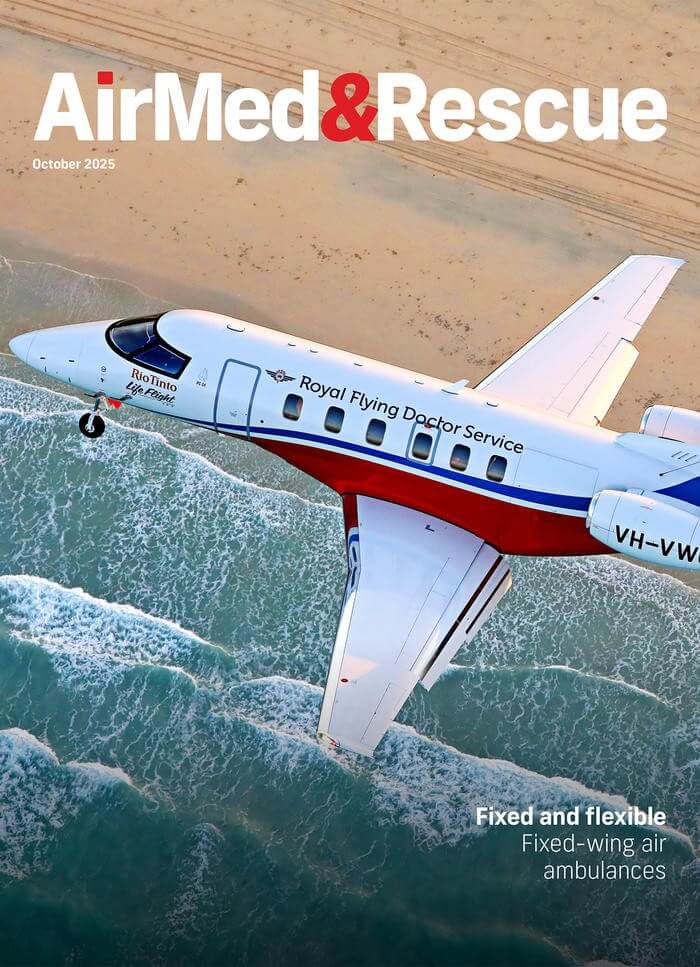
In our October edition, we bring you news, features and more showcasing special missions from around the world. We have features that focus on the fixed-wing air ambulance platforms that are enhancing air medical operations; the care and considerations when transporting children with infectious diseases at risk of deterioration; the law enforcement agencies that use aircraft to find and track persons of interest; and the challenges of treating patients with hyper- and hypothermia.
Mandy Langfield
Mandy Langfield is a Director of Palladium Media Partners and former Publishing Director at Voyageur Group. She has written extensively on international travel and health insurance, medical assistance provision, and air medical transportation. She was Editor of AirMed&Rescue from December 2017 until April 2021. Her favourite helicopter is the Chinook, having grown up near an RAF training ground.