
Interview: Leading from the front

Captain Jordan Garner from AirMed International spoke to Mandy Langfield about her passion for aviation, and what she loves about working in the air medical industry
What’s your background in aviation, and how did you come to work in the air medical transfer world?
I found aviation in college. I wasn’t happy with my initial field of study and stumbled upon ‘flight education’ when registering for classes. I’d always had an interest in airplanes and decided to at least try out the ground school. I caught the bug and switched to Auburn University’s flight program the next semester. During college, I worked at the local airport and after graduation, I continued working with airports at the Alabama Department of Transportation as a general aviation airport safety inspector, and program and grant manager, and I flew a Beechcraft Baron E55. I stepped into the corporate aviation world in 2020, flying Learjet LR45 and LR75 aircraft for a great 135-operator based in the Midwest USA. It was a crazy time to begin my flying career, but they kept me flying throughout the pandemic years and I gained valuable flying and industry experience.
However, something was missing. I’ve always wanted to make a difference in my career. A former Chief Flying Instructor of mine, he works at AirMed International (AMI), knew of my goals and encouraged me to apply for an open First Officer position at the company. It’s been incredible to combine that goal and aviation! I’ve been flying with AMI since 2022 and upgraded to Captain in July 2024.

What’s different about air medical flights than other areas of the aviation sector you’ve worked in? What makes it special/unique?
I think the most obvious difference is the clientele – our patients. We fly non-emergent patients worldwide and take them home and/or to higher medical care. AMI’s Hawker fleet has a unique mission. First, we transport worldwide. Secondly, we’re capable of flying cases that require specialty equipment like a balloon pump or extracorporeal membrane oxygenation (ECMO) machine, or some cases require a certain cabin pressure.
I think what sets medevacs and air ambulance flights apart is the teamwork needed to make these trips happen. It’s not unusual for some of our international trips to be 50-plus hours of flight time, require multiple flight crews, and for the medical crews to have patient contact time of 30-plus hours. Pilots, medical crews, aircraft, and medical equipment are all being pushed to the max, and lots of communication, coordination, and trust has to be present for these trips to be safe, efficient, and successful. Each part of our team, from the medical crews and pilots on the trip to the dispatchers and clinical coordinators, has to work together.
When it comes to training, how much do you do in a sim versus in the air? Is it ever a challenge to get your hours in?
We do most of the aircraft training in simulations to meet the FAA training requirements for 135 operators. Initial type training and recurrent checks are all done at approved training centers. We complete company initial, company recurrent, and international operations training with company instructors and on the line. We fly these Hawkers worldwide, and our training must reflect those missions to ensure safety and compliance.
I spent my first year here as a First Officer, flying many trips between Honolulu and Guam
It isn’t difficult to maintain any type of currency. Most Hawker pilots at AMI average between 450–600 hours a year at all times of the day and in all types of weather! I spent my first year here as a First Officer, flying many trips between Honolulu and Guam with fuel stops in the Marshall Islands. That’s quite a bit of time in a Hawker! Trips to Europe aren’t normally as long, but the international and oceanic operation experiences for both oceans are invaluable.
This is the Women in Aviation edition of AirMed&Rescue, so let’s talk about your route into aviation as a woman – how did you find it entering what some might still think of as a man’s world? Did you encounter any negative experiences or attitudes?
My route to aviation is a classic story: my World War II veteran grandfather’s aviation journey sparked an interest in aviation. Having been raised and deeply influenced by strong women in my family, I never really thought twice about pursuing a career in a male-dominated industry. While my journey as a woman in aviation has not been void of challenges, I’ve been fortunate to work with incredible individuals who have provided me support throughout my career. Of these men and women, some have become valued mentors – professionally and personally. They’re a fantastic team and resource for professionally navigating adversity.
AirMed International has many women working in the cockpit and on the medical crews as well – indeed, you and a colleague were the first two women to co-pilot the Hawker jet on a mission recently! The company certainly seems to be getting behind more women in the air medical transfer sector. Would you agree?
AirMed International hires the best and most qualified candidates for the job and it's great to see so many skilled and well-trained women aviators entering a challenging yet rewarding field. This job, the missions we fly, aren’t always easy, typical ‘cookie-cutter’ type flights. I’ve flown missions to South Africa, United Arab Emirates, Cambodia, New Zealand, Mexico, and Norway. A lot can change quickly on a mission where safe and precise decision-making must be done quickly. A person’s training, integrity, and teamwork are most important to a mission.
What do you want to see in terms of what the aviation industry at large still needs to change to attract more women into becoming flight crew?
Visibility is the greatest way to attract skilled aviators to the industry. Many companies are already doing that! It’s not a ‘quick fix’ nor should it be when the goal is to attract and retain well-trained professionals. There are also many barriers to entry in aviation. Organizations like Women in Aviation International, the 99s, and other nonprofits promote women in aviation and STEM [science, technology, engineering, and mathematics] fields, and they are working hard to show the future generations there are numerous ways to get into aviation. They do so by providing scholarships, mentorships, and networking.
Visibility is the greatest way to attract skilled aviators to the industry
There’s a misconception that to be in aviation you must be a pilot and that’s simply not true. The aviation industry offers ample opportunities. As for AMI’s operations, pilots and medical crews are the face of the company to our patients, but it takes literal teams of people to make it happen. Our C-suite teams, dispatchers, and maintenance are important parts of our industry that make my job possible. Outside of the company, lots of teams are needed to maintain safe airports and line operations. Are you great at finance and accounting? Great! There’s a spot for you in aviation. Do you like restoring cars? Fantastic. Let’s talk about what you could do in aviation. Do you have a talent for planning? Please, let’s talk about the difference you can make. Flying is absolutely amazing, but there are so many other ways to be a part of aviation and the air medical sector.
What are your hopes for your future in aviation?
I’ve achieved an incredible goal at AirMed and am planning and re-evaluating what the future might hold. One immediate goal, to fly larger aircraft, will be happening as soon as AMI transitions the Hawker 800 fleet to Challenger 605s. This change is exciting on so many levels, and I’m looking forward to what’s ahead! I have two master’s degrees that I’d love to put to use as my career progresses, and I’m planning and waiting for opportunities should they arise.
August 2025
Issue
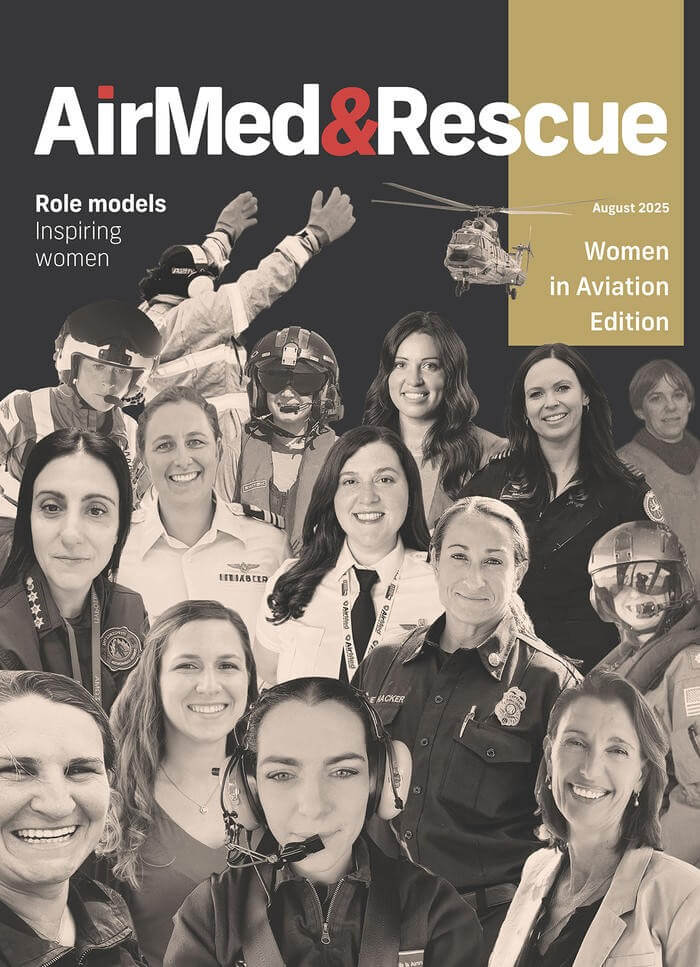
Our August magazine is the inaugural women in aviation edition, highlighting and showcasing female voices from the airborne special missions sector. We have features on blood products used in emergency medical services, challenging hoist rescues, pregnancy while flying, and portable water sources for firefighting. We also have interviews, a gallery, an industry voice, a news analysis piece, and a provider profile, as well as a review of the Paris Air Show.
Mandy Langfield
Mandy Langfield is a Director of Palladium Media Partners and former Publishing Director at Voyageur Group. She has written extensively on international travel and health insurance, medical assistance provision, and air medical transportation. She was Editor of AirMed&Rescue from December 2017 until April 2021. Her favourite helicopter is the Chinook, having grown up near an RAF training ground.