
Interview: Safety culture and operational excellence

Steve McLeod, Training and Check Pilot with the Royal Flying Doctor Service (Western Operations), tells Mandy Langfield how he keeps training standards current and robust through a continual improvement cycle and a strong safety culture
You have over 35 years in aviation, from the Royal Australian Air Force to the Western Australia Police, culminating in your role as Training and Check Pilot for the Royal Flying Doctor Service. Could you walk us through the major milestones of your career – key aircraft types, significant missions, and the transition into the RFDS training role?
Over the past 35 years, I’ve had the privilege of flying in diverse operational environments, from military to law enforcement, and now in aeromedical services. My aviation journey began with the Royal Australian Air Force, followed by 19 years with the Western Australia Police Air Wing, where I flew missions in both the Pilatus PC-12 and the Cessna Caravan. I was closely involved in the Caravan’s entry-into-service project, which was a significant milestone in fleet capability.
During my time with the Police Air Wing, I participated in a wide range of high-profile missions. These included aerial support during the Queen’s visit to Perth in 2011 for the Commonwealth Heads of Government Meeting, interstate extraditions of high-profile criminals such as Brenden Abbott (the ‘Postcard Bandit’), as well as fire mapping during bushfire seasons, and multi-agency counterterrorism exercises.
Transitioning to the Royal Flying Doctor Service felt like a natural evolution. The flying training skill set transferred well, but the scope expanded significantly. I am now involved in the ongoing flight proficiency of approximately 60 pilots, the integration of a fixed-base flight training device, and support the fleet upgrade to the Pilatus PC-12/47G PRO.
This role constantly reinforces two key lessons: to be comfortable with being uncomfortable and own your mistakes, otherwise your mistakes own you.
In your check pilot capacity you oversee training and standards for RFDS operations. How do you define the essential competencies (technical, decision-making, human factors) for air medical crews, and how does that differ from standard charter or cargo flight operations?
Aeromedical flying demands a unique and highly specialized blend of skills that go well beyond standard aviation competencies. Technically, pilots must be deeply proficient in aircraft systems, multi-tasking and performance management, often operating into remote environments where infrastructure and facilities are minimal or non-existent. We operate as a crew in a 24/7/365 operational space, often in marginal weather and occasionally into improvised landing zones, requiring exceptional airmanship and sound threat and error management techniques.
Decision-making in aeromedical operations is markedly more dynamic and time-sensitive than in charter, cargo, or even many commercial passenger flights. Pilots must constantly weigh multiple, often competing, factors: the urgency of the patient’s condition, the safety of the crew and aircraft, rapidly changing weather conditions, and the suitability of landing sites, all while under significant time pressure. There is rarely a clear-cut answer, and decisions must be made quickly, with incomplete information, and often in coordination with medical professionals who may have different operational priorities.
Decision-making in aeromedical operations is markedly more dynamic and time-sensitive than in charter, cargo, or even many commercial passenger flights
Human factors are central to mission success. Effective communication and teamwork between pilots, medical transport specialists, our operations team, and ground personnel are critical, especially when lives are on the line. Pilots must manage fatigue, stress, and workload levels while maintaining high levels of situational awareness and cognitive flexibility. The emotional weight of transporting critically ill or injured patients, sometimes including children, adds another layer of psychological complexity.
Compared to standard operations, the stakes in aeromedical flying are significantly higher. The margin for error is smaller, and the need for seamless coordination, mutual trust, and shared situational awareness is far greater. It’s a domain where technical skill, emotional resilience, and human connection intersect, and where every decision can have life-altering consequences.
Safety culture is vital in air medical/rescue contexts, where missions can be high-stress, remote and/or time-critical. What specific safety regimes or processes have you implemented or refined that you believe make the biggest difference in preventing incidents?
A key safety initiative I’ve refined is the integration of scenario-based training that emphasizes human factors – particularly communication, fatigue management, and situational awareness. By simulating high-stress, time-critical missions, we help crews develop decision-making skills under pressure. This proactive approach, combined with regular crew resource management (CRM) refreshers and fatigue monitoring, has significantly reduced incident risk and strengthened our safety culture.
Many accidents in aviation stem from the ‘non-technical’ side (e.g. communication breakdown, fatigue, complacency). How do you incorporate human factors and scenario-based training into your programs, and how do you assess their effectiveness in your organization?
We incorporate human factors and scenario-based training by simulating high-pressure missions that emphasize communication, fatigue management, and situational awareness. Effectiveness is assessed through regular CRM refreshers, feedback loops, and monitoring performance trends across real-world operations.
We incorporate human factors and scenario-based training by simulating high-pressure missions that emphasize communication, fatigue management, and situational awareness
From your perspective, what are the key training gaps or weaknesses you observe in newer entrants to air rescue/medevac operations? And what advice would you give to operators aiming to raise their training standards to best practice?
New trainees often show gaps in decision-making under pressure and in understanding the human factors critical to aeromedical operations. My advice to operators is to prioritize scenario-based training that mirrors real-world challenges, and to foster a strong safety culture through continuous feedback and CRM development.
With advances in technology (e.g. enhanced avionics, telemetry, remote-location mission planning) and evolving regulatory frameworks, how do you ensure that your training standards and check-pilot programs stay current and robust for future challenges?
We keep our training and check-pilot programs current by continuously integrating new technologies like a fixed-based flight training device, and refining procedures in a continual improvement cycle through empirical into scenario-based training. We also align our standards with evolving regulations through regular reviews and collaboration with industry bodies to ensure relevance and robustness.
Can you share a story (while respecting operational confidentiality) where the training you implemented or oversaw directly influenced a successful rescue mission – ideally one illustrating the blend of preparation, training, and real-world decision-making?
While I can’t pinpoint one event, like many of your readers who are in the aeromedical profession would attest to, simple taskings can quickly escalate.
One mission that stands out was a standard retrieval that was a relatively simple mission to attend, retrieve, and reposition a patient to our home base. Upon arrival at the remote scene, the patient’s condition deteriorated, resulting in the medical crew having to stabilize the patient before moving.
This delay required a re-examination of the destination and en route weather, as the original timings had us avoiding a cold front approaching the home base.
Coordination between myself and the medical crew was paramount, as we all had competing priorities that needed to be synchronized for a successful outcome.
The medical crew and I applied CRM principles and decision-making skills under pressure, just as practiced during simulation.
Our ability to adapt quickly and communicate effectively under time pressure ensured the now-stabilized patient was successfully retrieved.
We train for the worst outcome and hope for the best
This example is not uncommon in our industry, which is why we train for the worst outcome and hope for the best.
This case reinforced the value of realistic training in preparing teams for complex, time-critical operations.
Looking ahead, what is your vision for the future of air medical rescue training and operational safety, both within RFDS and more broadly across the industry? What changes, innovations, or cultural shifts do you think are most important over the next five to 10 years?
Looking ahead, I see air medical rescue training evolving through greater use of immersive scenario-based learning, integration of emerging technologies like telemetry and advanced avionics, and a stronger emphasis on human factors. Culturally, fostering adaptability and continuous learning will be key to maintaining safety and operational excellence across the industry.
January 2026
Issue
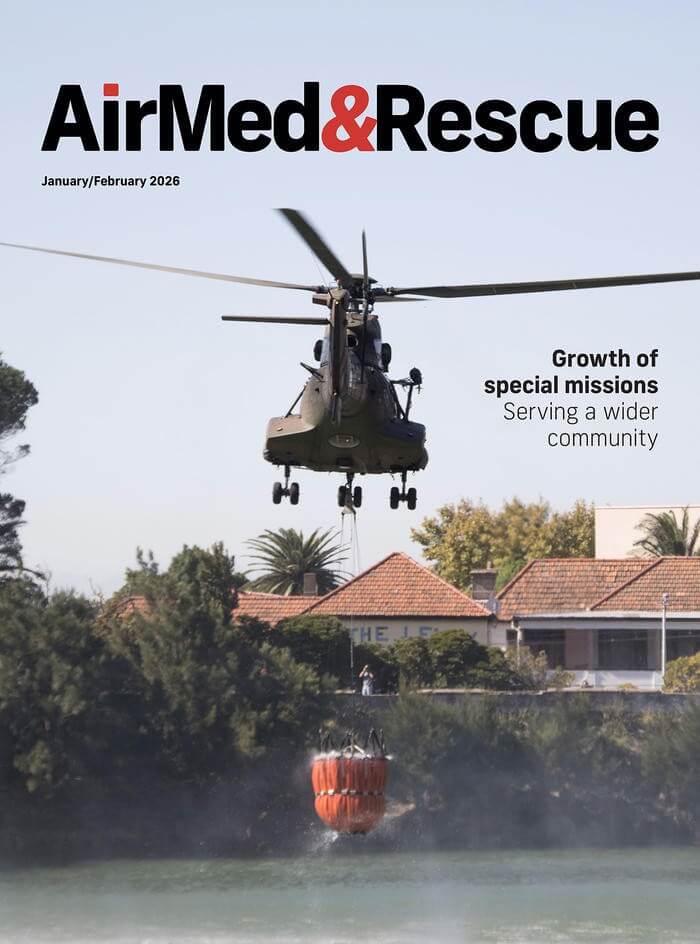
A new year and a new edition, and with it comes articles relating to special missions from all across the globe. We have features that look into the special missions in the Middle East and Africa; the benefits and differences associated with leasing helicopters; and the way that aerial firefighting is conducted at night.
Mandy Langfield
Mandy Langfield is a Director of Palladium Media Partners and former Publishing Director at Voyageur Group. She has written extensively on international travel and health insurance, medical assistance provision, and air medical transportation. She was Editor of AirMed&Rescue from December 2017 until April 2021. Her favourite helicopter is the Chinook, having grown up near an RAF training ground.