
Keep calm and carry them to safety

Robin Gauldie investigates the demands on the tools and equipment that military SAR and medevac teams use for carrying injured and ill patients to the security of a waiting aircraft
Around the world, air force, coast guard, naval and military crews carry out airborne medevac and casevac (casualty evacuation) operations in challenging conditions – sometimes in combat zones on deployments that their governments are reluctant to discuss in detail; more often to aid other emergency responders and civilians caught in events such as wildfires, earthquakes or floods, or from vessels at sea.
Depending on their geographical area of responsibility, they must contend with environmental extremes that are tough on personnel and equipment.
Some of the equipment they use has been around for decades, like the tried-and-tested Stokes litter, developed by US Navy Surgeon General Charles Francis Stokes and still, with some modifications, a vital tool for military and civilian search and rescue (SAR) operators worldwide more than a century after it was introduced.
With medevac units in all 50 US states and two overseas territories, the US National Guard has high-altitude, flood, and storm response units across the country.
“Our primary rescue helicopters in our domestic medevac and SAR programs is the UH-60 Black Hawk. We also have the UH-72 Lakota, which is the military variant of the EC145 outfitted with a BF Goodrich hoist,” said Master Sergeant Joseph Stringer, air medical evacuation Standardization Liaison Officer with the National Guard Bureau, based in Arlington, Virginia.
“Over the past year we’ve seen dozens of evacuations in subarctic Alaska, dozens in Colorado’s Rocky Mountains, several hundred rescued after Hurricane Helene battered North Carolina, dozens in Kentucky after storms that led to massive flooding, several high-altitude mountain rescues in the northeast regions, and even one evacuation in the Arizona deserts, due to flash flooding. Colorado Army National Guard’s hoist rescue program recently completed a hoist rescue of two injured hikers at over 14,000ft altitude,” he said.
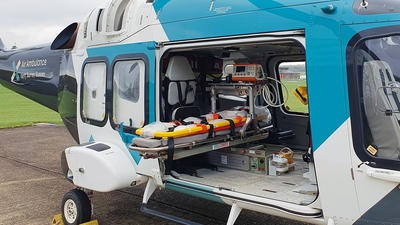
“While, traditionally, we have made use of the standard Stokes litter basket, Skedco litters, or 420 rescue hoist seat, we’ve been working on employing more cutting-edge equipment, such as the Air Rescue Systems Air Rescue Vest (ARV), and the StableFlight bag from Cascade Rescue Company,” MSgt Stringer said.
“Weather and terrain are key factors in consideration of hoist operations for our units. While we don’t often have to confront saltwater operations (those tend to be handled by the US Coast Guard), we do have to identify power limitations due to high-altitude and high-heat conditions in many areas.
“Equipment type plays an important role in executing successful SAR missions, but more important than the equipment are the techniques utilized. We’ve recently begun an investment in more advanced hoisting techniques that take advantage of parasitic drag on the load at the end of the cable. This lowers the power demands on our aircraft engines and allows a more predictable movement of the hoist hook when delivering into confined areas. With the more modern equipment we’re implementing, these techniques give a streamline effect to flyaway extraction, lowering the turbulence for the rescuer and patient,” MSgt Stringer concluded.
Complex logistics in Canada
For America's northern neighbor, a vast and diverse geography presents medevac and SAR teams with logistical hurdles, making timely responses to remote or hard-to-access areas complex, said Alex Tétreault, Senior Communications Adviser at the Canadian Armed Forces (CAF). Extreme weather conditions, including Arctic cold, mountainous terrain, and turbulent seas, further complicate operations and increase risk, he pointed out. The CAF shares responsibility for SAR operations with the Canadian Coast Guard (CCG), with the CAF tasked with aeronautical SAR while the Coast Guard is responsible for maritime SAR services.
The CH-149 Cormorant and CH-146 Griffon helicopters that make up Canada’s primary SAR rotorcraft fleet offer the ability for precision response with hoist capabilities to recover people from very remote situations, Tétreault said.
“SAR aviation is undergoing significant evolution, driven by advancements in technology and the introduction of modernized platforms,” he noted. “The upgraded CH-149 Cormorant are set to enhance the capabilities of SAR crews. These platforms are designed to improve operational effectiveness, allowing for better support in diverse and challenging environments.
“Cost, size, effectiveness, ease of use, and maintenance requirements are all factors in tool selection,” he added.
The CCG is responsible for the provision of the maritime component of the federal SAR system and strategically positions SAR vessels nationwide, but not all its vessels and bases are equipped with helicopters, pointed out spokesperson Craig Macartney.
“While some CCG vessels and bases are equipped with Bell 412, or Bell 412 and Bell 429 airframes, primarily for ice reconnaissance and aids to navigation, these aircraft are not equipped with hoists and are not required to carry trained rescue specialists on board during flight. Nonetheless, these helicopters can support search operations or assist in patient extraction when landing in proximity to an incident allows responders to embark the patient for transport,” Macartney said.
The CCG mandates that all its rescue specialists have unrestricted access to a plastic backboard; a short immobilization device, such as the Kendrick extrication device (KED); a floating basket stretcher; and the appropriate peripheral equipment, such as straps and cervical collars, he added.
“For the extrication of patients in the maritime environment, a variety of immobilization and extrication equipment may be used, depending on the particulars of the incident,” Macartney said.
For spinal immobilization, a backboard such as the Laerdal BaXstrap may be employed to restrict spinal movement while the patient can be loaded on board a vessel and delivered to a higher level of medical care. If a patient is in a restrictive area, such as at the helm of a small vessel, a specialized KED or Kemp Metal Scoop Stretcher may be employed to package the individual.
“In the event of a helicopter patient transfer with the Royal Canadian Air Force, the aircrew will be equipped with the appropriate equipment to affect the transfer,” Macartney added.
The CCG does not mandate specific models of extrication and spinal immobilization equipment to be used by its crews, he said, instead allowing ships and bases working in vastly different environments – from the Arctic Circle to the Pacific and Atlantic coasts of Canada – considerable latitude in choosing the kit that works best for them.
“We provide specifications and parameters that various equipment must meet to be suitable for our operations,” Macartney said. “This enables flexibility for specific vessels and SAR stations to procure equipment that is optimized for their unique area of responsibility and the challenges they may face. For instance, crews on our coast may opt to purchase a scoop stretcher made of polymer as opposed to metal, to provide better corrosion resistance.”
That said, he pointed out, “our equipment must be made to handle adverse environmental conditions to be suitable for maritime SAR use on our vessels. Weather and sea state are important factors in the tactical decision-making of our crews in their approach to an incident, but the gear employed for extrication largely remains consistent,” Macartney concluded.
French connections
On the other side of the Atlantic, France’s armed forces have more recent active experience of medical and casualty evacuations in conflict zones than most militaries. Over the last 30 years, French boots have been on the ground in more than 100 combat, peacekeeping and training missions, from the Balkans and Afghanistan to Iraq and, notably, the Sahel countries, from which France has been withdrawing its troops since 2022. Back home, the Puma and Caracal helicopters of the Armée de l’Air et de l’Espace (France’s air and space force) carry out SAR and medevac operations in the challenging terrain and weather conditions of the Alps and Pyrénées, off France’s Mediterranean and Atlantic shores.
In addition, unlike other European Union (EU) nations, France retains remnants of its far-flung former empire, in the form of overseas territories that are regarded as integral parts of France, so the SAR, medevac and casevac missions carried out by French forces extend to Latin America, the Indian Ocean, the Pacific, and even the fringes of Antarctica.
“Overseas, helicopters are on permanent alert for SAR and medevac, and intervene when other government resources are unavailable, insufficient, unsuitable, or nonexistent,” said Melissa Genua, a French military spokesperson for the Armée de L’Air et de l’Espace.
“In French Guiana, crews carry out numerous medevac missions in equatorial forest for the armed forces or the population. In New Caledonia, they can operate on land or at sea. The squadrons are mixed (helicopters and airplanes), which allows for combined operations for certain evacuations. For example, in December 2024, a stroke victim was evacuated from the Queen Elizabeth cruise ship, which was more than 400km offshore.”
Refueling from a medium-range CASA tanker gave the helicopter sufficient range for the mission.
According to the Crew Center website, French helicopters airlifted five passengers from cruise ships to New Caledonia between 29 December 2024 and 7 January this year.
Overseas, the Pumas equip SAR and casevac bases in French Guiana, Djibouti, and New Caledonia, and will soon be replaced by the H225M Caracal, Genua said. In metropolitan France, French forces primarily use Puma, Caracal and Fennec helicopters, with Fennecs based at Villacoublay on the outskirts of Paris and at Orange in southern France, Caracals at Cazaux in the foothills of the Pyrénées, and Pumas at Solenzara in Corsica.
“The Pumas at Solenzara and the Caracal at Cazaux are particularly well suited to interventions at sea to rescue ships in difficulty or to evacuate sick or injured passengers or crewmembers,” Genua said. “We use a wide variety of equipment, mostly French, such as the Transaco stretcher and Petzl harnesses and swivels.” The Armée de l’Air is looking at upgrading this kit, she added.
“It’s all about balancing cost, utility, size, use, and maintenance. As part of our technological monitoring efforts, we recently approached Franco Garda of France, the Italian company Kong, and a US manufacturer [of] rescue baskets. The materials we use for maritime rescue are certified by the manufacturer and qualified by the DGA (French Directorate General for defense and security), which works in conjunction with the CEAM [Centre d’expertise aérienne militaire] to define the best equipment for long-term durability. This is mostly stainless steel.”
A major factor in future equipment acquisitions will be the evolution of the French military’s helicopter SAR fleet, with the upcoming retirement of the Puma (2026) and its replacement by the H225M Caracal with its bigger payload, longer range, and systems including the autopilot and optronic control unit, which allow these missions to be carried out in more challenging conditions while maintaining a higher level of safety, Genua added.
Special challenges in NZ
With a population of just 5.2 million, New Zealand presents special challenges for all three of its relatively tiny armed services, whose domestic rescue and evacuation missions must cope with climate and terrain that ranges from the subtropical north to the alpine glaciers and Antarctic-adjacent waters of South Island, and a 15,000km coastline with fjords and hundreds of offshore islands.
No 3 Squadron of the Royal New Zealand Air Force (RNZAF), one of the Force’s two helicopter squadrons, uses the NH90 medium utility helicopter (MUH) and the A109 light utility helicopter (LUH) and is responsible for providing capabilities ranging from air mobility, special operations, and overwater operations to SAR and training.
“We provide support to other New Zealand Defence Force units and multiple other agencies,” said Deputy Standards Officer Flight Lieutenant Byron Hodge. “Typically, our SAR missions are domestic, but on occasion we have provided casevac for other units we are working alongside, transporting stable patients to higher medical aid.”
The NH90 is primarily designed as a battlefield support helicopter, FLTLT Hodge pointed out, so does not have the onboard medical equipment to transport patients needing high-level intervention or monitoring.
All of the Squadron’s winch equipment has recently been reviewed and new equipment introduced into service to replace outdated equipment or to enhance capability, he said.
“Functionality was the key driver in our equipment selection. Numerous pieces were trialed in the air and on the ground to ensure we had the right kit,” FLTLT Hodge said.
“The operating environment is critical to us, so our equipment is for the most part ‘all weather’,” he added. “Our SAR has taken place in mountainous terrain and in response to significant weather events such as tropical cyclones. We are now starting to train and provide overwater capabilities, leading to us having equipment better suited for a marine environment.”

The Squadron now uses the IrvinGQ Hi-Line Transfer kit, and the Lifesaving Systems TRITON Harness, worn underneath the Air Warrior Survival Vest for helicopter loadmasters, as a bare harness for qualified winch persons and fitted with an inflatable personal flotation device for winch-operator-qualified medics.
A Lite Flite Sling Strop is used frequently on the NH90 for the insertion and extraction of fit and healthy winch survivors during training and operational winching serials, and is used to conduct winch insertions and extractions of qualified divers during wet and deck winching serials.
“The CMC Pro air rescue bag, used on the NH90 to extract survivors pre-packaged on a stretcher system and/or medical backboard, is ideal for NH90 operations as it allows us to winch survivors that have been prepared for transfer by army, navy, and/or other government agencies’ personnel without having to remove the winch survivor from a stretcher system. It can be easily deployed in the supplied carrying bag under the supervision of a winch person,” FLTLT Hodge said.
Other equipment in use includes the CMC Pro Helitack HotSeat, which FLTLT Hodge said was easily deployable on the A109 and NH90 for the insertion or extraction of untrained adult or child
winch survivors.
“The Lifesaving Systems 495 Rescue Basket, used on the NH90 during wet winching operations, is perfect for time-sensitive hoist extractions, as prior equipment knowledge is not required by the winch survivor,” he said.
The Lifesaving Systems 406 Medevac Litter is the most used piece of equipment on the NH90 for extracting winch survivors with suspected injuries, FLTLT Hodge added. It is easy to deploy with a winch operator, thanks to its collapsible titanium tubular design, and is often tag-lined during extractions to ensure the safety and stability of the litter while it experiences NH90 downwash, he said.
Not all of the equipment that medevac and casevac crews employ has the inherent glamour of a state-of-the-art rescue helicopter, but more mundane items such as stretchers, bags and baskets are all integral to the mission, and SAR operators continue to evaluate developments and eye future acquisitions.
September 2025
Issue
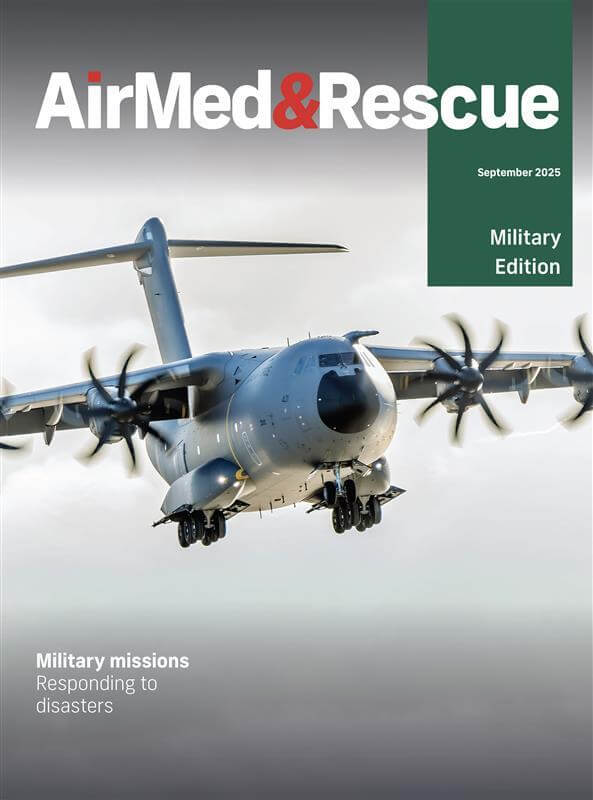
Our September edition is the special military issue, bringing together news, features and other articles that showcase military contributions to special missions. We have themed features on air forces helping with disaster response, the stretchers and baskets that make combat search and rescue possible, and the varied duties of military coast guards, and we have an extra non-themed feature on the medical equipment used in air ambulances.
Robin Gauldie
Robin Gauldie is a former editor of Travel Trade Gazette and other travel and tourism industry titles. Now a freelance journalist specialising in travel, aviation and tourism, he writes for a variety of international consumer and business publications including International Travel & Insurance Journal, AirMed and Rescue, and Financial World.