
Provider Profile: Keewatin Air

AirMed&Rescue find out what it takes to operate air medical services in the rugged Canadian Arctic from Keewatin Air
In recent developments, Keewatin Air has partnered with its sister company Custom Helicopters to launch a critical care rotary program to offer services to the Manitoba Health system.
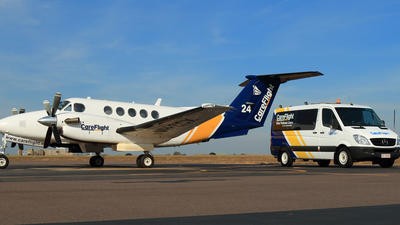
Keewatin Air operates a range of different aircraft, all of which were chosen for different reasons, according to Jason Kendall, Acting President and Person Responsible for Maintenance: “We chose the King Air B200 for its overall reliability of both the airframe and the Pratt & Whitney engines, which provide excellent runway performance specifications for the rugged arctic environment that we fly in everyday.”
On the Citation 560, Kendall said they were selected because they offered ‘the right range and speed for the missions we fly’, which are typically missions of 1,400 miles one way. The jets have gravel kits, allowing further versability of the aircraft to land on gravel runways in the arctic.
“The Pilatus PC-12 was chosen for its overall reliability, speed and runway performance, which allow the aircraft to land on short runways. The large cargo door is great for bariatric missions,” added Kendall.
Keewatin Air has designed and completed all its medical conversions in house, and is also independent when it comes to employment of medical crew. Melody Bishop, Aeromedical Educator, commented: “We are fully staffed with our own dedicated medical crews – flight nurses, advanced care paramedics (ACP) and registered respiratory therapists (RRT) – giving us the expertise to manage diverse patient acuity, from basic to critical care. A typical flight crew consists of a flight nurse and / or ACP and an RRT and / or second medic. Teams are determined based on call acuity and triage.”
Training medical crews for complex procedures
Medical crews at Keewatin Air undergo a comprehensive training program inclusive of advanced airway, mechanical ventilation, obstetrics, pediatric, neonatal, complex procedures and aeromedical training, which are done at initiation of employment and on a yearly basis to maintain recertifications. Bishop added: “We also offer extensive in-house scenario-based training for all staff and in house ACLS / PALS / NRP certifications for ongoing training re-certifications. Online module training programs are assigned to staff throughout the year on a monthly basis, allowing for training development, company changes and upskilling. We have recently partnered with FlightBridge, and all our medical staff are completing critical care courses through their education platform.”
Critical care transport capabilities
Aircraft are fully staffed and equipped to deliver critical care treatment, including advanced pharmacological management, advanced airway management, mechanical ventilation, cardioversion, pacing, arterial line monitoring, advanced obstetrics, neonatal and pediatrics, high flow humidified oxygen, non-invasive ventilation and much more. Bishop told AirMed&Rescue: “We are equipped with bedside ultrasound units, and have select medical staff who are certified for trauma, cardiac, basic OB and lung scanning to assist in patient treatment and management.”
The organisation is currently in the process of applying for status with CAMTS and Accreditation Canada.
Covid focus has increased air medical services and flights
The Covid pandemic has not diminished the care/services or response of Keewatin Air; in fact, over the past year, there has been an increase in services and flights. “We remain fully operational and have expanded our medical charter flights to help facilitate Covid testing and vaccination delivery in the Canadian Arctic. Our commitment to maintaining medical services to indigenous and under-serviced communities is our utmost priority,” noted Bishop.
Challenges Covid-19 has brought to the organization include:
- Strict isolation protocols for all staff while on public safety, all staff must quarantine unless dispatched on a medical call
- Decreased domestic commercial flights causes challenges in getting rotational staff up to the bases for their rotations
- Frequent Covid screening and testing to ensure patient and client safety.
Routine IPAC practices prior to the pandemic included disinfecting the aircraft after every medevac, but with the global pandemic, Keewatin has an ongoing commitment to minimizing transmission risk, and so, additional IPAC practices have been added to enhance aircraft disinfection. These include:
- All medical equipment in drawers/bags have been separated and sealed in bags that can be easily disinfected (this decreases contamination risks)
- After each medevac, the aircraft is completely unloaded / stripped and all equipment (medical and non-medical) is comprehensively wiped and disinfected with hospital grade disinfectant before being loaded back into the aircraft
- After manual disinfection, the aircraft is fogged with an approved disinfecting agent to add an additional precautionary step
- Tracking sheets are filled out for each call and all steps are listed with a sign-off sheet and attached to the external body of the aircraft for clear communication that the aircraft is disinfected and ready to use.
At the start of the pandemic, parent company EIC and Keewatin Air were very forward thinking, explained Bishop: “We were the first Canadian private carrier to purchase and implement the EpiShuttle isolation pods in our aircraft. These state-of-the-art pods allow for complete isolation of patients with communicable pathogens and add enhanced piece of mind to our clients and customers that we are prepared for Covid as well as any other challenge that can be presented.”
In addition, Keewatin Air has started using the NOCOSPRAY disinfecting device, which utilizes vaporization of hydrogen peroxide tailored to the specific dimensions of the space requiring disinfection. This device is clinically proven to disinfect closed spaces with 99.99 per cent effectiveness to even the most resistant hospital-grade infections. An additional benefit of the NOCOSPRAY unit is utilization of ‘test strips’ that can be placed in hard-to-reach places that can prove that the vapor has reached even the tightest spaces. “This feedback mechanism is often the missing link when dealing with disinfection,” noted Bishop. “Being able to prove that all areas of the aircraft are fully disinfected is the ultimate goal and an absolute goal of our disinfecting processes.”

Supporting indigenous communities during the pandemic
“At Keewatin Air, we are very proud of the services and close connections we have forged in the arctic and across Canada,” said Bishop. “We are committed to delivering the highest standard of care to the indigenous and Inuit communities of Nunavut and Manitoba. In the midst of challenging pandemic conditions, we have increased the number of aircraft available to the North, ensuring important Covid tests are delivered to these small remote communities, medical staff are transported to facilitate testing and samples are expeditated to labs to ensure rapid test results. We consistently check in with communities and health centers that we service to ensure we are fulfilling their needs and are constantly willing to re-evaluate and make changes to better suit our client and patients’ needs.”
Issue 117 | June 2021
In this issue:
- Building an aeromedical evacuation capability in the RCAF – Chinooks prove their worth
- Making the leap from military to civilian life – challenges and opportunities
- Black Hawk training – how does the US military prepares its pilots?
- Giving old aircraft a new lease of life as aerial firefighters
- Interviews: US Air Force PJs past and present; Dr Neville Vlok, HALO Aviation
- Provider Profile: Keewatin Air
In this issue
June 2021
Issue
In this issue:
- Building an aeromedical evacuation capability in the RCAF – Chinooks prove their worth
- Making the leap from military to civilian life – challenges and opportunities
- Black Hawk training – how does the US military prepares its pilots?
- Giving old aircraft a new lease of life as aerial firefighters
- Interviews: US Air Force PJs past and present; Dr Neville Vlok, HALO Aviation
- Provider Profile: Keewatin Air
Mandy Langfield
Mandy Langfield is a Director of Palladium Media Partners and former Publishing Director at Voyageur Group. She has written extensively on international travel and health insurance, medical assistance provision, and air medical transportation. She was Editor of AirMed&Rescue from December 2017 until April 2021. Her favourite helicopter is the Chinook, having grown up near an RAF training ground.
More from the Military Edition
What does it take to become a US Air Force PJ?
Interview: HALO Aviation's Chief Medical Officer on night flying, fleet variety and emergency medical provision
Blizzard Protection Systems focuses on HEMS patients
Sponsored by Blizzard Protection Systems