
News analysis: European wildfires start early, putting pressure on firefighting resources

At the end of June, multiple nations across Europe were already fighting enormous wildfires – highlighting the need for increased aerial firefighting assets. Mandy Langfield rounds up the latest news
Temperatures reach record highs
Large swathes of the UK and Europe were sweltering through a heatwave in the final week of June, with England’s southeast predicted to soon hit temperatures of 35°C and parts of Europe including Paris, Rome and Athens to reach over 40°C.
Records continue to be broken in terms of heat – the temperature reached a new high in the Spanish town of Huelva, near the border with Portugal, topping the previous June record of 45.2°C set in 1965 in Seville, according to Agencia Estatal de Meteorología (AEMET), the Spanish national weather agency. The last few days of June saw the advent of a heat dome that enveloped nearly the entire country, shattering century-old records and prompting alerts from the agency.
Samantha Burgess, Strategic Lead for Climate at the EU’s Copernicus Climate Change Service, noted that while major wildfires are sadly now a normal part of European summers, the timing is changing: “Large parts of Western Europe are experiencing extreme heat and heatwave conditions that are normally observed in July or August, rather than June.”
Wildfires break out across Europe
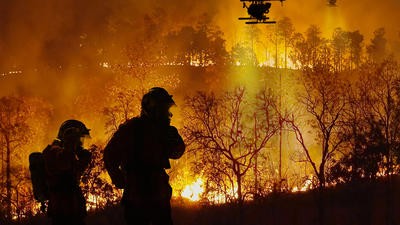
Throughout the month of June, Turkey saw nearly 1,500 fires break out. More than 1,000 personnel backed by 11 planes and 27 helicopters fought the wildfires, according to Turkish Forestry Minister Ibrahim Yumakli.
High temperatures combined with high winds meant that fires moved swiftly in the west of the country through the provinces of Izmir and Manisa. Local fire crews struggled to contain the outbreak, in which nine of the 77 fires were classed as “major”, where winds of more than 75mph grounded firefighting planes.
The industry was reminded that safety of the crews should always be the first priority in what is a very high-risk endeavor when a Cargolux-operated waterbomber, part of its subsidiary Aquarius Aerial Firefighting (AAF), overturned and crashed on 18 June in Turkey while scooping water from the Seyhan Dam Lake. The aircraft was an Air Tractor AT-802F Fire Boss with registration LX-AFE. Fortunately, there were no casualties; the pilot and a Turkish observer on board both were rescued by a police boat and taken to a hospital for precautionary checks. The incident occurred amid AAF’s ongoing support of the Turkish Forestry Agency, with eight aircraft deployed across four coastal bases in collaboration with partner Titan Firefighting.
The Hellenic Ministry of Climate Crisis and Civil Protection signed a contract for the purchase of eight H125 helicopters in April
Earlier this year, Columbia Helicopters announced the renewal of its aerial firefighting contract with CMC Savunma Sanayi in Turkey, marking its fifth consecutive fire season supporting Turkey’s national wildfire response, reinforcing its partnership with both CMC and the Turkish General Directorate of Forestry. Under the new contract, Columbia will deploy four of its Model 234 Multi-Mission Chinook helicopters, supported by flight crews and dedicated maintenance personnel for the 2025 fire season. Each aircraft is equipped with a 2,600gal Bambi Bucket, providing water and retardant delivery to high-risk areas.
Firefighting aircraft were also deployed in France, where Canadair planes dropped water on a fire in Aude, and a Dash 8 airtanker dropped retardant on a wildfire near Bizanet in the southwest of the country.
Gale force winds in Greece saw wildfire alerts raised to ‘extreme risk’ in many parts of the country. Multiple fires started and were hard to control, prompting authorities to issue emergency alerts urging residents to evacuate the area around southeast Athens as 24 aircraft and more than 100 firefighters worked to control the outbreak. On the island of Chios, hundreds of firefighters, 85 fire engines, 11 helicopters and two waterbombers were deployed to tackle a blaze that raged for several days.
Efforts to boost firefighting resources in Greece include the availability of 18,000 more firefighters, who will be deployed from the end of June until October. The Hellenic Ministry of Climate Crisis and Civil Protection signed a contract for the purchase of eight H125 helicopters in April this year. The contract will be based on a government-owned, contractor-operated (GO-CO) model, for which Airbus Helicopters will be partnering with experienced H125 firefighting operators Airtelis and SAF Hélicoptères, for the technical and operational support.
Increased preparedness – but was it in time?
To prepare for the increased wildfire risk during July and August, the European Union (EU) put together teams of firefighters and aircraft to help European countries affected by wildfires as part of the rescEU initiative.
To support local fire brigades, throughout the hottest summer months, almost 650 firefighters from 14 European countries will be strategically positioned in key high-risk locations in France, Greece, Portugal, and Spain to boost the number of firefighters in each country.
In addition, 22 firefighting airplanes and four helicopters will be stationed in 10 member states to intervene in case of need. Coordinated and co-financed via the EU Civil Protection Mechanism, these resources will help mitigate risks and enable a faster and more robust crisis response. These assets come on top of national capacities.
Overview of the EU-supported summer fleet:
- France: four medium amphibious airplanes and one helicopter
- Greece: four medium amphibious airplanes
- Croatia: two medium amphibious airplanes
- Italy: two medium amphibious airplanes
- Spain: two medium amphibious airplanes
- Sweden: four light planes
- Portugal: two light planes
- Cyprus: two light planes
- Czechia: two helicopters
- Slovakia: one helicopter.
In addition, a further 19 ground firefighting teams, of around 30 firefighters each, and one advisory and assessment team are ready to be mobilized by the EU in close collaboration with member and participating states via the Mechanism. A dedicated wildfire support team will be established at the EU’s 24/7 Emergency Response Coordination Centre to monitor risks, and analyze scientific data.
The European Commission’s Commissioner for Equality; and Preparedness and Crisis Management, Hadja Lahbib, commented: “Extreme heat and wildfires in Europe have sadly become the new normal. I am glad the EU has more to offer than just words of concern and consolation: our support is tangible and makes a difference on the ground. This wouldn’t be possible without a strong team effort across borders – thank you to Spain and to all other countries working together to make Europe safer in the face of this changing reality.”
Future developments
While Europe baked under scorching temperatures, Airbus was busy working on its latest tool to help fight fires from the air, announcing the successful completion of a series of test drops and demonstrations of its A400M firefighting demonstrator kit in Nîmes-Garons, France.
The objective of this test campaign was to conduct an independent assessment of the effectiveness of the A400M firefighting kit. The tests were conducted by the Entente-Valabre’s Test and Research Centre (CEREN), a French public institution authorized and approved by the French Ministry of the Interior to assess forest firefighting equipment and train personnel in France and abroad, which is an international authority in this field.
Extreme heat and wildfires in Europe have sadly become the new normal
The test campaign involved the A400M performing multiple drops over a designated section of the airfield. These so-called cup grid tests allowed CEREN to assess the system’s capabilities, including the accurate distribution and concentration of retardant upon reaching the ground. During the drops, the aircraft reached altitudes under 30m (98ft) and speeds around 230km/h (125kts).
The A400M roll-on/roll-off (Ro-Ro) firefighting kit requires no permanent modification to the aircraft, allowing any A400M in a fleet to be rapidly converted for firefighting missions on very short notice. The system, housed in the cargo hold, can discharge up to 20,000L of water or retardant by gravity through the rear ramp, with tanks capable of being refilled in less than 10 minutes using standard ground pumps.
“Following initial tests conducted in Spain, the successful completion of these tests in Nîmes is a crucial step forward in our ambition to shape an ecosystem of firefighting capabilities,” said Jo Müller, Head of Sustainability and Communications, Airbus Defence and Space. “The A400M’s exceptional versatility, combined with the rapid deployment capabilities of this kit, offers a game-changing asset to complement existing technologies and platforms on the ground, in air and in space.”
August 2025
Issue
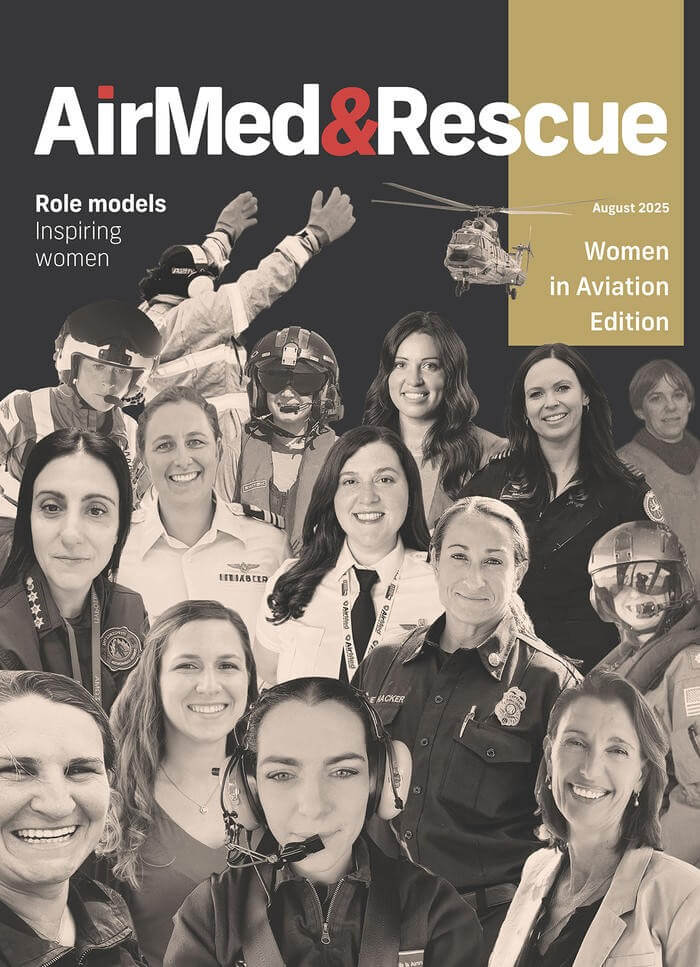
Our August magazine is the inaugural women in aviation edition, highlighting and showcasing female voices from the airborne special missions sector. We have features on blood products used in emergency medical services, challenging hoist rescues, pregnancy while flying, and portable water sources for firefighting. We also have interviews, a gallery, an industry voice, a news analysis piece, and a provider profile, as well as a review of the Paris Air Show.
Mandy Langfield
Mandy Langfield is a Director of Palladium Media Partners and former Publishing Director at Voyageur Group. She has written extensively on international travel and health insurance, medical assistance provision, and air medical transportation. She was Editor of AirMed&Rescue from December 2017 until April 2021. Her favourite helicopter is the Chinook, having grown up near an RAF training ground.