

Perception, comprehension, projection: the art of situational awareness

Situational awareness is crucial for a safe flight, but pilots must interpret large amounts of information while focusing on what’s most relevant to the mission. Robin Gauldie looks at how this is done and how technology has evolved to help
Ever-evolving technology is reducing workload and improving situational awareness for flight crews operating special missions. The once-innovative ‘glass cockpit’ – cutting-edge when it was first developed in the 1970s for military then large civil aviation operators – is now standard, even on many smaller private aircraft, and manufacturers continue to refine it. Yet the new technology is not without attendant risks, caution some providers and users. Aircrew may need to be convinced of the benefits of next-generation cockpit technology, while at the same time they must be trained not to become over-dependent on it.
“The issue of crews over-relying on technology is one that I recognize from my own background, having been trained to conduct overland search and rescue (SAR) with a 1:50,000 map and a stopwatch,” commented Jon Duke, Head of Aviation at Airbox Systems and himself a former Royal Navy pilot flying SAR Sea King helicopters. Airbox Systems has been supporting SAR, helicopter emergency medical services (HEMS), law enforcement and defense aircrew for over 10 years, with apps for carry-on devices that make understanding and sharing mission information as seamless as possible.
“We had a GPS of sorts – even if only the mission crew could see it – but as the logic of the time went, you need to be able to operate if that fails. That logic still holds true, but the baselines have shifted – both in the technology at the cutting edge, and the systems that provide the backup,” Duke said. “Flying crew take a range of places on the innovation adoption curve, but it’s not unusual for them to be rightly skeptical of any technology that makes big promises, particularly where it comes from those that don’t have a track record in aviation,” he noted.
“It‘s also a positive trait that aviators take a critical view of any information that they are presented with in the cockpit. Complete trust in a single source of information generally ends up being bad for situational awareness in the long run – this goes just as much for mission crew as it does for pilots. The real conundrum is figuring out which information is the most reliable, and fusing those disparate information sources to help the crew develop an accurate mental model. Interpreting any information source and making a decision about how much to trust it takes time, and in critical situations, that is time they may not feel they have – leading to rushed decisions based on a single source.
“This is where technology in the cockpit can help, by helping them manage their workload – as well as configuring the information feeds so that they support them in the activity that is most salient at the time.
“I see training as fundamental to helping to solve this paradox, as it is one of the few ways which is well proven to enable crews to reduce their workload. But it needs to be representative training in terms of scenario, and using the equipment that they will be using ‘for real‘.”

From analog to digital
The need for situational awareness has existed since the dawn of the age of flight. Arguably, it’s been around much longer than that. Skippers of 19th-century sailing ships, at the mercy of wind and tide, needed to be alert to multiple factors affecting their vessels, just as 21st-century pilots do, albeit in just two dimensions and at a slower pace – and without sophisticated instrumentation to help them. In the 21st century, HEMS and SAR pilots operate in an often fast-moving, fast-changing spherical volume in which good all-round visibility, ergonomic cockpit and cabin layout and fittings are vital aids in enabling them to act decisively on large amounts of complex data.
Urban HEMS operators fly missions over vast urban environments comprising clusters of office and residential blocks that may top 300m, traffic-filled city streets and multi-lane highways, all overflown by aircraft serving busy major airports and subject to a wide array of airspace restrictions. In these environments – and on HEMS missions to remoter settings, such as offshore oil and gas installations or SAR flights to mountainous wilderness regions – situational awareness can be impaired by a range of human factors like fatigue and stress. Training and regular evaluation and refreshment of situational awareness skills can be key to preventing such factors from also impairing fulfillment of the mission.
Situational awareness can be impaired by a range of human factors like fatigue and stress
The ‘glass cockpit’ concept – essentially, shorthand for replacing relatively cumbersome analog instrumentation with ever-more-sophisticated digital display screens – has become ubiquitous over the last 20 years. For SAR, HEMS and aerial firefighting operators, it is now an indispensable tool.
In spring 2025, Astronautics Corporation of America will begin verification of a program to retrofit 12 of Erickson’s fleet of S-64 Air Crane helicopters with a glass cockpit upgrade that includes Astronautics’ Badger Pro+ Gen 2.0 integrated flight display system, Engine Data Concentrator Unit (EDCU), and AeroSync Mission connectivity system, a lightweight connectivity system for data collection, storage, and export, along with broadband connectivity.
Astronautics is additionally customizing the Badger Pro+ Gen 2.0 system to enhance situational awareness for S-64 Air Crane pilots related to the specific missions they fly, with mission display pages that indicate the status of onboard systems such as the retardant tank, hoist and pendant, and video from the enhanced vision system cameras.
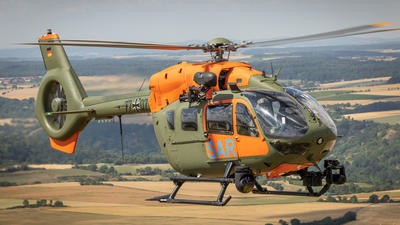
On the other side of the Atlantic, Airbus Helicopters continues to push its Helionix system as a solution that provides greater operational safety and mission flexibility in an intuitive, pilot-friendly cockpit environment. The avionics suite also comprises a GPS navigation/communication system and traffic advisory notification, along with a mission system incorporating a digital map, terrain avoidance capabilities and synthetic vision cockpit technology. Further contributing to a reduction of the pilot’s workload and enhanced safety is the Helionix four-axis autopilot, the manufacturer says. “Helionix is continually evolved with each new version, taking customers’ requests and feedback into account,” said Christian Gottschalk, Airbus Helicopters’ Head of the Helionix Program. “This includes bolstering SAR capabilities and introducing Rig’N Fly automatic mode approaches for landings on oil platforms. Other flight monitoring and failure management functions have recently been developed as well.”
Further contributing to a reduction of the pilot’s workload and enhanced safety is the Helionix four-axis autopilot

Fundamental in preventing accidents
Blogging on his company’s website, Dan Cook, Head of Marketing at Bytron Aviation Systems, defines the three primary stages of situational awareness as perception, which involves pilots continuously scanning their environment, utilizing visual cues, instrument readings, and auditory inputs to gather relevant information; comprehension, or correct interpretation of the information collected and understanding how different elements interact and impact the flight operation; and projection, where a pilot with complete understanding of the situation is able to anticipate future developments and prepare to take proactive actions.
“Situational awareness also significantly enhances efficiency within flight operations,” Cook wrote. “By maintaining a clear understanding of the airspace and traffic conditions, pilots can optimize flight paths, reducing fuel consumption and operational costs. Additionally, situational awareness allows for smoother and more precise communication with air traffic controllers, ensuring streamlined operations in congested airspace.”
Situational awareness allows for smoother and more precise communication with air traffic controllers, ensuring streamlined operations in congested airspace
Technology plays an essential role in enhancing situational awareness in the aviation industry, such as terrain awareness and warning systems (TAWS), traffic collision avoidance systems (TCAS), enhanced weather radar, and providing pilots with real-time information critical to flight safety.
Perhaps counterintuitively, though, a multiplicity of state-of-the-art equipment can lead to information overload and over-reliance on automation, posing a challenge to good situational awareness. The modern cockpit, crammed with advanced technology and data, can flood the pilot with non-critical information, while overdependence on automated systems may diminish pilots’ situational awareness, Cook cautioned.
With its innovative cockpit layout featuring two to four multi-function screens designed to improve pilots’ situational awareness, Airbus’s Helionix system specifically addresses this issue, according to Gottschalk: “The system displays only the most pertinent details of a flight phase – filtering out all unnecessary and distracting information.”
“It’s quite common to hear crews talk about cockpit workload reduction, but just as important – and less widely discussed – is the ability to manipulate the workload to suit the mission by taking advantage of technology to get ahead of the aircraft,” added Duke. “From my own perspective, the critical thing that we have at the front of our mind is that we have to deliver information to our users that helps them make the right decision, but never attempts to make it for them. Primacy of the aircraft captain is non-negotiable, but so are the decisions made by medical crew, tactical flight officers (TFOs) and other mission specialists. This will only take you so far, though; just ask any TFO when the ‘quiet times’ are during a live mission – there aren’t any! So I think enabling crews to efficiently access and manipulate data is just as important,” Duke concluded.
January 2025
Issue
In our combined January/February edition, explore how islanders get emergency medical aid; find out about the way technology is being used to improve safety through increased situational awareness; discover all about hoist systems used in special missions; and see what is coming to the world of aviation in new platforms, technology and equipment; plus more of our regular content.
Robin Gauldie
Robin Gauldie is a former editor of Travel Trade Gazette and other travel and tourism industry titles. Now a freelance journalist specialising in travel, aviation and tourism, he writes for a variety of international consumer and business publications including International Travel & Insurance Journal, AirMed and Rescue, and Financial World.