
Phoenix from the flames

The recent wildfires in Los Angeles were defined by images of aerial firefighting assets and crews working tirelessly to battle the onslaught of multiple active blazes. One of the most valuable tools in the firefighters’ arsenal was the Sikorsky Firehawk. Mandy Langfield finds out the story behind the development of the aircraft
When the first Sikorsky UH-60 Black Hawk helicopter rolled off the production line in 1974, and entered service with the US Army in 1979, few could predict the distinguished career that would follow. And even fewer knew what the future of airborne firefighting would look like. From the smallest drones capable of capturing data that allow the best use of resources and effective outcomes in today’s wildfires to the fixed-wing assets that drop tons of retardant and water at a time, those fighting fires from the air have myriad choices in how they deploy their assets and resources. In the USA, though, and especially on the west coast, one Black Hawk variant seems particularly dominant: the S-70 Firehawk.
The Firehawk concept was originally pitched by Sikorsky to the US National Guard. Black Hawks were modified and flown with a fixed tank. In the end, the mission wasn’t adopted by the Guard.
But in the late 1990s, the Los Angeles County Fire Department (LACoFD) approached Sikorsky with the idea to transform the Army’s principal assault helicopter into a different kind of attack platform. The idea being that if the Army could land troops on the ground and support them with aerial firepower, why not land firefighters at the fire line, and support them with water drops?
The conundrum of how to turn the Black Hawk into an effective aerial firefighting platform required innovation and a unique approach to problem solving. Enter Sikorsky and United Rotorcraft – a division of Air Methods that was created 30 years ago to develop and install the medical interiors for the Air Methods fleet of helicopter emergency medical services (HEMS) operations.
United Rotorcraft had already won the Sikorsky contract for outfitting the US Army’s HH-60 helicopters with medical interiors. And it was this relationship that led to Sikorsky asking United Rotorcraft to work with it and the LACoFD to commercialize the Firehawk platform. This is an important aspect of the previous and current development of the aircraft in its firefighting iteration. There is a triumvirate here: Sikorsky, United Rotorcraft / Air Methods, and the operator. Together, the three entities are stronger as each is playing to their individual areas of expertise.
United Rotorcraft integrated a 3,785L (1,000 US gal) external water tank, an extended landing gear to give the tank added clearance from the ground, and a retractable snorkel that fills the tank in less than 60 seconds. United Rotorcraft also designed the controls that allow the pilot to drop water in different quantities depending on the spread of the fire.
Michael Williams, Senior Director, Strategy and Marketing, for United Rotorcraft, went into more detail about the process: “In 2017, United Rotorcraft won the contract to start building the Firehawk fleet for the California Department of Forestry and Fire Protection (CAL FIRE). Under the terms of a deal made with Sikorsky, United Rotorcraft gained exclusive license to the engineering data Sikorsky had gathered over the years developing the Black Hawk aerial firefighting modifications. What does this mean in real terms? No-one else can make an official Firehawk. By 2018, United Rotorcraft had signed the contract to provide CAL FIRE with its first three Firehawks. Ongoing research and development investments by United Rotorcraft have boosted the aircraft’s already stalwart capabilities.”
Under the terms of a deal made with Sikorsky, United Rotorcraft gained exclusive license to the engineering data Sikorsky had gathered over the years developing the Black Hawk aerial firefighting modifications
The aircraft’s domination over the California skyline is complete, and it now has its first foothold in Colorado as well – the first Firehawk was delivered there in 2024, and there are firm hopes for another already in production at United Rotorcraft to take to the skies before the end of the year, joining the other 25 Firehawks already on active duty.
The result of such collaboration and innovation is a helicopter with the engine power to transport 12–14 firefighters to the scene of a fire, then carry and drop over 4 tons of water. The aircraft’s capability to operate with safe power margins in hot temperatures at high altitudes is key – especially in Los Angeles County, where terrain extends from sea level to 10,000ft altitude.

In the beginning, there were three…
In the early 2000s, LACoFD acquired its first three S-70 Firehawk aircraft (S-70 being Sikorsky’s designation for the Black Hawk), adding two more 17 years later. By then, LACoFD was successfully putting out countless small wildfires in their nascent stage, before they could become megafires. Other California fire agencies, the State of California’s CAL FIRE in particular, began to take notice.
Speaking to AirMed&Rescue, Sikorsky Business Development Lead Kate Grammer extolled the Firehawk’s military design, saying the airframe can withstand the enormous physical stresses when taking on and dropping 1,000gal of water multiple times during a firefighting mission. The combination of the high-strength and corrosion-resistant airframe significantly reduces maintenance costs, she said.
The airframe can withstand the enormous physical stresses when taking on and dropping 1,000gal of water multiple times during a firefighting mission
Williams added: “When it comes to efficiency, the Firehawk is doubtless a leading performer. It needs just 1 meter of water from which to fill its 1,000gal tank in 45 seconds. The advantage of the tank is that it’s not considered an external load, so once it is full, the aircraft can reach the fire at its top speed near 140kts – no changing in top speed is required, and no change in flight path. Its work rate and productivity is impressive. Every effort to get the maximum efficiency out of the aircraft has been taken – when it comes to dropping the water, the belly tank funnels the water out to produce a flow in a laminar column, ensuring the maximum amount of water is dropped on the fire, minimizing the loss of water to mist between aircraft and fire, and maximizing the impact on the burning fuel source below.”
Rob Gaylor, LACoFD’s Acting Assistant Chief, Air and Wildland Division, commented to AirMed&Rescue: “The Firehawk provides a margin of safety and performance that allows my personnel to operate in an all-risk environment. Their confidence in the aircraft’s performance widens the acceptance of missions related to emergency operations. As a result, the Air Operations Section can provide the public with the emergency services they expect and deserve.”
Grammer says the aircraft’s retractable snorkel and belly tank also produce less drag in flight when transiting from the water source to the fire. In an era where multi-mission aircraft are becoming key to more and more operators, the Firehawk’s belly tank configuration means that in the middle of fighting fires, the pilot is able to switch to a search and rescue (SAR) or medevac mission. And that multi-mission capability is what makes it so valuable, according to one operator we spoke to.
Michael J Sagely, Senior Pilot for the LACoFD Air Operations team, said of the aircraft he has flown for 38 years: “The Firehawk helicopter is in my opinion overall the best helicopter design in the world today. The reason for this is simple: versatility. Many helicopters are designed and manufactured for a fairly specific market – EMS, VIP, offshore oil and gas, training etc. Along with that, most have some significant limitations. For example, they might be fast but have a limited payload. Or small but with limited range; large but with limited maneuverability. The LACoFD Air Operations Section conducts high-risk no-fail multi-mission operations 24 hours a day in a very diverse and demanding environment. The Sikorsky Firehawk combines all of the critical design features needed to safely and efficiently conduct our daily operations. I cannot think of a more capable helicopter to meet the needs of the mission and the citizens of Los Angeles County.”
The LACoFD Air Operations Section conducts high-risk no-fail multi-mission operations 24 hours a day in a very diverse and demanding environment
Further efficiencies are the constant loop of water drops that the Firehawk is able to perform – basically, as long as there is fuel on board, the aircraft will continue its mission to drop as much water as possible on a fire. The wildfires that destroyed vast swathes of Los Angeles in January saw Firehawk crews perform more than 1,000 drops over nine days. And it could have been more, had it not been for the Santa Ana winds – although Firehawks can fly in a maximum wind speed of around 60mph, takeoff wind speed has to be lower – and safe flight parameters are the choice of individual operators.
Customization is key for customer success
Williams told AirMed&Rescue: “Each aircraft has a basic configuration, although this can be customized to varying degrees for each operator. For practical and safety reasons though, certain items in the cabin and cockpit will always remain the same. For fleet standardization and crew resource management, pilots need to be able to shift from one helicopter to another seamlessly, and without cockpit standardization it could go south very quickly. For example, emergency buttons such as hoist cable cut and water tank emergency dump should always be located in the same place to complement pilot reaction times. Around 80% of the time, the airframe, cabin and cockpit are going to have their standard configuration.”

The Firehawk is truly a multi-mission aircraft – from troop transport to disaster relief, SAR, and, of course, aerial firefighting. When it comes to the Firehawk add-ons, the aircraft can be kitted out to transport firefighters, with seats that can be installed quickly, plus space for their various equipment – axes and whatever else is required.
According to Williams, “partnerships with multiple industry players mean that United Rotorcraft can install the most appropriate additional equipment as needed – a hoist from Onboard Systems, the engine inlet barrier filters from Aerometals, Becker communications, Axnes Wi-Fi, the choice of two tanks (Kawak supplies the metal tank, while DART Aerospace has developed the composite one), and much more. The development of the composite tanks further enhances the platform’s capabilities – patching it can be just as easy as patching the metal tank, it’s more aerodynamic, and it saves weight. Adoption of this option will grow as new customers enter the market.”
Widening scope of operations
Although currently all 32 Firehawks on order or in service are deployed in the continental USA, Grammer confirmed that she has seen increased interest from operators in other regions of the world. And small wonder when you consider the ferocity of recent fire seasons in Europe and Australia. Climate change also means that fire seasons are converging – where previously assets could potentially be moved from one continent to the other to fight fires on more than one front, this is becoming harder. Grammer queried, with assets as precious as Firehawks, would many operators really be willing to loan out their helicopter in the hope that they’d get it back in the same condition? What about expensive maintenance costs?
Staying ahead of the game on maintaining aircraft is a key part of keeping them in the air – and this is something that Sikorsky is passionate about. Keeping their clients airborne for the maximum amount of time is what matters. As such, explained Grammer, the company runs maintenance programs for clients that result in them having the parts they need in advance of when they need them.
There are always improvements that can be made – small tweaks here and there that can contribute to weight loss of the airframe, and then resultant increase in maximum loads it can carry
For customers buying new, Sikorsky has offered a two-year warranty on parts; some also select an enhanced support package. For those customers that then go to United Rotorcraft for the Firehawk customization, they get a separate guarantee of United Rotorcraft’s work done, plus additional after-market support.
Looking ahead, Grammer noted that there are always improvements that can be made – small tweaks here and there that can contribute to weight loss of the airframe, and then resultant increase in maximum loads it can carry. One of these currently is a composite belly tank. While the standard is a metal tank, and there are some operators that are diehard supporters of its strength and capability, others are open to the idea of something a bit more lightweight.
Other improvements are harder to come by. What about increasing the range of the aircraft? “This is tough,” said Grammer. “If you put more fuel on so you can fly firefighting missions for longer, what if the trade-off is that you can carry slightly less water? There has to be a weight-benefit ratio.”
While several initiatives are in development to help fire agencies track and predict the direction of wildland fires, one technology that firefighting helicopters like the Firehawk could adopt is flight autonomy.

Uncrewed capability examined
Sikorsky is developing this capability with its MATRIX flight autonomy system. In 2022, the company flew a Black Hawk helicopter with no humans on board, demonstrating to the US Army its utility to resupply troops in a contested battle environment.
“With the MATRIX system, no human pilot is controlling the aircraft from the ground,” said Grammer. “Instead, a human sends high-level objectives from a tablet via data link to the aircraft. The system and the aircraft’s onboard sensors take over to launch, perform the mission, and return to base. The human is in the loop as mission monitor, and can change the mission parameters as needed during the flight.”
The system and the aircraft’s onboard sensors take over to launch, perform the mission, and return to base
In October 2024, Sikorsky and a California-based startup called Rain took autonomy to the firefighting level. At Sikorsky headquarters in Stratford, Connecticut, the two companies showed the effective fusion of Sikorsky’s MATRIX flight autonomy with Rain’s wildfire mission autonomy system to suppress a fire in its incipient stage.
Rain’s technology sent commands to the autonomous Black Hawk helicopter to take off, identify the location and size of a small fire, hover over a nearby river so as to fill the bucket with water, and then guide the aircraft to accurately drop water that suppressed flames on the Sikorsky flight field.
Witnessing the demonstration were representatives from NASA, the Federal Emergency Management Agency, the Defense Advanced Research Projects Agency, LACoFD, Orange County Fire Authority, and investors supporting Rain.
Grammer could not be more excited by the results. “Although we started small, with a dumpster fire and a barbecue fire, the results of the tests were impressive,” she told AirMed&Rescue. “A lot of operators who already fly in a single-pilot configuration are open to the idea of using a system like MATRIX technology to reduce workload and increase flight safety. When combined with Rain’s software, the result is to help improve detection of fires and accuracy of water drops.”
Accepting that it would be a long time – if ever – before completely uncrewed aircraft would work for airborne firefighting, what Sikorsky is doing now is taking the best of the aircraft, the best pilots, and the best software on offer, and combining them in an effort to improve safety, efficiency and outcomes.
Flying high, looking forward
What does the future hold for Sikorsky and its parent company Lockheed Martin? “Right now, we are seeing unprecedented demand for S-70 Black Hawk helicopters,” said Grammer. “Direct acquisition contracts can take up to three years to come to fruition, so there can be a lag between contract and delivery. The wait time isn’t ideal for operators, and we know that, but this is the nature of the business. What we do know is that with the increase in wildfires that is being seen all over the world, governments and private operators are allocating more budget to aerial firefighting assets.”
New customers are a tricky aspect of the Firehawk. Globally, budgets are tight and there is a growing market for smaller operators with smaller budgets. With the rapid pace of climate change increasing frequency and severity of wildfires, for some there is no waiting.
Thus, some operators are turning to legacy Black Hawks, said Williams. “The US Army’s divestiture program gives access to aircraft the military are no longer using. These operators are buying the aircraft and handing them over to United Rotorcraft to make them ‘as new’ aerial firefighting platforms.”
The US Army’s divestiture program gives access to aircraft the military are no longer using
The industry needs to get more firefighting assets in the air – and that goes for everything from Air Tractors to airtankers. Aerial firefighters need every asset in their toolbox to prevent small fires from becoming major disasters, but they do need the capability to respond should a situation escalate – as it so often does when the weather is controlling the outcome of an event.
The dynamic world of aerial firefighting will continue to evolve, and one thing is for sure: the manufacturers that are listening to operators, customizing their aircraft to fit the operational parameters, and ensuring maximum efficiency for clients, will be the ones to come out flying.
April 2025
Issue
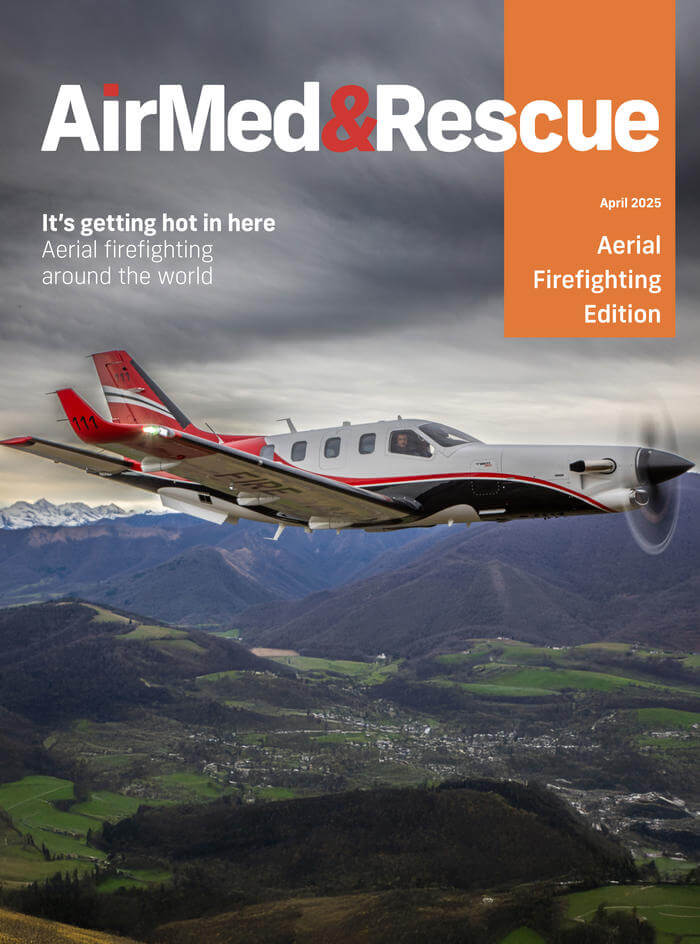
Our April edition has a special focus on aerial firefighting, with features that include rescues during wildfire situations; the coordination process and tools used between aircraft and firefighters; the distinct job of the smokejumper; the different use cases for buckets and tanks, and what needs to be considered for your airframe; the continued appeal of the Firehawk platform; and the importance of proper expertise when treating traumatic brain injuries; plus more of our regular content.
Mandy Langfield
Mandy Langfield is a Director of Palladium Media Partners and former Publishing Director at Voyageur Group. She has written extensively on international travel and health insurance, medical assistance provision, and air medical transportation. She was Editor of AirMed&Rescue from December 2017 until April 2021. Her favourite helicopter is the Chinook, having grown up near an RAF training ground.