

Pregnancy and the demands of special missions aviation

Jennifer Ferrero looks at the considerations for pilots and crewmembers when either pregnant themselves or treating a pregnant patient in an emergency
Dana Hamilton, a Critical Care Flight Paramedic with Ornge in Ontario, Canada, has worked for up to six months’ gestation during her two pregnancies. She said that during her second pregnancy, she knew she had to take leave when a rescue required a hover exit into the waist-deep snow to a cabin to treat a patient in a snowmobile accident. It is uncommon for a pilot to exit the helicopter to help, but one of the two did when she needed help pulling a sled with the patient downhill. She said the job is physically challenging even without being pregnant and “adding pregnancy makes it harder for many reasons”. She added that on her next shift, with a pregnant belly in the way, she performed CPR in the helicopter and was “pumping hard and fast, and it was exhausting”.
Working while pregnant and treating pregnant patients on helicopter rescue missions can be risky and stressful, especially if the patient is nearing delivery. In this article, we’ll examine the parameters of working as a pregnant paramedic and considerations for treating pregnant patients en route to the hospital.
Prue Young is a Critical Care Flight Paramedic with GCH Aviation in New Zealand who completes a range of rescue missions “involving winch, water and boat rescue, interhospital transfers, and primary medical and trauma jobs”. The organization’s role varies, including private jet and commercial helicopter operation services, AeroMed Pacific international medical air transport, the New Zealand Flying Doctors service, and helicopter emergency medical services (HEMS) throughout the Canterbury, West Coast, Nelson, and Marlborough regions.
Rosario Aurora Campayo Garcia is the Spanish Medical Director for Avincis. She works in HEMS and has been in this role since 2020. She said: “Avincis is the largest provider of emergency aerial services in Europe, with additional operations in Africa and South America. Governments trust us to deliver safe, reliable, and efficient services when their people are most in need. Our environment is challenging and complex, but our purpose is clear – we exist to save lives and protect communities wherever we serve.”
Hamilton said she is one of 200 paramedics with Ornge: “Ornge serves more than 14 million people over 1 million km² (386,000 square miles) of land – the size of France, Spain, and the Netherlands combined.” She has been with the company for 14 years, and earned her education while working with Ornge: “We are fortunate with in-house training.”
Knowing when to stop
Hamilton’s crew consists of two pilots and two paramedics, and she is explicitly trained to handle any medical issue for any person of all ages, including obstetrics and neonatal care. She said that knowing when to stop flying as a pregnant paramedic is a gray area. She said her company had no policy, and her obstetrician (OB) didn’t have “literature on the topic”. She added that her OB was concerned about vibration, radiation, and lifting. But ultimately, “it fell back to me and what I was comfortable with”.
Accommodations that can be made include changes to the flight suits and uniforms, shift changes and limiting or ceasing travel from your main base where required for roster cover
In her career, she had worked to an elite level in a demanding field. Drive and resilience are deeply ingrained. “You don’t want to go off early, and you want to do a good job,” she said.
Hamilton had to determine when the workload was too much. But she shifted her focus from her professional ambition to the wellbeing of her child. “It was a totally new moment for me to face, a turning point, and an intensely personal one.”
Hamilton added that because they spend so much time with their crew, “they become family; therefore, they did things to help lighten my load: they would grab the heaviest bag and help with lifting”. She said the crew would support the pregnant staff members suffering from morning sickness and “take the reins”.
In New Zealand, Young said, “accommodations that can be made include changes to the flight suits and uniforms, and discussions have included shift changes and limiting or ceasing travel from your main base where required for roster cover”.
She added that pregnancy decisions for crewmembers are taken on a case-by-case basis. “Depending on how the individual is coping with pregnancy, it may range from standing down from flight duties as soon as they confirm their pregnancy, to working until 20–24 weeks dependent on the current medical opinion and the individual’s own preference,” she said. “The suggested level of discussion is a review every two weeks from notification to the employer.”
At Avincis in Spain, Campayo flew until she was 20 weeks pregnant. Generally, she said, regulations require that “a pregnant licensee will be assessed as fit, with ordinary maternity leave (OML), for the first 26 weeks of gestation, following a review of the obstetric assessment by the Aeromedical Center (AeMC) or Aviation Medical Examiner (AME), who will report to the licensing authority. The AeMC or AME must provide written advice to the applicant and her gynecologist regarding potential significant pregnancy complications.”
Regarding accommodations for pregnant pilots and paramedics, Campayo said that pilots can take another position if unable to fly, or an employee can take sick leave due to pregnancy, which may include a contract suspension with benefits until the baby is born.
Hamilton said they have light duty available, “but when you are a front-liner, that is not always appealing; when a call comes, we must respond to every situation. It is hard, and we are used to shift work; if you go from [that to] Monday to Friday, it flips your whole world,” especially with changing day care or babysitting schedules.
At Avincis in Spain, pregnant crewmembers are allowed 16 weeks of maternity leave. A pregnant paramedic must be cleared for flight by her doctor but cannot fly beyond 26 weeks.

Managing pregnant patients
Transporting pregnant patients is a matter of course for all three subjects. Young said: “I have transferred or been involved in the care of multiple emergencies involving pregnant women.” She cited medical conditions like sepsis and trauma from accidents, and said that challenges include premature, difficult, and breech births. “While I have never had a birth during flight, we have delayed transport to deliver a baby before transport and have been prepared with two full sets of resuscitation gear in the helicopter while transferring a mother in premature active labor with twins.”
Hamilton said they have had pregnant women on flights “countless times”. She and her husband chose a midwife for her first pregnancy. As a critical care flight paramedic, she is knowledgeable about deliveries and what can go wrong. Her midwife suggested that few pregnancies the midwife deals with result in complications. However, Hamilton’s riposte, given her role, was that in obstetrical emergencies, there is something wrong 100% of the time for the women she encounters. “We get a multitude of obstetrical emergencies, and the complications can be broad.”
While I have never had a birth during flight, we have been prepared with two full sets of resuscitation gear in the helicopter while transferring a mother in premature active labor with twins
In one situation, she had a pregnant young woman whose placenta was detaching from the uterine wall, and she was bleeding inside her abdomen. Hamilton, who also works with her paramedic husband, said success for the young woman was “coming down to seconds”: they were giving her lots of blood, pain management, and comforting her husband. They quickly got the woman to an operating room (OR), and a doctor performed a C-section on the patient. Hamilton said they rarely hear about patient outcomes, but after the fact, they heard through the grapevine that the mother and baby were doing well.
From a safety standpoint, Hamilton said one challenge is the amount of space on the helicopter. She said they didn’t want to deliver en route to the hospital. Assessments are made of managing the situation before taking off to pick up the patient, and they communicate with the transport physician and often consult a high-risk obstetrical physician.
“There is much critical information assessed before we depart. Do we stay and deliver here, or where do they want to be?” After critical consultations and assessments, they put the patient on the aircraft, positioning the mother in a lateral position, with supplemental oxygen, medication to slow down contractions, and medication to stop hemorrhaging. She added that they can do blood work in the aircraft and replace blood. They can also deliver the baby and resuscitate the neonate. She said that the baby’s father or relatives can’t always travel with them to the hospital because of space and weight restrictions.
For GCH Aviation, safety considerations for the mother and baby include stretchers or incubators and positioning of the patient in case of delivery during flight. “Further, where there is the possibility of birth during flight, consideration of having two patients, both of whom may be very sick, needs to be planned and discussed within the team before the flight,” Young said. “This may include taking extra staff, including a midwife, obstetric consultant, or second critical care flight paramedic.”
Regarding training to prepare for the treatment of a pregnant woman, Campayo said they have deep training to include a program called Practical Obstetric Multi-Professional Training (PROMPT). She added: “This evidence-based, multi-professional, practical training specifically discusses the difficult situation where pregnant women must be transferred with either helicopter or fixed-wing services, including paramedics, midwives, and doctors. Further, we attend a Pre-Hospital Emergency Anesthesia (PHEA) course annually where pregnancy complications, birth, and resuscitation, including neonates, are discussed in detail, and technical skills such as neonatal intubation are practiced.”
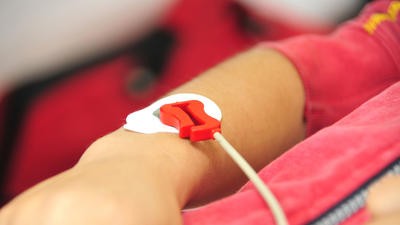
We have specific birthing and neonatal resuscitation equipment, including intubation and vascular access, a wide range of medications, and, where required, can transport with a full incubator setup
If a baby is delivered in flight in Spain on an Avincis flight, Campayo said they are well equipped. “The equipment carried on all rescue and medical helicopters is extensive. We have specific birthing and neonatal resuscitation equipment, including intubation and vascular access, a wide range of medications with associated clinical practice guidelines, and, where required, can transport with a full incubator setup.”
Campayo said that in the case of an accident, car or otherwise, with a pregnant woman, they position the mother in “the left lateral decubitus position to avoid vena cava compression syndrome and [preserve] the vitality of the fetus, in addition to the considerations we have with any patient. Another critical point to consider when assessing these patients is that the physiology of pregnant women is somewhat different from that of the general population.”
Shared experience
Subjects in Spain, New Zealand, and Canada are in separate organizations. However, by consensus, they have had extensive training in transporting mothers and babies in emergencies to hospitals. Each organization mentioned scenarios for pregnant crewmembers and cited a gray area regarding how long pregnant women can fly on the crew and when to take leave, which seems to hover around 24–26 weeks of pregnancy. The reasons for when to start leave were mixed between career commitment and difficulty performing duties related to lifting, space restrictions, and the ability to perform tasks like CPR.
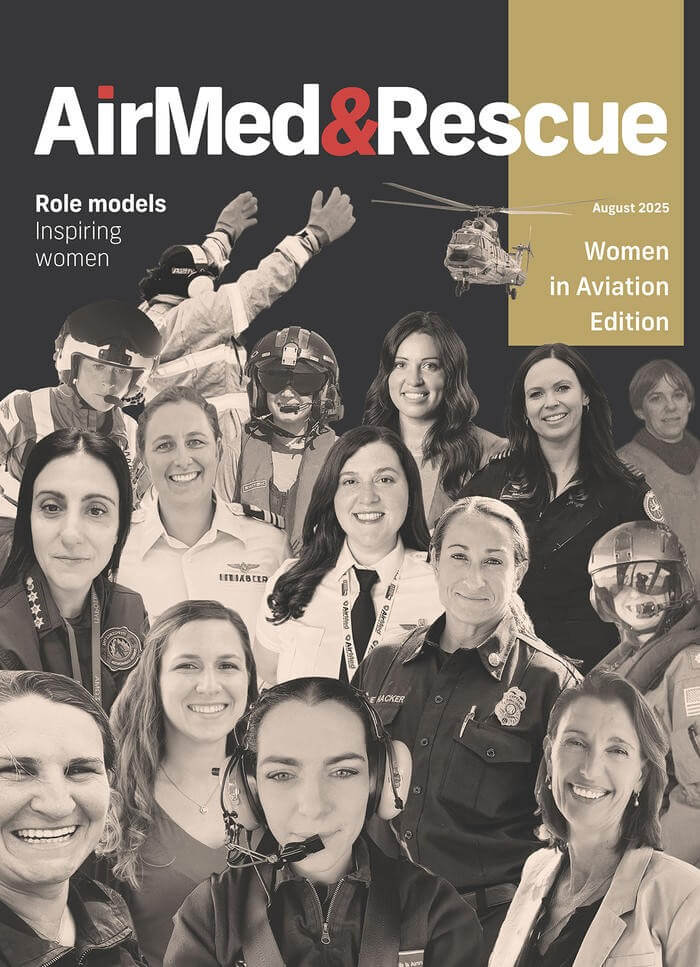
August 2025
Issue
Our August magazine is the inaugural women in aviation edition, highlighting and showcasing female voices from the airborne special missions sector. We have features on blood products used in emergency medical services, challenging hoist rescues, pregnancy while flying, and portable water sources for firefighting. We also have interviews, a gallery, an industry voice, a news analysis piece, and a provider profile, as well as a review of the Paris Air Show.
Jennifer Ferrero
Jennifer Ferrero owns Ferrero Agency. She focuses her writing on feature stories for aerospace and manufacturing trade publications. She also provides marketing and public relations services. She has been an entrepreneur and writer for over 25 years. She lives in Spokane, Washington.