
Interview: Striving for clinical excellence

Dr Ulrich Carshagen, Lead Flight Physician at Air Rescue Africa, tells Mandy Langfield why it was always a dream for him to work for the air ambulance provider and help lead the way in the standard of care deliverable in Africa
What’s your background in emergency services, and what drew you to working for Air Rescue?
I’ve always had a very keen interest in the field of pre-hospital and retrieval medicine, and initially started doing part-time work for a helicopter emergency medical services (HEMS) operator in South Africa. My involvement grew to the point where I was appointed as the Chief Medical Officer of the service. In the meantime, I also started working as a flight physician for Air Rescue Africa. In 2022 I was appointed as the medical lead for the service in Africa.
It has long been a dream of mine to work for Air Rescue because of the exceptionally well-functioning system that has been built up through the years since its inception in 2000. There has always been a strong desire to stay at the forefront of what is possible when it comes to the aeromedical transport of patients.
Where are you based, and what is your area of operations?
I am based with Air Rescue Africa in Johannesburg. We operate across the entire African continent and the surrounding islands. Occasionally we would also do intercontinental work to Europe, the Middle East, and Asia.
What fleet does Air Rescue operate, and what do the choices of aircraft signify in terms of the operational and logistical challenges of where you fly?
We currently operate Hawker 800A and Hawker 800XP aircraft. The ideal medical configuration, range, landing requirements, cost, and availability in the market are some of the factors that ultimately influence this decision, and as we know there aren’t any perfect options. In Africa, we need reliable aircraft with sufficient range to cover the large geographical area. We are, however, always looking for opportunities to expand on the variety in our fleet to further increase our capability and we have some very exciting prospects for the future.
How do you ensure that the standard of care on board your aircraft is as high as possible? What training do your medical team take? Do you make use of medical simulators/manikins?
Ensuring we provide only the best standard of clinical care in our service is one of the things I am extremely passionate about. Transfer of critically ill patients over long distances poses many challenges and inevitably remains a high-risk intervention. It is therefore non-negotiable that we strive for clinical excellence in everything we do to ensure patient safety. We believe that a robust clinical governance system covering all medical aspects of the operation is key to achieving this.
Ensuring we provide only the best standard of clinical care in our service is one of the things I am extremely passionate about
Specifically about our medical team, it all starts with recruiting the right individual with the appropriate skill set and qualifications. A thorough induction program follows, which includes a detailed base training and a minimum amount of observer flights. Medical crew are expected to continue work outside of the air ambulance in an appropriate emergency / critical care setting and they are expected to keep a logbook of certain clinical cases and interventions. Each team member has a clinical portfolio assigned to them and they are responsible for providing regular updates with relevant resources about the specific topic, ensuring all we do on the air ambulance is in keeping with the latest evidence. Weekly debriefing sessions provide the team with the opportunity to learn from complicated cases. During our monthly morbidity and mortality meetings, details are provided about the outcomes of all our cases, and an interesting case or relevant academic topic is presented.
Training and simulation take place on a dedicated training day once a month and this includes a wide range of clinical scenarios, procedures, interventions, equipment applications, etc. We have found that these days do not only improve clinical performance and teamwork but also contribute towards the medical team’s sense of belonging and fostering of a high-performance culture in the organization. Outside of our continuous medical education program, as mentioned, our team is also expected to stay current in several relevant emergency and critical care short courses, which are all funded by the organization.

What medical kit is carried on board as standard, and what additional kit do you have access to should you need it for a particular patient?
Due to the environment we operate in, we often do not have updated or reliable medical reports at the time the mission is dispatched. Hence, as a standard, we have a wide range of kit that we take with us on every flight. Basically, it comes down to everything you would need to transfer a critically ill patient on a ventilator. We also carry a backup multiparameter monitor, ventilator, and suction on each flight.
We have certain patient profiles that we take additional equipment and disposables for: orthopedic, severe burns, advanced pregnancy, etc., being some examples.
What, for you, is the most valuable piece of medical equipment you carry on board, and why?
Our handheld ultrasound device. Point-of-care ultrasound has become synonymous with emergency medicine and critical care over the past few years, and adds an enormous amount of value in our setting, both diagnostically and for procedures.
Point-of-care ultrasound has become synonymous with emergency medicine and critical care over the past few years, and adds an enormous amount of value in our setting, both diagnostically and for procedures
How important is it for air medical professionals to work with people from different countries and learn from each other regularly? What do you personally get out of international training exchanges?
I find working with people in different settings one of the key aspects of improving your own system. One must continuously look at what other services are doing and try and adapt what is working well to your own setting. I have very strong relations with many services in the UK and have built many valuable relationships through my involvement with the Diploma in Retrieval and Transfer Medicine that is run by the Royal College of Surgeons of Edinburgh.
What do you enjoy most about your role with Air Rescue?
As mentioned already, we all have the common goal of providing excellent and safe patient care and that serves as motivation to excel in everything we do. The unpredictable and challenging nature of the work we do in Africa is also something I really enjoy.
You also work in the emergency department of a hospital, and are the Chief Clinical Officer for ER Consulting Inc., where your focus is on developing skills in retrieval and pre-hospital medicine. How does each of these demanding roles interplay with each other?
The different hats I wear daily actually complement each other well. The golden thread through it all is to continually improve the standard of care we can provide in the transport of critically ill patients. My main focus is on systems development and that includes investing time into people to make sure we have clinicians with the right skill set and knowledge. The work in the emergency department helps with keeping my clinical skills sharp and feeds back into the pre-hospital and retrieval work I do.
My main focus is on systems development and that includes investing time into people to make sure we have clinicians with the right skill set and knowledge
What are your hopes for the future of air rescue and air medical services in Africa?
My hope for Air Rescue Africa is that we will continue leading the way when it comes to the standard of care deliverable in Africa. We want to deliver a world-class service that is focused on patient safety through the application of evidence-based medicine in the aeromedical environment.
For the rest of the continent, I hope that we can continue developing the field of pre-hospital and retrieval medicine to collectively improve the safety of patients being transported across Africa.
March 2025
Issue
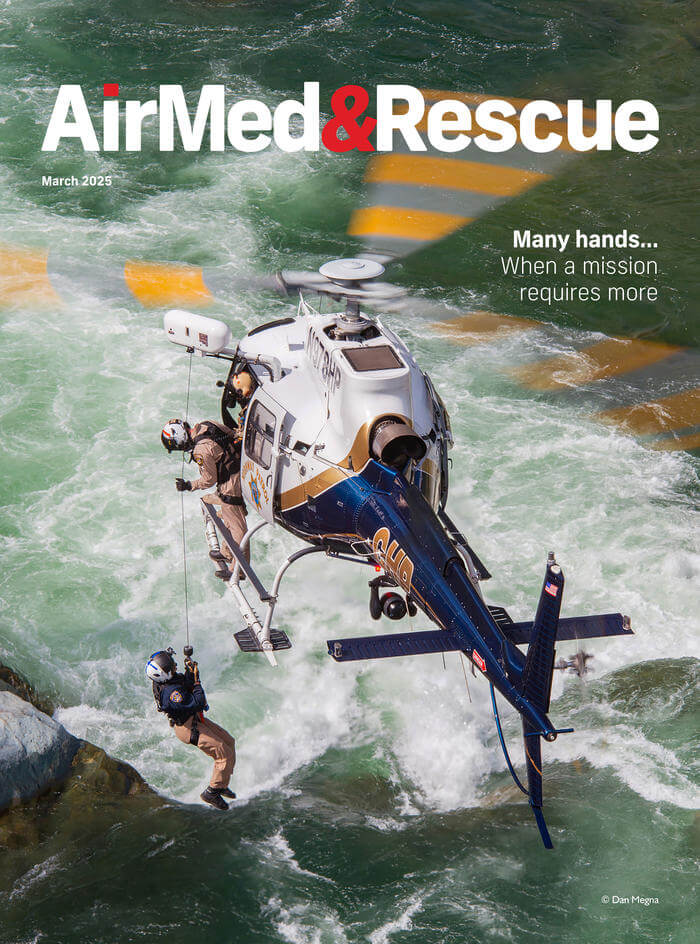
Our March edition has features that let you discover the level of training provided by simulators; learn the ins and outs of medical interiors in aircraft; find out about how health and usage monitoring systems are changing special missions; and see how aerial firefighters communicate and coordinate their missions across multiple agencies and stakeholders; plus more of our regular content.
Mandy Langfield
Mandy Langfield is a Director of Palladium Media Partners and former Publishing Director at Voyageur Group. She has written extensively on international travel and health insurance, medical assistance provision, and air medical transportation. She was Editor of AirMed&Rescue from December 2017 until April 2021. Her favourite helicopter is the Chinook, having grown up near an RAF training ground.