
Preparing for neonatal patient transports

Transporting a newborn baby is fraught with risks. The AirMed&Rescue team find out how operators prepare for and mitigate the hazards involved
Neonatal air medical transport represents one of the most technically demanding sectors of air medical services, requiring the integration of sophisticated clinical care with complex aviation operations. The transport of critically ill newborns across significant distances involves challenges that extend beyond standard patient transfer protocols, encompassing specialized equipment requirements, altitude physiology considerations, and the management of conditions that can rapidly deteriorate in flight.
Geographic factors play a decisive role in operational planning, particularly in countries with continental dimensions, remote populations, and concentrated distribution of neonatal intensive care capabilities. The uneven availability of tertiary-level neonatal facilities creates transport corridors that may span hundreds or thousands of kilometers, often crossing varied terrain and climate zones that influence aircraft selection and mission execution. These operations demand careful attention to the physiological vulnerabilities of neonatal patients, the technical specifications of transport equipment, and the training requirements for medical crews operating in the aviation environment.
It is important to examine the operational framework for long-distance neonatal air medical transport, analyzing the clinical, technical, and logistical considerations that shape mission planning, aircraft platform selection, equipment configuration, crew composition, and risk management protocols in remote and geographically challenging environments.

Remote transport challenges
According to Dr Carly Roxburgh and Dr Fergus Gardiner in a 2021 publication entitled ‘Royal Flying Doctor Service optimising maternal outcomes for rural Australians’, a large proportion of women reside in rural and remote Australia, and while early transfer is preferable, these women can still experience sudden complications and require emergency transfer. “Management depends upon the capacity of the maternity unit to manage the preterm neonate. Tocolysis is employed to delay labor to facilitate transfer. In almost all cases, intrauterine transfer is preferable to transferring a preterm neonate,” they said.
In addition, rural and remote areas have higher rates of socioeconomic disadvantage, poverty with reduced access to services, lower educational attainment, and poorer health, with these disparities increasing with remoteness, Drs Roxburgh and Gardiner observed.
When intrauterine transfer is not possible or a premature infant is born in a facility lacking appropriate neonatal care capacity, the focus shifts from maternal transport to the complex logistics of moving critically ill newborns, a challenge that requires sophisticated medical aviation capabilities.
Brasil Vida performs a full range of interfacility and long-distance neonatal transfers, including the transport of premature and extremely premature infants requiring specialized incubators; newborns with respiratory distress requiring non-invasive or invasive ventilation, such as congenital heart, neurological, surgical, metabolic, or infectious diseases; and postoperative newborns requiring intensive care unit (ICU)-level monitoring, affirmed Dr Luana Moura Batista, Chief Medical Officer at Brasil Vida Táxi Aéreo.
“We also transport critically ill newborns requiring vasoactive support, continuous infusion therapy, or advanced airway management,” she said. “Brazil’s geography profoundly influences mission planning and platform selection. The country’s continental size, uneven distribution of neonatal intensive care units (NICU), and vast remote regions such as the Amazon, the central plateau, and coastal hinterland generate missions ranging from short metropolitan transfers to long-haul international flights.
Brazil’s geography profoundly influences mission planning and platform selection. The country’s continental size, uneven distribution of neonatal intensive care units (NICU), and vast remote regions such as the Amazon, the central plateau, and coastal hinterland generate missions ranging from short metropolitan transfers to long-haul international flights
“The main environmental factors include very long distances, which often exceed the limits of helicopter operations; the variability of the tropical climate, with storms and convective weather conditions that require robust flight planning; [and] the heterogeneity of the territory, which affects airport accessibility and even population distribution, with highly complex neonatal centers concentrated in just a few states. For these reasons, fixed-wing aircraft are the primary platform for neonatal transport, offering cabin stability, reduced vibration, pressurization control, greater range, and optimal integration of neonatal incubator systems.”
Aircraft and equipment selection
Brasil Vida determines aircraft platform selection by the distance and expected duration of the mission; the need for pressurized cabins, essential for newborns with air-leak syndromes or pulmonary hypertension; aircraft cabin size and compatibility with neonatal incubators; weather and terrain conditions; airport accessibility; crew rest and duty time considerations for long-duration missions; operational safety standards; and Anac (the national civil aviation agency) certification requirements.
“All aircraft used for medical transport are equipped with certified aeromedical kits with standardized medical modules, structural attachment points, aircraft power outlets, internal backup electrical systems, and medical oxygen systems compatible with ventilators and neonatal incubators,” said Dr Moura Batista.
The neonatal transport systems used by Brasil Vida include the FANEM IT 158 TS servo-controlled neonatal transport incubator, OxyMag neonatal/pediatric/adult ventilator, Instramed multiparameter monitors with cardioverter-defibrillator and pacemaker capabilities, capnograph for continuous CO2 monitoring, Fresenius Agilia Volumat infusion pumps for precise micro-infusions, medical suction and humidifiers, and complete airway kits (laryngeal masks, orotracheal tubes of various sizes, tracheostomy tubes). “We also equip our aircraft with an acrylic pediatric transport bassinet, an intravenous access kit with micro-infusion capabilities, portable medical oxygen cylinders, trauma and immobilization equipment, and a complete drug inventory in accordance with Ordinance 2048/2002 of the Brazilian Ministry of Health,” stated Dr Moura Batista.
Selection criteria include reliability and resistance to vibration and acceleration forces, battery life and redundant power supply capability, compatibility with aircraft electrical systems, weight and size suited to aircraft cabin constraints, neonatal-specific monitoring ranges and alarm systems, ease of attachment to certified aircraft mounts, and compliance with Brazilian Anac and international air medical standards, according to Dr Moura Batista.
We operate under rigorous infection control policies with documented cleaning, disinfection, and sterilization protocols, comprehensive equipment maintenance programs, and detailed post-mission inspection procedures
“The equipment is installed on certified Spectrum Aeromed aeromedical stretchers, specific models for each aircraft type, with mechanical attachment systems approved through Anac supplemental type certificates (STC),” she said. “Redundancy measures include dual power supplies (aircraft electrical system and internal backup battery), backup ventilation capability (manual resuscitation bags), multiple infusion pumps for the administration of critical medications, pre-flight checklists for neonatal equipment, standardized reserve of critical medications and medical oxygen, and electrical isolation systems to protect patients during defibrillation procedures. We operate under rigorous infection control policies with documented cleaning, disinfection, and sterilization protocols, comprehensive equipment maintenance programs, and detailed post-mission inspection procedures.”

Team composition and training
Brasil Vida employs specialized neonatal air medical teams whose composition varies based on clinical complexity. “Our standard neonatal team consists of a physician specializing in intensive care, anesthesia, general surgery, or emergency medicine, a flight nurse specializing in intensive care/emergency medicine, and an additional respiratory therapist, if clinically indicated,” said Dr Moura Batista. “The minimum requirements for physicians are a medical degree with membership in the Regional Medical Council; a certified specialty in intensive care, anesthesia, general surgery, or emergency medicine; a minimum of two years of professional experience; [and] completion of a specific company aeromedical training program; while Advanced Trauma Life Support (ATLS), Advanced Cardiovascular Life Support (ACLS), and Paediatric Advanced Life Support (PALS) certifications are recommended.”
For flight nurses, the minimum requirements are a bachelor’s degree in nursing with registration in COREN, a specialty certification in aerospace nursing; a minimum of four years’ experience in intensive care/emergency care; a minimum of two years’ experience in intensive care and/or emergency care or trauma units; and completion of a specific company air medical training program, with Basic Life Support (BLS), ACLS, and PALS certifications being recommended, explained Dr Moura Batista. “All medical personnel must also have training in aeronautics medicine and aerospace physiology, annual competency recertification, criminal background checks, data protection training, and proficiency in English,” she added.
All medical personnel must also have training in aeronautics medicine and aerospace physiology, annual competency recertification, criminal background checks, data protection training, and proficiency in English
The initial (42-hour) training program includes a four-hour course covering air medical technical knowledge, including crew resource management (CRM) specific to air medical operations, operational procedures for air ambulance missions, patient assessment and care during all phases of flight, biosafety protocols, and equipment familiarization, said Dr Moura Batista. “Aerospace medicine is a two-hour course covering the history and development of aeromedical transport, the role of flight physicians and nurses, atmospheric composition and respiratory physiology, recognition and management of hypoxia, dysbarism (effects of gas expansion), acceleration forces and vibration effects, noise management, circadian rhythm disruption, and exposure to toxic gases,” she explained.
Eighteen or 19 hours of the initial training are committed to clinical protocols, including neonatal, pediatric, and adult patient preparation, cardiovascular emergencies and cardiac patient transport, respiratory emergencies and pulmonary disease patients, stated Dr Moura Batista. “Clinical protocols also cover trauma and multiple trauma patients; burn management; obstetric emergencies; high-risk neonatal transport, such as prematurity, respiratory distress, congenital conditions; psychiatric patients and restraint techniques; infectious disease control and isolation procedures; and post-transport care protocols,” she added. “A 14-hour aviation safety program includes aircraft familiarization and safety procedures, emergency evacuation procedures, fire suppression and smoke control, survival techniques, flight crew communication protocols, equipment securing, and weight/balance considerations and safety during approach and departure around the aircraft. Finally, a four-hour hands-on training includes patient loading/unloading procedures, emergency evacuation drills, fire extinguisher use, and emergency exit procedures.”
Recurrent annual training lasts 31 hours and reinforces essential skills with a focus on emergency procedures, equipment updates, and clinical protocol reviews, explained Dr Moura Batista. “We also maintain ongoing clinical education through case reviews, simulation-based training, and regular updates on neonatal care protocols,” she said.
Risk management
Brasil Vida’s neonatal transport protocols incorporate a comprehensive risk assessment. “Key mission variables include a pre-flight assessment, including flight distance and fuel planning with alternate airports; cabin pressurization requirements based on neonatal pathology; weather forecast analysis and turbulence probability; international border-crossing requirements and documentation; confirmation of NICU bed space at the receiving facility; calculation of medical equipment battery life; oxygen consumption modelling for the duration of the mission; and compliance with crew duty time and fatigue management,” according to Dr Moura Batista. “Clinical risk factors include respiratory conditions, such as the risk of pneumothorax requiring chest tube placement before flight, and air-leak syndromes requiring altitude restrictions; cardiovascular conditions, such as congenital heart disease, and pulmonary hypertension requiring careful oxygen management; neurological conditions, such as intracranial pressure considerations, and seizure management; metabolic conditions, such as temperature regulation (critical in neonates), and glucose management; and infectious conditions, such as isolation procedures for contagious conditions.”
Altitude-sensitive conditions are subject to special protocols. For example, pneumothorax requires mandatory chest drainage with an underwater drainage system before flight, gas-containing injuries require flight altitude restrictions to minimize gas expansion (Boyle’s Law effects), and serious cardiopulmonary conditions require supplemental oxygen with careful monitoring, explained Dr Moura Batista. “Operational protocols include a pre-departure medical briefing between the physician and flight crew, continuous monitoring of vital signs throughout all phases of flight, communication procedures for in-flight medical emergencies, altitude restrictions based on the patient’s condition, procedures for worsening medical conditions in-flight, and post-flight patient handover protocols with complete documentation,” she said. “Temperature maintenance is crucial. Our protocols cover cabin temperature control, servo regulation of the incubator, and the use of thermal blankets.”
A balancing act
The effective execution of neonatal air medical transport in remote and geographically challenging regions requires the systematic integration of clinical expertise and aviation capabilities. Distance, terrain, climate variability, and the concentration of specialized neonatal facilities in limited geographic areas create operational parameters that influence every aspect of mission planning and execution. Aircraft selection must balance range requirements with cabin environment control, while equipment configurations must address the dual imperatives of clinical functionality and aviation compatibility. The physiological vulnerabilities of neonatal patients, particularly their sensitivity to altitude-related gas expansion, temperature fluctuations, and vibration, demand both technical safeguards and clinical vigilance throughout all phases of transport.
Training programs that integrate air medical knowledge with neonatal clinical protocols provide the foundation for safe operations, while risk assessment frameworks that account for both aviation variables and patient-specific factors enable informed decision-making under time-critical conditions. Equipment redundancy, power supply backup systems, and pre-flight verification procedures serve as essential safety layers in an operational environment where equipment failure can have immediate clinical consequences.
References
Roxburgh C, Gardiner F. Royal Flying Doctor Service optimising maternal outcomes for rural Australians. O&G Magazine 2021;23(1).
April 2026
Issue
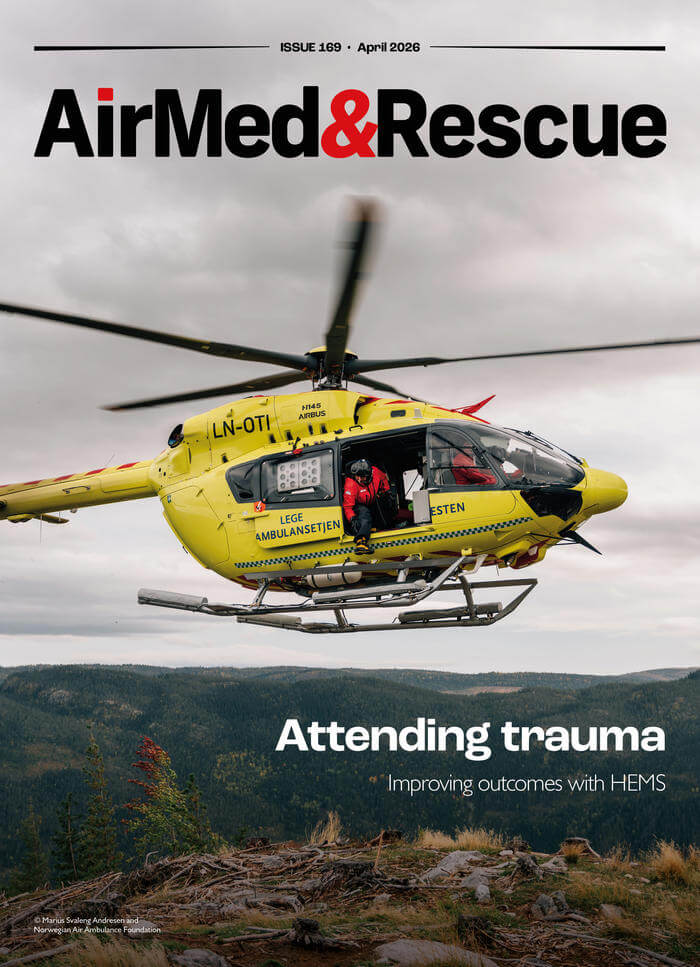
Launching into spring, we have another great edition covering the world of airborne special missions. We have features on the European approach to aerial firefighting; how maintenance, repair, and overhaul companies are still managing the complex supply chain environment; neonatal transfers in regions that are not conducive to easy ground transport; and how helicopter emergency medical services deal with attending to traumatic accidents and injuries.
Editorial Team
The AirMed&Rescue Editorial Team works on the website to ensure timely and relevant news is online every day. With extensive experience and in-depth knowledge of the air medical and air rescue industries, the team is ready to respond to breaking industry news and investigate topics of interest to our readers.