
Safely transporting neonatal and pediatric patients with RSV

Transporting small and vulnerable patients with respiratory syncytial virus requires expertise, precision and rigorous infection prevention measures. Experts share with Lauren Haigh how they navigate the complexities of neonatal and pediatric transport for these patients
When the smallest and most fragile patients require urgent transport, specialist skills, equipment and protocols are required for safe and efficient transfer. The challenges inherent in transporting neonatal and pediatric patients are further heightened when these patients have respiratory syncytial virus (RSV) due to the risk of rapid deterioration and the highly contagious nature of the virus. RSV is a leading cause of hospitalization for babies and young children on a global scale. Frequent complications are bronchitis, pneumonia and even respiratory failure. The safe transport of neonates and pediatric patients with RSV relies on specialist equipment, expert knowledge and robust infection control measures.

Seasonal surges
RSV cases surge seasonally, placing annual pressure on hospitals and air medical teams. According to South Africa’s National Institute for Communicable Diseases, the 2025 RSV season began around four weeks later than the average, starting in March. Healthcare professionals have linked this to the Covid-19 pandemic and related restrictions, which disrupted the usual circulation patterns.
In 2022, Air Methods reported a surge in pediatric RSV cases and air medical transfers, highlighting a 4% increase in pediatric patients compared with 2021, and anticipated a rise to 10% by the end of 2022. A 2022 research study published in The Journal of Infectious Diseases confirmed that RSV was a leading cause of hospitalization in children aged five and under, with the highest proportion of hospitalizations occurring in patients aged naught to six months.
While RSV cases have been high worldwide, demand for the transport of neonatal and pediatric patients varies according to region and provider. For example, AirMed&Rescue spoke with Jonathan Lee, Critical Care Paramedic at Ornge, who said that 888 patients under the age of one were transported by the Canadian provider in 2022–23 due to respiratory distress, bronchiolitis or other respiratory issues. This decreased to 700 in 2023–24 and decreased again to 645 in 2024–25. “The true number may be higher given how diagnoses are recorded,” Lee stated.
In Austria, Tyrol Air Ambulance reported that RSV cases account for less than 1% of their annual transports. “There are very few cases per year,” Dr Eva Wurz, Chief Medical Officer, confirmed.
Looking into logistics
Geography can impact the logistics of neonatal RSV transport, influencing platform choice and flight protocols. Ornge operates across 1 million km2, with some regions only accessible by air. The distances involved, which are comparable to the combined land mass of France, Spain and the Netherlands, direct platform selection and present additional challenges. “Limited aviation infrastructure in some northern communities, combined with harsh winter weather, complicates response times,” highlighted Lee. “And RSV peaks coincide with the worst of our Canadian winter.”
Limited aviation infrastructure in some northern communities, combined with harsh winter weather, complicates response times and RSV peaks coincide with the worst of our Canadian winter
Dr Wurz noted that there were environmental challenges encountered by Tyrol Air Ambulance, but that these were mitigated through training. “Only heavy fog can occasionally impact our flight operations at our Innsbruck base. However, takeoff is always possible,” she underlined.
Inside the aircraft
Another element linked to the safe transfer of pediatric RSV patients is aircraft type, with requirements including sufficient space and the right layout to limit infection exposure. Tyrol Air Ambulance uses the Gulfstream 100 for infectious transport. “It offers more space and a closed cockpit, protecting the flight crew from potential exposure,” Dr Wurz commented. “Our medical crews wear FFP2 masks and we deploy isolation chambers or incubators as needed.”
Ornge’s fleet is standardized, as Lee explained: “Our fleet of land ambulances, AW139 and PC-12 are all capable of transporting patients over 3kg without an incubator while providing mechanical ventilation, invasive monitoring, and the complete range of critical care medications.”

Exploring equipment
Specialized equipment is also required to transport neonates with RSV. This includes ventilation systems that provide oxygenation and respiratory support. These must be combined with effective protocols. For example, a 2020 study in the Air Medical Journal developed and evaluated the use of a checklist to improve the ventilator management of pediatric patients for air medical transport. It was developed using recommended guidelines, and teams that used it reported significant improvements in pediatric ventilator management, benefiting patients and air medical teams alike.
Another research project, also published in the Air Medical Journal, explored whether the implementation of a respiratory protocol emphasizing the use of bubble continuous positive airway pressure (bCPAP) during interhospital transfers could reduce mechanical ventilation without compromising safety. The study found that following the rollout of the protocol, fewer infants required mechanical ventilation during transport, with a greater number safely managed with bCPAP. This suggests that neonates and pediatric patients with RSV could also avoid invasive ventilation.
Lee said that both invasive and non-invasive ventilation are utilized by the Ornge team. “HAMILTON-T1 ventilators are used throughout our system for invasive, non-invasive, and high-flow nasal cannula oxygenation. We are currently transitioning to a provincial-standard transport incubator, with the goal of having both Ornge and all of the hospital-based ped/neo transport teams on a standardized deck,” he stated. “The deck will be modular to be able to meet the individual needs of the user, while using standard weights and securing systems to improve our ability to move them in any of our assets.”
The deck will be modular to be able to meet the individual needs of the user, while using standard weights and securing systems to improve our ability to move them in any of our assets
Dr Wurz listed Tyrol Air Ambulance’s neonatal transport equipment. “We have a BabyPod incubator available, and we use Oxylog 3000 ventilators and a closed suction unit,” she revealed. “The isolation chambers were purchased from Air Ambulance Technology in Austria and adapted for our aircraft.”
Post-pandemic protocols
The Covid-19 pandemic underscored the need for flawless infection mitigation protocols and specialized equipment to minimize exposure. “We have an isolation chamber and a special bag for personal protection care,” said Dr Wurz. “We also have point-of-care (POC) Covid tests and are able to perform rapid PCR tests.”
For Ornge, a significant change since the pandemic is enhanced competence in managing proned patients. “Our comfort and capacity to manage proned patients in transport has improved,” highlighted Lee. “Processes and protocols around extracorporeal membrane oxygenation (ECMO) cannulation and retrieval also evolved during Covid. As a system, we do not use nitric oxide, so Covid prompted the introduction of pulmonary vasodilatory drugs such as epoprostenol (using the Aerogen as a delivery device) to our pharmacy.”
Lessons learned during the pandemic continue to inform equipment and protocols for RSV patients. By combining historical knowledge gleaned from SARS with practical findings from Covid, providers can proactively handle the transport of pediatric RSV patients. “Having a significant organizational memory from the SARS outbreak, our system has continued to improve our infection control standards,” Lee stated. “During Covid, we functionally evaluated the ability of our respiratory support to generate aerosol particles while in the aircraft. This type of organizational specific information is combined with best practice to inform our infection control standards.”
By combining historical knowledge gleaned from SARS with practical findings from Covid, providers can proactively handle the transport of pediatric RSV patients
Prepared for the unexpected
Training has also evolved since the pandemic, with a heightened focus on infection prevention standards and the ability to respond to seasonal surges of RSV. At Tyrol Air Ambulance, annual training ensures that crews remain up to date and knowledgeable about current protocols. “Every medcrew member has to do annual training, which also includes special cases like doing infectious transports, as well as evacuation training,” said Dr Wurz.
For Ornge, training has evolved in response both to the pandemic and to geographical challenges. “Geography provides challenges for training,” said Lee. “Since Covid, our system has added a Clinical Practice Lead to each base whose role is to provide base-level education. This provides a mechanism for the just-in-time approach to training that allows a great deal of flexibility to react to specific challenges such as an outbreak.” This training approach ensures that training is up to date and crewmembers are prepared to safely and effectively manage complex infectious respiratory cases.
Unpredictability in the form of the unprecedented Covid-19 pandemic and extreme weather, as well as infrastructure limitations, underscore the need for continual adaptation and learning. The safe transport of neonatal and pediatric patients requires meticulous infection control protocols, careful planning, specialized equipment, and highly trained, adaptable and vigilant crews. These factors combine to ensure the smallest and most vulnerable patients receive the highest standard of care.
October 2025
Issue
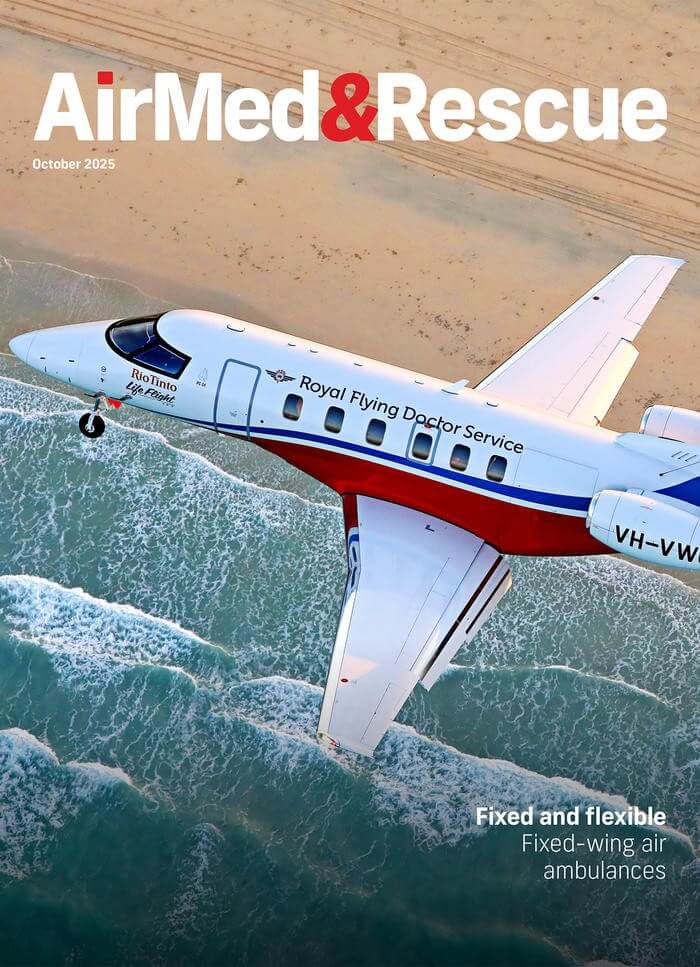
In our October edition, we bring you news, features and more showcasing special missions from around the world. We have features that focus on the fixed-wing air ambulance platforms that are enhancing air medical operations; the care and considerations when transporting children with infectious diseases at risk of deterioration; the law enforcement agencies that use aircraft to find and track persons of interest; and the challenges of treating patients with hyper- and hypothermia.
Lauren Haigh
Lauren has worked in the publishing industry for eight years and reads and writes about healthcare, science and travel insurance on a daily basis. Her favourite aircraft is the plane from the title sequence of British educational children’s TV series Come Outside.