

Protecting the protectors

Chris Croot finds out the dangers of working in aerial law enforcement, and what the police aviators are doing to diminish the threats to operations
Police aviation units deliver valuable services across the globe. Whether it be traditional vehicle/suspect pursuits, searching for missing people, intelligence gathering, event control, or search and rescue (SAR), crews utilize the capabilities of their aircraft to the best of their abilities.
However, not all are so happy to see police aircraft overhead and have occasionally resorted to nefarious means to deter crews. High-power lasers, easily purchased online, have the potential to cause lasting retinal nerve damage. Small arms fire is capable of striking and theoretically downing aircraft. Finally, drone strikes, whether deliberate or accidental, pose a substantial risk to life in the event of a collision. AirMed&Rescue rounds up some of the equipment designed to detect/prevent the aforementioned and keep crews safe.
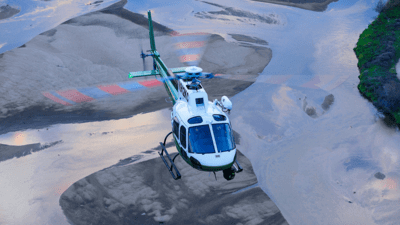
Laser protection
Handheld lasers pose a risk to all air traffic, with numerous incidents of aircraft being targeted by members of the public. Not all strikes are malicious, but all carry the threat of eye damage should the laser be fired at an angle whereby it passes through the aircraft’s windows. Although the number of laser strikes reported in the USA has fallen for the past two years in a row, the number of incidents in 2025 was more than 60% higher than in 2020 (10,995 versus 6,852). In 2023, there were a remarkable 13,304 reported strikes, according to the Federal Aviation Administration (FAA).
One of the most common forms of protection is simple glasses designed to be worn under flight crew helmets and headsets. There are numerous models available commercially, the majority of which work by filtering out green light (the FAA states the majority of laser strikes are using green lasers; red laser events are rare) before it can reach the wearer’s eye.
As a result of this green filtering, any remaining light is more dominant – a green light may appear more blue or more yellow, while a white light may appear more yellow or red. These perceived changes can be compared to those with mild color vision deficiencies, generating results similar to those displayed in Ishahara test plates.
The Human Systems Division at the United States Air Force’s (USAF’s) Air Force Life Cycle Management Center (AFLCMC/ROU) is devising a next generation of protective technology. Kevin Frost, Operation and Support Mechanical Engineer, and Eric Miltner, Operations and Support Equipment Specialist, are responsible for developing the new equipment.
The AFLCMC/ROU’s new eyewear, which it is calling Block 3, consists of six modular devices that are each worn under specific takeoff and landing conditions. Separate day/night and ballistic spectacles and visors offering peripheral protection while wearing night vision goggles are included.
The equipment features a dye that filters a wider range of light wavelengths, and new night spectacles that allow more natural light through the lens, increasing visibility for aircrews
The equipment features a dye that filters a wider range of light wavelengths, and new night spectacles that allow more natural light through the lens, increasing visibility for aircrews. AFLCMC/ROU intends to field more than 45,000 units to the USAF by 2029.
Sentinel Photonics is a British company that designs and develops laser sensing equipment for the military and civilian markets. Its Laser Signal and Event Recording Device (LASERD) family of products range from compact wearable devices for individual operators or law enforcement officers, through to devices with vehicular and airborne possibilities.
Although primarily serving the defense sector, the product does have an application for the security/law enforcement market. The system uses cameras to capture the spatial and spectral signature of a laser, differentiating it from traditional photodiodes (a semiconductor that converts light to electrical energy), which look for rapid temporal flashes. This can lead to such a detection system failing to detect continuous-wave lasers or generating false alarms.
The system uses cameras to capture the spatial and spectral signature of a laser, differentiating it from traditional photodiodes (a semiconductor that converts light to electrical energy), which look for rapid temporal flashes
LASERD analysis detects lasers in real time and is able to provide users, such as aircrew, with a threat evaluation. The system can differentiate between a civilian pointer, which may have been accidentally waved across the aircraft (it is worth noting lasers have credible civil applications, such as astronomy), and high-power tools being consistently aimed at the aircraft. LASERD will catalogue detected lasers aiding law enforcement interdiction.
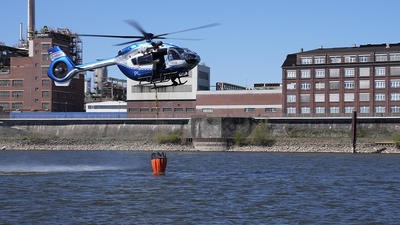
Small arms
Although the risk is relatively low, slow and low-flying police aircraft are at risk of accurate small arms fire. In regions where weapons of varying calibers are readily available, such as the USA, this risk is, of course, higher.
Companies such as Mehler Systems, LifePort, and Integris Composites have developed modular ballistic protection systems applicable to a range of aircraft. While primarily targeted at military customers, there is a civil application. Integris Composites has designed and produced a package for the Airbus Helicopters H125, a popular law enforcement platform.
LifePort offers ballistic protection packages for a number of rotary platforms that are commonly used by law enforcement: Bell 407, 214, 412 and 429, Sikorsky UH-60/S-70 and MD Helicopters 530. Products are available ‘off the shelf’ or can be customized to suit a specific mission set. The panels fit around aircraft controls, under crew seats, on doors, and within cabins, and are designed to be removable when not required.
Ready-to-fit solutions are National Institute of Justice (NIJ) Level IIIA, III, and IV standard, designed to stop high-power handgun rounds, 7.62mm, and .30 armor piercing rounds, respectively. The armored panels are designed to be repairable in the event they sustain damage.
While LifePort does not publicly disclose the fine details of how it constructs its ballistic protection, it is likely made of layers of composite materials made of high-performance polyethylene (HPPE). The layers are designed to shatter or deform the incoming round, dissipate its energy, and catch any armor-piercing portions of the round, preventing them from entering the cabin. A protective coating, LifeGard, improves durability.
However, adding armor to aircraft incurs a weight penalty. Any armor would be carried at the expense of fuel, equipment, and/or crew. Even the latest add-on composite armor packages applied to military aircraft have a not insignificant weight.
Any armor would be carried at the expense of fuel, equipment, and/or crew. Even the latest add-on composite armor packages applied to military aircraft have a not insignificant weight
It is, therefore, not commonplace for police aircraft to carry ballistic armor. Aircraft systems, such as fuel and hydraulic lines, may be protected through manufacturer design if that platform has a military version. For crews, their primary lines of defense are height, speed, and distance from any threat. Some operators may choose to equip their crews with body armor while conducting high-risk operations.

Drone protection
Once the reserve of militaries, uncrewed aerial systems (UASs), or drones, are now relatively affordable to the general population. Whether flown maliciously by hostile actors or innocently by the public, they pose a significant threat to air traffic irrespective of their size.
As police aircraft tend to operate at lower altitudes, crews must be vigilant against collisions. In April 2025, a UK National Police Air Service (NPAS) Airbus H135 was forced to withdraw from a tasking after a near miss with a drone. The helicopter was responding to reports of drone activity over Royal Air Force (RAF) Lakenheath, a USAF-operated base in Suffolk. Such incidents highlight the challenges of visually identifying drones, especially during night operations.
Davenport Aviation has developed the Airborne Counter Unmanned Aircraft System (ACUS), designed to improve aircrew safety and situational awareness. ACUS uses Skyview MPV3 radio frequency (RF) detection to provide 360-degree coverage to airborne aircraft. When the system detects a UAS, a warning is issued to the crew and displayed on the Shotover augmented reality system (ARS) integrated into the mission system display.
When the system detects a UAS, a warning is issued to the crew and displayed on the Shotover augmented reality system (ARS) integrated into the mission system display
The information is displayed via dropdown menus and includes data from the SkyView MPV3’s RF Signature Library to provide the UAS’s make/model and serial number, the latitude/longitude of both the system and the pilot, and altitude after RF signal demodulation. It will also show crews their distance from the UAS and its speed. Within the menus are the options to slew the aircraft’s electro-optical and infra-red (EO/IR) camera system to either the drone or pilot for visual identification. This information, combined with the Shotover mapping, could allow crews to coordinate ground-based law enforcement to intercept the UAS operator. The system is purely for detection and identification; it cannot intercept or jam UASs.
In July 2025, the Texas Department of Public Safety’s (DPS) Aircraft Operations Division became the first public service organization to equip its aircraft with ACUS. The unit equipped one of its Airbus H125 aircraft with the system, becoming fully operational that August. Although the system could be used to guide officers to UAS pilots, the Texas DPS has stated that it will not be doing so, instead utilizing ACUS solely as a detection and situational awareness tool.
Ground-based counter-UAS (C-UAS) is a popular solution to tackling the problem of drones, albeit it requires a ground team to be either in position or rapidly deployable. DroneShield offers dismounted, on-the-move, and fixed-site C-UAS systems, supported by dedicated software. The products can be combined to form a layer defense network.
“AI-enabled drone detection is now a must-have capability for police aviation. It gives crews real-time awareness of low-altitude threats, enabling rapid identification and safe response to drones, and closing a critical gap in the operating picture,” said Angus Harris, Chief Technology Officer at DroneShield.
AI-enabled drone detection is now a must-have capability for police aviation. It gives crews real-time awareness of low-altitude threats, enabling rapid identification and safe response to drones, and closing a critical gap in the operating picture
Units such as the vehicle-mounted DroneSentry-X Mk2 could be used to provide mobile defense to airborne crews, or dismounted to form static sites at major public events. As well as detecting a UAS, the DroneSentry-X Mk2 is capable of using countermeasures to disrupt a UAS operation. This may result in the UAS crashing, hovering in place, landing, or returning to the operator, as a result of jammed frequencies. DroneShield’s equipment does not rely solely on RF detection; visual and acoustic sensors are combined to build a picture of incoming systems.
Finally, so-called ‘drone guns’ are also becoming popular tools to counter drones, though it should be noted that they are not currently carried on board aircraft. When fired at a hostile drone, the guns work in much the same way as other C-UAS systems by forcing the drone to land or return home. They have the marked advantage over kinetic-impact weapons of keeping the UAS intact, aiding police investigations. Like the aforementioned DroneShield systems, the DroneGun needs to be in the right place at the right time to be effective.
July 2026
Issue
As another July rolls around, it’s wonderful to bring you the airborne policing edition of AirMed&Rescue. We have features on the development and strategies used during aerial missing person searches; the active threats that affect aviation and law enforcement services particularly; the bread and butter of police aviation, the patrol and support operations; and the increasing use of drones as a force multiplier and sometimes as a first responder.