

Provider profile: Avincis Group – Italy Fixed Wing

Oliver Cuenca talks to Marco Amort of Avincis about the company’s work providing aerial firefighting services on behalf of the Vigili del Fuoco
Aviation services provider Avincis operates a fleet of 18 CL-415 Canadair fixed-wing turboprops on behalf of Vigili del Fuoco, the Italian government’s agency in charge of fire and rescue operations.
These aircraft make up one of the largest Canadair fleets in the world, and primarily operate in southern and central Italy fighting the growing threat of wildfires during the summer months.
The aircraft are owned by the agency, with Avincis serving as its aviation operations and maintenance partner.
Three permanent bases, with relocation as necessary
While Avincis will relocate its aircraft to temporary bases whenever required, the fixed-wing fleet is typically stationed at three bases, said Marco Amort, Head of Operations, Canadair CL-415 fleet, Avincis Group – Italy Fixed Wing.
“We have three bases in Italy – the main base is in Ciampino; Rome, of course. We have another permanent base with maintenance capacity in Lamezia Terme, which is in south Italy – Calabria. And then we have another permanent base in Genova.
“But of course during the summer season … we open up a lot of bases required by our Civil Protection. Generally we have one base in Sardinia, one base in Sicily, and then we have one in Naples.”
Avincis conducts all of its maintenance, repair and overhaul (MRO) for the Canadair fleet in-house, Amort explained, with no reliance on third parties. This includes the “big inspections – we do those over the course of the winter time to make sure we have the maximum amount of aircraft available during the high season”.
Beyond this, he noted that the company is permitted under the terms of its contract with the Vigili del Fuoco to carry out some modifications to its aircraft, “developing new structures and new devices for the aircraft”.
A nationwide fleet
Responsibility for forests and the fighting of forest fires is ultimately the responsibility of Italy’s 20 administrative regions. Despite this, Avincis’ Canadair fleet, being owned by the national government and operated as part of the Vigili del Fuoco, can respond anywhere at the request of the regions affected by wildfire.
“This fleet … is able to go in and provide help to regions that need additional help,” said Amort. “This is done via an operations center that is in Rome, operated by Civil Protection, which also coordinates other emergency situations such as earthquakes, or crises of a different nature.”
As well as providing firefighting services in Italy, the Canadair fleet serves as part of the European Union’s rescEU fleet. “We do it each year,” said Amort, “with two aircraft dedicated to that. Last year, for example, we were in Greece two times, and one time in Portugal. There’s also been some operations in Albania.”
This can lead to some language hurdles – while the fleet will usually conduct its missions using Italian while at home, there is often a need to speak in English or another language, necessitating the use of a translator on occasion.
Benefits of Canadair over larger aircraft
Amort explained that one reason for the use of CL-415 Canadairs over larger fixed-wing airtankers is their ability to manage the varied Italian landscape.
“In Italy, we are dealing with high mountains in the north, a lot of valleys. We have flat land in, say, Sardinia or in Sicily,” said Amort. “And as far as I know, the Canadairs are actually the best solution that can cover all these different environments in Italy.
In Italy, we are dealing with high mountains in the north, a lot of valleys. We have flat land in, say, Sardinia or in Sicily
“If you have to put out a fire in a very flat area, then the best solution would be like in the US, where they have a big aircraft that has a huge amount of water and can go straight ahead and you do not have any obstacles,” he explained. “But in Italy, we have a lot of different environments, so we cannot afford not to have the capacity to maneuver over all the valleys and mountains.”
He added that Canadairs can also draw from a wide range of water sources – something that larger aircraft often find challenging to do: “We generally [fly] over the sea, and we can do scoops over there. We also have a lot of lakes in Italy that are usable for us. And if safe, we can do it in a big river, even.”

Not a standard pilot job
To operate the Canadair fleet, Avincis is required to maintain a minimum of at least 102 pilots under the terms of its current seven-year contract, signed in January 2025.
“Of course, around pilots we need all kinds of services, so we need the maintenance, the staff to do the operational room, and all the other services required in this situation,” said Amort.
He clarified that flying firefighting missions in Italy is “not a standard pilot job – it is a very committed, highly demanding role.
We are looking for highly motivated people, because during summer you have to work a lot – you’ll be flying for six hours at 45°C temperatures. Going out and back from fires is not easy
“We are looking for highly motivated people, because during summer you have to work a lot – you’ll be flying for six hours at 45°C temperatures. Going out and back from fires is not easy. We are looking for guys who are determined to do that,” he said. “We have a variety of pilots from various backgrounds. We have some pilots coming from military experience, which could be air force, navy, or army – police also. But we also have pilots coming from airline companies as well, because they want to find a new motivation for their job, and they get tired of doing the same jobs. But everybody has the same commitment, and that’s important.”
To enroll as part of the Avincis firefighting team, Amort said that the company requests a minimum amount of experience – at least 1,000 hours of flight time.
Existing pilots also undergo regular training throughout the year, “especially during the winter,” he noted. “We do a lot of recurring training – crew resource management, flying training missions.”
Avincis also makes use of a Class D full-flight simulator built by TRU Simulation + Training, and operated by Ansett Aviation Italia at its facility near Milan’s Malpensa Airport.
“It’s the only one in the world, and fortunately it is in Italy!” said Amort. He added that, ultimately: “We have to prepare for the high season in the best way we can, and Avincis is strongly committed to safety, so we try every year to improve the ability to fly in the safest and [most] efficient way possible.”
The future
As Avincis looks to the future of the Italian fixed-wing fleet under its new seven-year contract, Amort noted that the service will need to continue to adapt as it faces growing demand – especially in the face of worsening climate change.
Every year they ask for more assets for a longer period of time. So we are trying to do the best, particularly in the maintenance point of view, to guarantee that all aircraft are at maximum efficiency for the summer season
“The climate is changing,” he said, “so every year they ask for more assets for a longer period of time. So we are trying to do the best, particularly in the maintenance point of view, to guarantee that all aircraft are at maximum efficiency for the summer season.”
To that end, Amort said Avincis is constantly looking to maximize the effectiveness of its aircraft through new technologies, such as equipping them with “infrared cameras, or a new system of communications to avoid collisions with other assets”.
“There have been a lot of possibilities that have been under discussion to understand how we could better operate in this environment,” he concluded.
April 2025
Issue
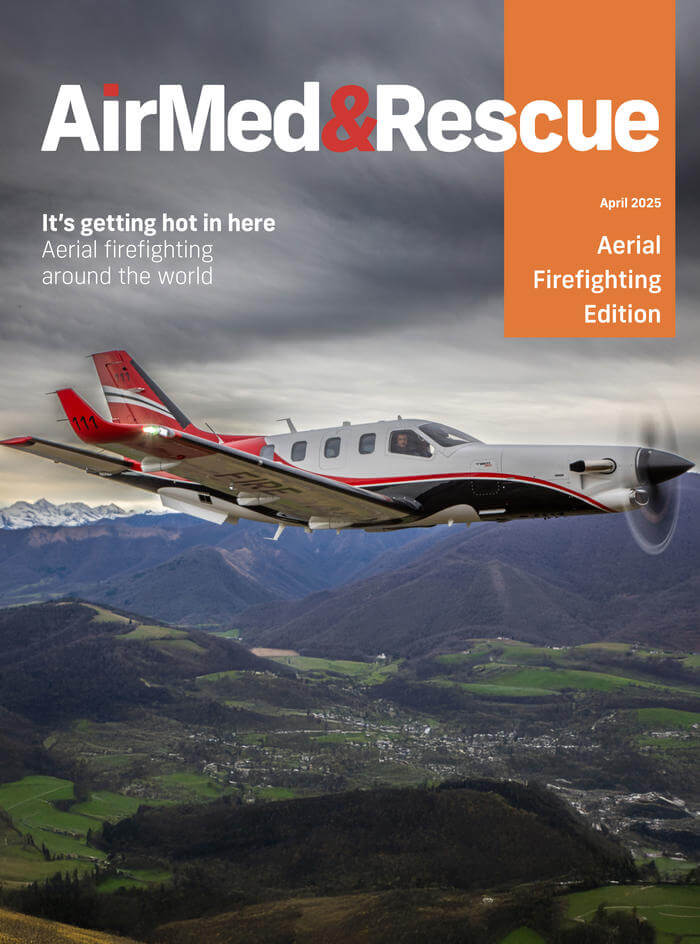
Our April edition has a special focus on aerial firefighting, with features that include rescues during wildfire situations; the coordination process and tools used between aircraft and firefighters; the distinct job of the smokejumper; the different use cases for buckets and tanks, and what needs to be considered for your airframe; the continued appeal of the Firehawk platform; and the importance of proper expertise when treating traumatic brain injuries; plus more of our regular content.
Oliver Cuenca
Oliver Cuenca was a Junior Editor at the Voyageur Group. He was previously a News and Features Journalist for the rail magazine IRJ until 2021, and studied MA Magazine Journalism at Cardiff University. His favourite helicopter is the AW169 – the workhorse of the UK air ambulance sector! He also led the creation of Waypoint: The AirMed&Rescue podcast, serving as its Production Editor and co-host.