
Provider profile: Great North Air Ambulance Service

Oliver Cuenca talks to Araminta Hartley, PR and Media Officer at Great North Air Ambulance Service (GNAAS), about the charity’s work
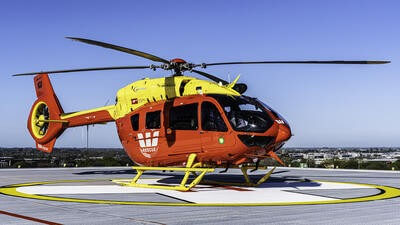
The Great North Air Ambulance Service (GNAAS) is a UK-based registered charity that provides helicopter emergency medical services (HEMS) to parts of northern England, the Scottish Borders, and the Isle of Man.
The service currently flies three helicopters – three AS365N Dauphins stationed at bases in Urlay Nook, County Durham, and Langwathby, Cumbria. Araminta Hartley, PR and Media Officer at GNAAS, explained that this comprises two primary aircraft, as well as a spare, used “when one of our main aircraft requires servicing or maintenance”.
The helicopters are managed and maintained on behalf of GNAAS by Leeds-based aviation services provider Multiflight – this includes “the licensing, insurance, legal and accounting documents, flight planning, pilot allocation, aircraft cleaning, maintenance and engineering schedules”, Hartley noted.
Founded in 2002, the charity has evolved significantly over the past 23 years. “Some of our achievements include introducing doctors on board our aircraft and rapid response vehicles … [and] delivering blood transfusions to more than 500 patients,” said Hartley.
Missions
The types of emergencies GNAAS typically responds to are diverse, Hartley explained, but some categories stand out: “Road traffic collisions and cardiac arrests have consistently been some of the most common types of incidents our team attend.
“However, over the last few years since the expansion of our nighttime service – we now operate 24/7 in the northeast – we’ve seen an increase in assaults, including stabbings,” she added.
We’ve seen an increase in assaults, including stabbings
In response to this, the charity has been working to improve its equipment and training to deliver thoracotomies – a procedure performed when a person has a penetration injury such as a stab or gunshot wound.
“This is an extremely advanced operation reserved for those patients not otherwise expected to survive,” Hartley said. “The procedure involves making a major incision across the chest and through the muscle, and thus exposing the heart and lungs. Our team can then identify the origin of the bleeding with a view to stemming the flow of blood, allowing the heart to beat again and restore circulation to the brain.”
In addition to this, GNAAS is looking to introduce “more specific transfer equipment to aid the longer critical care journeys we have started to see our teams do”, she said, based primarily on “data we have collected on the travel time to and from the Isle of Man, and transfers to regional Major Trauma Centres”.

The Isle of Man
As well as its usual operational fields in northern England and the Scottish Borders, GNAAS also operates HEMS services on the Isle of Man, in partnership with healthcare provider Manx Care. Services there were initially launched on a trial basis in March 2022, and have since responded to 54 incidents.
GNAAS has also carried out multiple interventions on the island, including putting patients in medically induced comas, administering blood transfusions, and carrying out chest surgical procedures.
GNAAS has also carried out multiple interventions on the island, including putting patients in medically induced comas, administering blood transfusions, and carrying out chest surgical procedures
“The introduction of a HEMS service and an enhanced emergency air bridge allows patients who are seriously ill or who have suffered a major trauma to be taken directly from their community on the Isle of Man to a center of excellence in the UK for emergency medical treatment,” Hartley explained.
She continued: “Working closely with paramedics from Isle of Man Ambulance Service, our team are able to provide patients with advanced levels of pre-hospital care thanks to the skills of our team and the equipment they carry on board their helicopter, and allow them faster access to specialist care at, for example, a Major Trauma Centre or cardiac hospital in the northwest of England.”
Training and partnerships
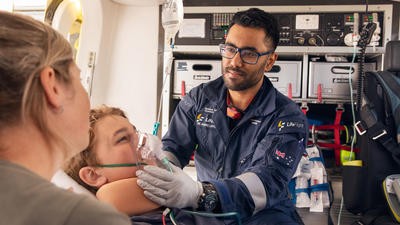
As well as regularly running a range of internal training courses for its operational staff, GNAAS prides itself on its work offering similar training to third parties.
“We offer courses such as the Pre-Hospital Emergency Crew Course (PHECC) and the Pre-Hospital Emergency Anaesthesia Course (PHEA),” Hartley explained. “We’ve trained people from all over the world, and it’s estimated that half of the HEMS services in the UK have someone who has either trained or worked at GNAAS in the past.”
The charity has also developed a number of one-day courses designed to be repeated as necessary, focusing on areas such as advanced life support, pediatric emergency and resuscitation life support, surgical skills, and ultrasound.
The charity has also developed a number of one-day courses designed to be repeated as necessary, focusing on areas such as advanced life support, pediatric emergency and resuscitation life support, surgical skills, and ultrasound
Hartley added that to “narrow the gap between the training and reality”, GNAAS has developed a number of partnerships with other local organizations, such as the County Durham and Darlington Fire and Rescue Service, and the Northumbria Police Firearms Support Unit. Such collaborative partners help the charity to deliver its courses, as well as create realistic environments and scenarios that candidates may experience in their career in the emergency medical sector.

The future
Looking to the future, GNAAS is exploring a range of opportunities to improve its service. While the charity began operating 24/7 in its northeast region in January 2023, it now plans to expand its operations in Cumbria as well, with the aim of achieving the same level of coverage there.
The charity has also been trialing the use of whole blood, rather than separated blood components (plasma and red blood cells), on board its aircraft and ground-based vehicles since May 2023.
“The two-year trial is being undertaken by 10 air ambulance services across the country, including ours, and we’re really looking forward to building on our previous research into blood transfusions,” said Hartley.
The two-year trial is being undertaken by 10 air ambulance services across the country, including ours, and we’re really looking forward to building on our previous research into blood transfusions
Beyond this, the charity has been working to implement a new version of its ARC-EMS operational, clinical management, and audit platform, which is used both to coordinate rescue missions and as a research tool. While perhaps less glamourous than other improvements, the upgrade is expected to offer sizable enhancements to GNAAS’s operations, said Hartley.
She explained, though, that one of GNAAS’s more exciting schemes – the trialing of jet suits for rescue operations, in partnership with Orsted and Gravity Industries – was no longer being pursued.
However, Hartley noted that “we are grateful for what we learned, and still continue to keep a close eye on emerging technologies, and how they could potentially support our aims”.
March 2025
Issue
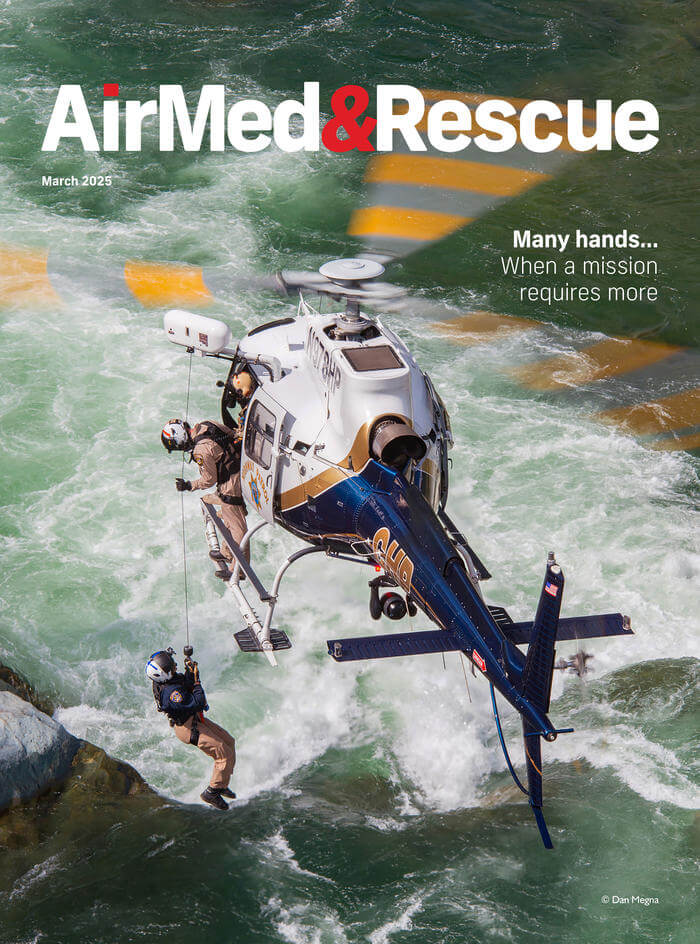
Our March edition has features that let you discover the level of training provided by simulators; learn the ins and outs of medical interiors in aircraft; find out about how health and usage monitoring systems are changing special missions; and see how aerial firefighters communicate and coordinate their missions across multiple agencies and stakeholders; plus more of our regular content.
Oliver Cuenca
Oliver Cuenca was a Junior Editor at the Voyageur Group. He was previously a News and Features Journalist for the rail magazine IRJ until 2021, and studied MA Magazine Journalism at Cardiff University. His favourite helicopter is the AW169 – the workhorse of the UK air ambulance sector! He also led the creation of Waypoint: The AirMed&Rescue podcast, serving as its Production Editor and co-host.