
Provider profile: Great Western Air Ambulance Charity

Oliver Cuenca talks to Anna Perry and Tim Ross-Smith about their charity’s work providing air ambulance and critical care services across parts of western England
Great Western Air Ambulance Charity (GWAAC), founded in 2007, provides air medical and ground-based critical care services across parts of the west of England, serving a population of around 2.1 million.
This includes Bristol, Bath and North East Somerset, North Somerset, Gloucestershire, South Gloucestershire, and parts of Wiltshire.
Since its establishment 19 years ago, the charity has grown significantly from humble origins, Anna Perry, Chief Executive of GWAAC, explained: “In terms of the origins of the organization, it was the chair of a local hospital, John Christensen, who wanted to address the problem of patients who need lifesaving interventions before they reach hospital, leading to poorer outcomes.
“He was alerted to that by two clinicians in particular, Professor Jonathan ‘JB’ Benger, and Dr Phil Cowburn, who were working in the emergency department and were increasingly concerned that people who could have been saved by earlier critical care just weren’t getting it,” she continued. “So, working with paramedics and Avon Ambulance Service, as it was then, they started responding by car from Bristol Ambulance Station – something that would be very hard to just get on and do today!”
To begin with, GWAAC only flew helicopter missions on weekdays, between 09:00 and 17:00 hrs, funding permitting, but now flies from 07:00 to 19:00 hrs, all year round, while its critical care cars continue to serve the public until 01:00 hrs each day.
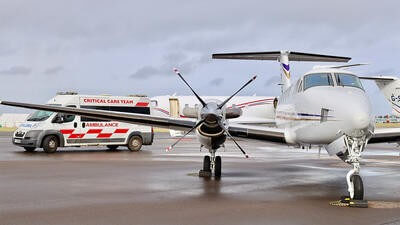
Perry added that the charity was not looking to expand its nighttime helicopter coverage further, due to a lack of operational need.
“We’ve got fantastic road coverage, and secondly the regulations around night flying mean that there are fewer landing sites and it takes longer to plan flights,” she said. “So we believe that, for us, given our unique situation, driving at night is almost always much faster than flying.”
We believe that, for us, given our unique situation, driving at night is almost always much faster than flying
Additionally: “Even if that wasn’t the case, our planning conditions for our air base mean we’re not allowed to take off after 23:00 hrs at night. And the other thing is cost – it would cost an enormous amount to have a second helicopter pilot shift, and that’s something we wouldn’t be able to bear at the moment.”
The present day
The charity acquired its current helicopter, an Airbus EC135 called Helimed 65, in 2017. The aircraft is operated in partnership with its aviation provider Babcock, alongside a fleet of four critical care cars – three Skoda Kodiaqs and one Volvo XC90.
“We’re currently in the process of replacing the Kodiaqs with new XC90s,” said Tim Ross-Smith, Operations Officer at GWAAC, explaining that the new vehicles would be hybrid cars.
“The Skodas are reaching the end of their life – we’ve had them five or six years, and they’ve done about 100,000 miles each,” added Perry.
Babcock has served as GWAAC’s aviation partner since 2008, when the charity launched helicopter operations. “So they’ve been with us for the whole life of GWAAC,” said Perry. “The contract comes up for renewal in 2028.”
Alongside the helicopter itself, Babcock also supplies flight crew and maintenance support to GWAAC: “They provide a single pilot and an engineer,” confirmed Perry.

Mission types
In recent years, demand for GWAAC’s services has increased – in 2025, the charity announced a record number of missions, responding to 2,344 people in urgent need of medical care. This equates to around six more callouts per month than in 2024.
In terms of the kinds of incidents GWAAC responds to, there is a roughly even mix between medical and trauma incidents.
“It’s still sitting around about 44% trauma and 56% medical,” said Ross-Smith. “And within that, on the medical side, the majority will be cardiac arrests, and the trauma side will be accidents – either road traffic collisions, or people injuring themselves.”
Perry added that there were also typically a small percentage each year of equestrian accidents, sporting accidents, noting that “there is a seasonal nature to it”.
“It tends to be more cars in the winter, more hikers in the summer,” she said.
Serving young patients
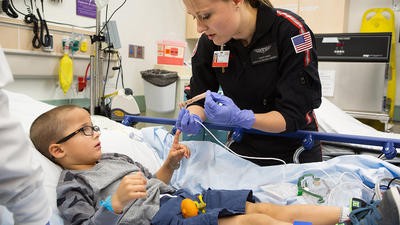
Perry highlighted that GWAAC also responds to a large number of young patients each year: “We do get called to help about 15% babies, children, and teenagers, which is higher than people think.
“I think this year it might actually be more like one in five,” she estimated. “And that’s a real mixture of neonates, kids with seizures, and teenagers getting injured.”
We’ve got a dedicated neonate and pediatric grab bag. And then within our primary response bags, we’ve got pediatric modules that are color-coded, so they’re very easily visually referenced at the scene of an incident
Ross-Smith also reported that this was reflected in the kind of equipment GWAAC carries on board its vehicles and aircraft. “All of our kit is the same across all units – helicopters and cars – and it’s all subdivided into modules within that. So we’ve got a dedicated neonate and pediatric grab bag. And then within our primary response bags, we’ve got pediatric modules that are color-coded, so they’re very easily visually referenced at the scene of an incident.
“We also carry two units of fresh frozen plasma, two units of packed red cells, and we carry LyoPlas as well,” he added.
Perry explained that the charity had a “particular emphasis on neonates – one of our doctors is a neonatal retrieval specialist, and one of our paramedics works part-time as a neonatal retrieval specialist as well”. She added that this helped to inform the charity’s work, and ensure that all equipment and consumables used are suitable.
Finding the right staff
When it comes to GWAAC’s medical crew, Ross-Smith said that all of its paramedics were supplied by the local ambulance service.
“When we recruit, we’re looking for experienced frontline paramedics – normally an absolute minimum of two to three years post-qualification,” he said. “And then there’s a two-year training program within the unit on top of that … to achieve Specialist Paramedic status. Meanwhile, for our doctors, we’re part of a national PHEM training program.”
Perry added that the charity’s doctors came from a range of backgrounds, including hospitals, military, and expedition medicine.
“We have about five military doctors – they bring a different sort of experience to those from purely hospital backgrounds,” she said. “They’re used to working in extreme situations. We’ve also got a lot of doctors and paramedics who’ve done event and expedition medicine, so they’ve been medics for events happening in deserts or up mountains.
We have about five military doctors – they bring a different sort of experience to those from purely hospital backgrounds. They’re used to working in extreme situations
“And what we’re very good at at GWAAC is harnessing those experts from all kinds of different backgrounds. It’s a team that’s hungry to learn, to do better, and to integrate best practice from elsewhere.”
Beyond this, Perry noted that one thing that had changed over the past decade in particular had been the “professionalization” of GWAAC’s doctors.
“Doctors with GWAAC didn’t start being paid at all until 2015, so eight years of them doing it completely voluntarily,” she said. “Which was great, but of course meant that it was working around their day jobs. We’ve gone through a gradual process of professionalizing the doctor cohort.”
The charity is also looking to expand
the range of medical staff it employs further in future, particularly with the goal of drawing in more women and people from minority backgrounds.
“We’ve run ‘Access to PHEM’ courses and workshops, where we’ve tried to help under-represented groups – mainly women, but also other minority groups – realize that PHEM could be for them, that they are not excluded, and we’re really trying to level the playing field,” she said.
Collaborating for better operations
GWAAC also works hard to build bridges with other organizations, both in the UK and overseas.
“We also work closely with some of our neighboring air ambulances – we have a good relationship with Dorset and Somerset Air Ambulance in particular. They’re quite similar in terms of their capabilities and delivery,” said Perry.
She added that the charity also frequently worked with Retrieve, the local Adult Critical Care Transfer Service (ACCTS), with plans for a joint clinical governance day between the two organizations in the near future. Additionally, Perry said that due to the part-time role of GWAAC’s consultant doctors, many had active roles working for entities such as the National Institute for Health and Care Excellence (NICE), the South Western Ambulance Service NHS Foundation Trust, the University of the West of England (UWE) and the University of Gloucestershire.
Further afield, Ross-Smith reported that GWAAC does “a fair bit of work” with SAFER in Norway. SAFER is a foundation and simulation center dedicated to the development of optimal healthcare provision. “So a few of our clinicians go over there every year to do some teaching on their university course,” he said. “And then last year, we hosted a group of them at GWAAC for a couple of weeks where they did some training and observership with the crew here. So that’s a really positive relationship, and one we’re keen to develop further.”
March 2026
Issue
This edition is bursting at the seams with articles from all corners of the special missions sector. We have features on the California wildfires that ravaged the state last year, what the cost–benefit analysis looks like for single-engine rotorcraft and autorotations, how the mission dictates the modification needed to the platform, and what can be done to further prevent the problems associated with inadvertent entry into instrument meteorological conditions.
Oliver Cuenca
Oliver Cuenca was a Junior Editor at the Voyageur Group. He was previously a News and Features Journalist for the rail magazine IRJ until 2021, and studied MA Magazine Journalism at Cardiff University. His favourite helicopter is the AW169 – the workhorse of the UK air ambulance sector! He also led the creation of Waypoint: The AirMed&Rescue podcast, serving as its Production Editor and co-host.