
Provider profile: REACH Air Medical Services

Oliver Cuenca speaks to Vicky Spediacci, Vice President and Air Chief Operating Officer at REACH Air Medical Services, about her organization’s work
REACH Air Medical Services – part of Global Medical Response (GMR) – is a provider of critical care air and ground ambulance services to communities across seven US states.
Founded in 1987 as Redwood Empire Air Care Helicopter (REACH), based in Sonoma County, California, the organization now operates a mixed fleet of aircraft across not just California but also Colorado, Nevada, Oregon, and Texas, as well as Alaska and Hawaii.
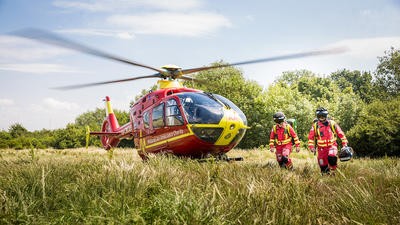
“We currently operate three King Air B200 airplanes, five Airbus H130s, 22 Airbus H125s, 31 EC135s, and an Airbus EC145,” explained Vicky Spediacci, Vice President and Air Chief Operating Officer at REACH Air Medical Services.
She added: “We have a mixture of lease and purchase agreements with our assets. Our business decisions on this mixture are predicated on market conditions, and the best use of our capital dollars to support the business entities and services.”
In terms of the range of specific aircraft types used by REACH, Spediacci explained that “each aircraft [type] we operate has unique capabilities, and we place aircraft in locations that best utilize those capabilities”.
For example: “Our H125s are our powerhouse aircraft and best suited for high-altitude operations or use in our bases that provide firefighting duties. Our H130s offer a larger crew/patient care compartment, high visibility and a Fenestron tail rotor design.”
Additionally: “Our twin-engine helicopters offer larger patient care capabilities, which work well for our partnered customers and specialty team transports that require additional personnel and/or special equipment such as an Isolette incubator.”

Spediacci also explained that certain aircraft were more suitable for single-pilot instrument flight rules (IFR), and that REACH’s King Air B200s were especially used for longer-range flights.
She added that REACH’s aircraft all carried a range of equipment to support the delivery of critical care: “This includes a cardiac monitor with defibrillation and invasive pressure monitoring, intravenous (IV) pumps, a fetal heart rate monitor, ventilator, video laryngoscopy device, medications, and all supplies necessary to perform surgical and lifesaving interventions. In essence, a flying intensive care unit (ICU).”
Crew and training
When it comes to sourcing new crew, Spediacci explained that REACH sources staff from a wide range of locations and backgrounds, “across the US and around the world, if they are able to work in the US and meet all our requirements”.
Such requirements include a high level of experience, professionalism, and compassion for patients.
However, she noted that, in particular, REACH “actively seeks out pilots and maintenance technicians from the military, law enforcement, and civilian backgrounds”.
REACH actively seeks out pilots and maintenance technicians from the military, law enforcement, and civilian backgrounds
REACH also prioritizes training for flight, medical, and support crews, on the basis that the operations they fly demand a high level of skill, with programs aiming to exceed requirements laid out by the US Federal Aviation Administration (FAA) and Commission on Accreditation of Medical Transport Systems (CAMTS).
“We recognize that having highly skilled and trained personnel to meet the demands of maintaining aircraft airworthiness, critical aeronautical decision-making, and to excel in patient care requires investments into our training programs for our aircraft maintenance technicians, pilots, and medical crewmembers,” said Spediacci.
For pilots, she added that new hires undergo a “multi-week onboarding program, with extensive use of high-fidelity simulators and aircraft flight experience”. This is then reinforced with regular, semi-annual training for all pilots.
New medical crew similarly undergo an extensive onboarding program, using “high-fidelity simulation [and] specialty equipment”, as well as “extensive air medical resource management (AMRM), safety management system, and aircraft knowledge” training.
“Our medical crewmembers also receive quarterly hands-on skills and specialty training, which is physician led and targeted to all scopes, specialties, procedures, equipment and patient profiles,” Spediacci said.
Finally, she noted that, for aircraft maintenance technicians, “REACH is one of a few entities that have FAA-accepted courses for the Airbus H125 and H135”.
Operations
When it comes to conducting its operations in various regions, REACH Air Medical Services places a high value on building strong connections with local organizations in the communities they serve.
“We feel that providing quality healthcare to our patients requires us to be part of the community,” said Spediacci. “It’s essential that we develop partnerships with local emergency entities, hospitals, and government agencies to ensure that we can best support their healthcare needs and can respond accordingly.”
We feel that providing quality healthcare to our patients requires us to be part of the community
However, in terms of navigating the diverse range of territories that REACH covers, she added that “one of the biggest challenges” was ensuring that the company’s aircraft were “equipped to deal with the wide variety of environmental factors within each geographic region”.
Spediacci explained: “Examples include withstanding the weather environments associated with winter operations in the mountains of Colorado, or the backcountry of Alaska. Conversely, [we have to] ensure our crews and aircraft can operate in the extreme heat conditions and high-density altitudes of the California Sierra Nevada mountains, and Central Valley conditions, where temperatures can easily exceed 110°F (43.3°C).”
The future
Looking forward, Spediacci said that as a well-established, major player in the world of air medical services, she was “confident that GMR, and by extension REACH Air Medical Services, would “continue to grow, innovate, and answer healthcare needs well into the future”.
“GMR’s mission statement is ‘providing care to the world in a moment’s notice’,” she said. “It’s something we live by every day and I’m sure well into the future. I continue to be amazed by our 28,000-plus frontline professionals who have the passion to serve the healthcare needs of their community every day.”
I continue to be amazed by our 28,000-plus frontline professionals who have the passion to serve the healthcare needs of their community every day
She noted that “our biggest announcement this year” was a partnership with Airbus, which will see GMR become the launch partner for its new H140 helicopter platform.
When it comes to other medical equipment, Spediacci added that “we continue to evaluate and acquire new product lines that can provide exceptional patient monitoring and intervention capabilities during transport modalities”.
November 2025
Issue
Our November edition is packed with content relating to special missions from around the world. We have features that explore the design and engineering that go into modern rotorcraft; the interactions between ground and air teams on helitack operations; the tools and attire needed for successful water rescues; and the new onboard technology that is revolutionizing special missions by detecting and communicating with cell phones.
Oliver Cuenca
Oliver Cuenca was a Junior Editor at the Voyageur Group. He was previously a News and Features Journalist for the rail magazine IRJ until 2021, and studied MA Magazine Journalism at Cardiff University. His favourite helicopter is the AW169 – the workhorse of the UK air ambulance sector! He also led the creation of Waypoint: The AirMed&Rescue podcast, serving as its Production Editor and co-host.