

Provider profile: Microflite Aviation

Oliver Cuenca speaks to Microflite Aviation about working in Australia’s special missions sector and the use of intelligence, surveillance, and reconnaissance (ISR) techniques
Founded in 2000 in Melbourne, Australia, Microflite Aviation initially used its single aircraft to provide tourism and charter services. In the quarter century since, however, the company has grown substantially to become a major operator in the special missions aviation sector.
While tourism and charter flights continue to play a role in Microflite’s operations, the company’s 26 aircraft and approximately 150 staff now predominantly support critical missions such as aerial firefighting, search and rescue (SAR), emergency management, and border surveillance.
Microflite’s rotary-wing fleet includes a range of helicopter platforms, including the Airbus EC120, AS350/H125, H135, and H145.
Alongside this, the company also operates PC-12 NG fixed-wing aircraft for “intelligence, surveillance, and reconnaissance (ISR) roles such as large-area ISR, firescan and specialist intelligence gathering, [as well as] air attack supervision, lead plane operations, cargo, and transport missions”, explained James Kagel, Head of ISR at Microflite.
Rodney Higgins, Chief Executive of the Microflite Group, said this growth in the special missions side of operations had “driven expansion in specialist capabilities, with training, engineering, and ISR developing into dedicated business units to enable each area to scale independently”.

ISR and aerial firefighting
Of these specialist capabilities, Microflite’s work in ISR has become a critical part of the company’s operations, particularly its role in aerial firefighting.
Kagel explained: “While many of these traditional aerial work missions have not historically required integrated ISR capability, [we] discovered that ISR technologies can significantly enhance these operations by improving situational awareness, delivering better mission outcomes, and increasing overall efficiency.”
He added that in response to both evolving requirements and a desire for greater flexibility, Microflite had worked to develop more compact, rapidly deployable ISR systems that could be quickly installed or removed from its aircraft.
“This flexibility is particularly beneficial during fire seasons, enabling Microflite to provide surge ISR capacity when required at short notice,” Kagel concluded.
This flexibility is particularly beneficial during fire seasons, enabling Microflite to provide surge ISR capacity when required at short notice
Firefighting and emergency response across Australia
Kagel said that Microflite operated “multiple ISR roles within the aerial firefighting domain … to provide critical real-time situational awareness to incident managers and air attack supervisors”.
“These ISR platforms support and complement the full life cycle of a fire incident, from the early detection of new ignitions, including post-lightning reconnaissance flights, through to monitoring fire behavior and rate of spread, and coordinating of aerial and ground operations during active suppression efforts,” he added.
Kagel reported that the company also used its ISR platforms to help identify emerging threats to community and infrastructure, to support emergency warnings and evacuations, and to provide assessments in support of post-incident recovery planning.
He also noted that Microflite operates an “ISR-equipped SAR aircraft on behalf of Life Saving Victoria [which] frequently patrols Victoria’s coastline and inland waterways, assisting in the detection of missing persons, distressed vessels, and providing situational overwatch capability during large-scale emergency operations”.
As part of Microflite’s nationwide operations, the company has served as part of Australia’s National Aerial Firefighting Centre (NAFC) fleet since 2010, offering both contracted and “call when needed” services, said Higgins. He explained that “the NAFC’s role is to procure aircraft on behalf of most Australian states and territories, to enable top-level oversight and strategic management for all firefighting aircraft in the country”. Once procured and allocated, he added, day-to-day aerial firefighting operations become the responsibility of the state or territory.
The initial challenges of ISR implementation
When implementing ISR capabilities into its aerial firefighting operations, Microflite encountered a number of challenges, including the need for agencies to adapt to the new technology.
“Agencies that had long been accustomed to traditional firefighting methods were suddenly required to integrate significantly greater volumes of information, delivered in near real time and at a faster pace than previously experienced,” explained Higgins.
Agencies that had long been accustomed to traditional firefighting methods were suddenly required to integrate significantly greater volumes of information, delivered in near real time and at a faster pace than previously experienced
Beyond this, as the capability has grown, the need to ensure that the technology provides data consistently and reliably has expanded alongside it, he added.
Kagel elaborated: “One of the primary technical challenges of operating ISR capability in Australia has been data communications, particularly the limited connectivity available in remote environments. Large volumes of video, imagery, and mission-critical data can be captured at an incredible pace; however, without the ability to reliably transfer this information to the relevant teams, its operational value can easily be lost.”
To address this, Kagel explained that Microflite had invested in solutions that provide data network and transmission pathway redundancy, including “cellular and bonded cellular systems, microwave IP networks, and satellite communication systems”.
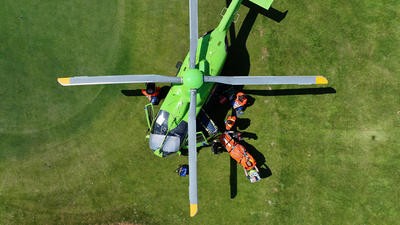
Training for missions
Due to the extensive range of challenging operation types that Microflite’s crews respond to, “comprehensive in-house training” is vitally important, said Neville Wright, Senior Training and Checking
Pilot, Flight Instructor and Flight Examiner
at Microflite.
This is especially true for the company’s rotary aerial firefighting missions, for which pilots receive varied training at the company’s Moorabbin Airport base to ensure they are “fully prepared to operate safely and effectively in complex fire environments”.
He explained: “Initial training for the Fire Fighting Application Rating includes five hours of dedicated instruction, delivered by experienced instructors who are actively involved in current firefighting operations. This training combines detailed ground-based learning with practical operational guidance.
“Upon completion of the instructional component, pilots undertake a formal rating assessment conducted by Microflite’s CASA-qualified in-house examiners. The assessment includes a comprehensive theory examination followed by a structured flight test to validate operational competency.”
The assessment includes a comprehensive theory examination followed by a structured flight test to validate operational competency
Additionally, Wright noted that after the initial rating, pilots are also required to complete an Aerial Application Fire Fighting Proficiency Check every 12 months, with recurrent checks conducted in-house by qualified examiners.
Alongside this, Kagel added that the company provides in-house training for ISR operators and technicians, “complemented by additional manufacturer training where applicable”.

Onboard equipment and technology
To support its operations, Microflite’s rotorcraft and fixed-wing aircraft are equipped with a range of sensors and other technology to support its missions.
“Our aerial platforms are sensor agnostic, meaning they have been engineered to accommodate a wide variety of mission payloads from leading technology providers,” said Kagel. “This flexibility ensures Microflite can rapidly configure aircraft to meet evolving operational requirements.”
This flexibility ensures Microflite can rapidly configure aircraft to meet evolving operational requirements
He added that specific equipment included “traditional electro-optical and infrared (EO/IR) imaging systems such as the WESCAM MX-10 or MX-15; tactical hybrid EO/IR searchlight solutions such as the TrakkaBeam TLXc; advanced multispectral nadir scanning systems such as the Overwatch Imaging TK-8; and mission management systems (MMS) such as Cartenav AIMS-ISR or Shotover ARS”.
Alongside this, Kagel added that the aircraft featured “configurable mission suites, including onboard mission computing systems, real-time video and data downlink/uplink capability, and fully interoperable communications systems” designed to support the specific operational requirements of various Australian states and territories.
Plans for the future
Looking to the future, Higgins said that Microflite would continue to develop its airborne ISR systems to be utilized “across multiple aircraft types, mission profiles, and operational requirements”.
“Through this continued investment in interoperable systems, scalable platforms, and advanced data integration,” Higgins concluded, “Microflite is building an ISR capability that is adaptable, future-focused, and ready to meet both Australia’s evolving emergency and national security requirements, as well international agencies and customers.”
May 2026
Issue
Training for special missions is on another level, so it’s a great pleasure to bring you the training edition of AirMed&Rescue for May. We have features on night flights for police aviators; the simulators for military special missions training; the systems and scenarios for hoist operations; and engineering training for airframe and powerplant mechanics.
Oliver Cuenca
Oliver Cuenca was a Junior Editor at the Voyageur Group. He was previously a News and Features Journalist for the rail magazine IRJ until 2021, and studied MA Magazine Journalism at Cardiff University. His favourite helicopter is the AW169 – the workhorse of the UK air ambulance sector! He also led the creation of Waypoint: The AirMed&Rescue podcast, serving as its Production Editor and co-host.