
Provider profile: Titan Aerial Firefighting

Oliver Cuenca speaks to Carlos A Craveiro, Director of Flight Operations at Titan Aerial Firefighting, about the expansion of its work fighting forest fires in Spain and beyond
Founded in Spain in 1965, Titan Aerial Firefighting initially launched its operations from a hangar in Manises Airport in Valencia, predominantly providing maintenance and repair services to aircraft operators in the crop-spraying and aerial firefighting industries.
Almost 30 years later, the company expanded its operations to become an aircraft operator, acquiring a fleet of eight PZL-Mielec M18 A Dromader fixed-wing aircraft in in 1994.
Titan began operations with approval from the Spanish Civil Aviation General Directorate in January of the following year, with a focus on aerial firefighting and surveillance.
In the same year, Titan also acquired its first Air Tractor AT-802, an aircraft type that now makes up the bulk of its fleet, and began providing regular firefighting and search and rescue operations on behalf of a number of government agencies.

A fleet of Air Tractor AT-802s
Carlos A Craveiro, Director of Flight Operations at Titan Aerial Firefighting, credited the shift to the AT-802 with the company’s present good fortune: “This aircraft, due to its unique characteristics for fighting forest fires, was the catalyst for our current success. A few years later, we were one of the first operators to fly the amphibious AT-802 Fire Boss, which was undoubtedly the cherry on the cake due to its enormous success.” Craveiro noted that the company now operates a large fleet of 40 aircraft across six countries around the Mediterranean and Middle East: Spain, Portugal, France, Saudi Arabia, Turkey, and Cyprus. Of these, he explained, 20 aircraft are owned outright, while a further 20 are subcontracted. Craveiro also reported that Titan maintains its own aircraft in-house, at its facilities at an airfield in Viver, Castellón, Spain.
A large team and regular training
To support its operations, Titan also employs approximately 60 pilots and 30 ground crewmembers, with the company placing a high level of emphasis on crew training. For this reason, Titan operates as a European Union Aviation Safety Agency (EASA) Approved Training Organisation, offering a range of courses at its training center to maintain a high standard of health, safety, and efficiency.

Training provided includes the use of a Level 2 flight training device (FTD), which offers simulated training for operations on both the land-based and amphibious versions of the AT-802, including for complex maneuvers, breakdowns, and aerial firefighting scenarios.
“We do yearly checks that consist of simulator training and at least four hours’ flight, plus always, as possible and if there is no big fire activity, they fly every week to maintain their recurrency,” Craveiro said.
We do yearly checks that consist of simulator training and at least four hours’ flight, plus always, as possible and if there is no big fire activity, they fly every week to maintain their recurrency
Government contracts
A key source of business for Titan’s aerial firefighting division is government contracts – the company has worked with a number of regional governments within Spain, such as the governments of Catalonia, Valencia, Galicia, and La Rioja, as well as the Spanish Ministry of the Environment.
Beyond this, the company has also worked heavily with government agencies overseas, such as Portugal’s Civil Protection, the Civil Defence of Saudi Arabia, Turkey’s Forestry Directorate, and the Department of Forests in Cyprus, Craveiro explained.
Despite the varying environments that Titan’s pilots operate in, he added that ultimately many of the challenges remained the same, including “high mountain operations with very low-level flights and moderate turbulence, combined with lack of visibility due to the smoke”.
However, he added that these could ultimately be mitigated by “lots of training flight hours, and also ensuring that newer pilots are accompanied by more experienced pilots, in a minimum formation of at least two airplanes”.
A successful platform
Looking to the future, Craveiro said he was confident in Titan’s ability to continue developing its operations to meet the needs of the future.
We intend to maintain this highly successful platform (the AT-802), which is undoubtedly one of the best solutions for fighting forest fires
“For the moment, we intend to maintain this highly successful platform [the AT-802], which is undoubtedly one of the best solutions for fighting forest fires,” he said. “Titan has one of the youngest fleets in the world for fighting forest fires, and renews its fleet regularly.”
June 2026
Issue
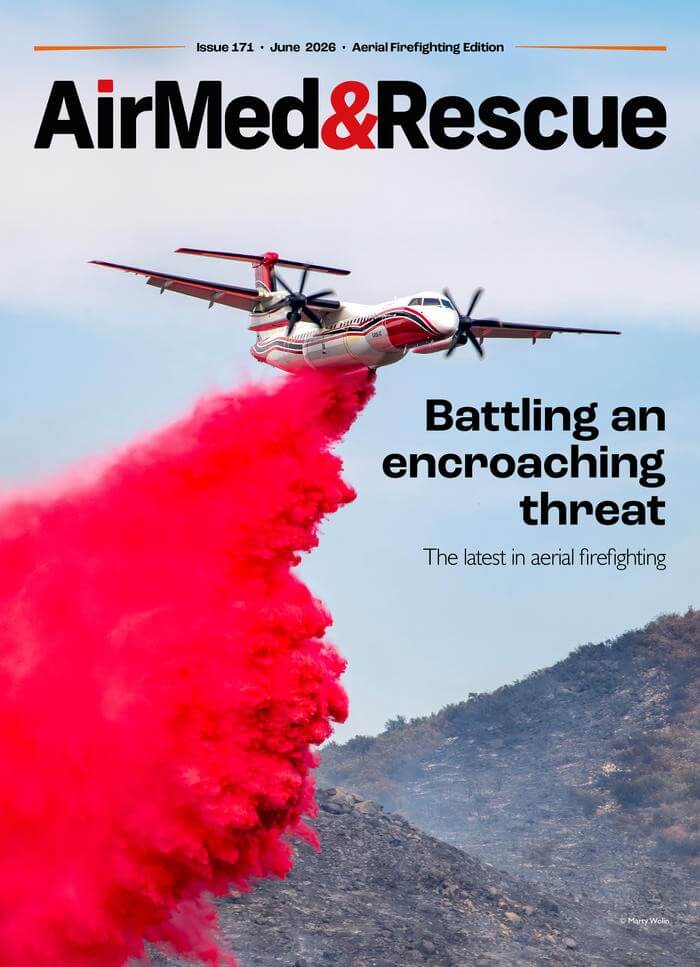
As the northern hemisphere heats up for another hot summer, I’m pleased to bring you the aerial firefighting edition of AirMed&Rescue. We have features on how climate change is accelerating firefighting technology; the improvements in Australian firefighting capacity; and getting ahead of wildfires before they become unmanageable.
Oliver Cuenca
Oliver Cuenca was a Junior Editor at the Voyageur Group. He was previously a News and Features Journalist for the rail magazine IRJ until 2021, and studied MA Magazine Journalism at Cardiff University. His favourite helicopter is the AW169 – the workhorse of the UK air ambulance sector! He also led the creation of Waypoint: The AirMed&Rescue podcast, serving as its Production Editor and co-host.