
Provider profile: United States Park Police Aviation Unit

Oliver Cuenca talks to Sergeant Timothy Ryan, Assistant Commander, Aviation, about the many roles his Unit plays while serving the people of the District of Columbia
The United States Park Police (USPP), founded in 1791 as the Park Watchmen by George Washington to protect federal property in the then newly established District of Columbia (DC), is the oldest continuously operating law enforcement agency in the USA.
In the present day, it operates under the eye of the National Park Service (NPS), alongside its sister organization, the NPS Law Enforcement Rangers.
According to Sergeant Timothy Ryan, Assistant Commander, Aviation at the USPP, the main distinction between the two organizations is the environments they work in.
“The USPP, our primary focus is here in DC, in Washington. But we also have field offices in New York and San Francisco,” he explained. “[We’re] very much an urban unit … whereas the park rangers are typically assigned to more rural environments like Yellowstone, or some of the big parks out west and places like that.”
While the USPP’s history dates back centuries, its Aviation Unit is a more recent creation. Founded in 1973, the Unit now operates three aircraft, all based in DC. “The two primary aircraft are Bell 412EPs, and then the backup aircraft – and the aircraft we also use for training – is a Bell 206,” Ryan explained.
He added that the helicopters are owned by the Department of the Interior, which also provides a range of support for their upkeep.
Personnel
The USPP Aviation Unit currently has four pilots and six rescue technicians, Ryan explained. “And we’ve got two rescue technician candidates in training right now.
“All of our personnel are police officers first, so everybody in the Unit – pilot, rescue technician, commander, assistant commander – we all started as patrol officers,” he added. “So we all do three years on the street, and then you’re eligible to apply for specialized positions, which can be aviation, SWAT, canines, motorcycles, horses.”
So we all do three years on the street, and then you’re eligible to apply for specialized positions, which can be aviation, SWAT, canines, motorcycles, horses
Despite this, Ryan said that recruits bring different experience to the role, often from their histories of working in other emergency services: “We have been fortunate to have some people come on who are already paramedics in previous lives. I was in fire and rescue before I came to the police, and we got a few other guys like that, that came in that direction.”
Primary operations
“We’re a police agency, so our primary job [as an aviation unit] is being up in the air, supporting our guys on the ground – whether it’s vehicle chases, foot pursuits, criminal searches, surveillance,” Ryan said.
However, he added that over the years, while the USPP’s core mission of providing aerial support to police has never changed, the Unit “has pulled in a lot of unique missions over the years that wouldn’t typically fall to a police agency”, including medical evacuations (medevac) and search and rescue (SAR).
One of the USPP’s other responsibilities is the safeguarding of national monuments throughout DC, Ryan noted. “That’s the Lincoln Memorial, the Washington Monument, the Jefferson Memorial, the Martin Luther King Memorial – everything that’s down in the National Mall area.
“There are literally millions of visitors every year, as I’m sure you’re aware – it’s a huge tourist attraction,” he continued. “It is also an important place for demonstrations, protests, that kind of stuff, and a key component of what we do with the USPP is managing those types of events.”
Demonstrations, he explained, often mean that considerably more people come to an area. The Aviation Unit’s role in these situations is to monitor the situation, warning ground-based police about crowd movement, large offshoots, or other contingents.
Additionally, USPP’s Aviation Unit also serves as “the reconnaissance or scout aircraft for any kind of presidential movements in the area”.
“Anytime the President or significant foreign dignitaries come into town or move around, we are part of that package,” said Ryan. “So our job is to get out in front of things, look for threats. If we’re doing a motorcade, we look for traffic issues – that kind of stuff. And that’s a big chunk of our business these days.”
Working with other police departments
While DC has “31 or 32 different police agencies”, Ryan explained that in practice each agency has its own jurisdiction, with the USPP having primary responsibility for land owned and administered by the NPS.
Despite this, “there is definitely overlap,” he said. “We have a very collaborative relationship with all the agencies in the area. If we’re not available, they’re backing up our guys, and if they’re not available, we’re backing up their guys.”
He noted that two pilots working with the municipal police department previously served with the USPP.
Medical evacuations
“Our helicopters are staffed by both a pilot and a rescue technician – the technicians are all nationally registered paramedics,” said Ryan.
Our helicopters are staffed by both a pilot and a rescue technician – the technicians are all nationally registered paramedics
As well as providing medical evacuations in DC, the USPP has a memorandum of understanding with the neighboring state of Maryland to support medevac operations on behalf of the Maryland
State Police.
“Because of our proximity,” Ryan explained, “they dispatch us the same as they do any of their troopers. So, if we’re the closest aircraft, then we get called for medevacs in Maryland as well.”
Search and rescue
USPP also offers support during search and rescue (SAR) operations – both rurally, working in partnership with park rangers at Virginia’s Shenandoah National Park, as well as what Ryan calls “urban SAR”.
“These are, like, elderly patients who’ve wandered off from their homes, or kids who have walked off from school. We’re searching city streets and things like that for people as well,” he explained.
Unusual requests
“While we have our core set of responsibilities, we’re always open to unusual requests. We did a rescue years and years ago – there was a family of bald eagles stuck in a mud flat, and there was no way of getting them out, so somebody called us up and asked, ‘Hey, can you guys assist?’ And we sent a helicopter over, hovered over the eagles, and scooped them out of the mudflats. Which seems a little silly, but it was kind of a cool mission. It was a good experience for everybody that did it, and obviously, bald eagles are a national symbol or national bird here!”
Restricted airspace
Ryan added that this multi-role situation was driven in part by the Aviation Unit’s early start, but has been perpetuated by how restricted airspace around Washington, DC, is.
One of the unique things about flying in this area is that it is one of the most heavily regulated airspaces in the country, probably the world
“One of the unique things about flying in this area is that it is one of the most heavily regulated airspaces in the country, probably the world,” said Ryan. “And it makes it difficult for new entities to come into that environment, just because the ability to get in and do different things is restricted because of security concerns.”
Ryan noted the use of uncrewed aerial systems (UAS) as “part of how air stuff is done – and we obviously recognize that there are some things that we do that can be more inexpensively done by a platform like that”. However, he argued that they cannot replace everything that the USPP Aviation Unit does, and ultimately while he expects “some changes” in the future, “the core of our mission probably is not going to change anytime soon”.
“You cannot do a medevac with a drone,” he continued. “You can’t do a rescue with a drone. We can’t land a police officer to assist with a drone – there are things that they’re just not capable of doing.”
July 2025
Issue
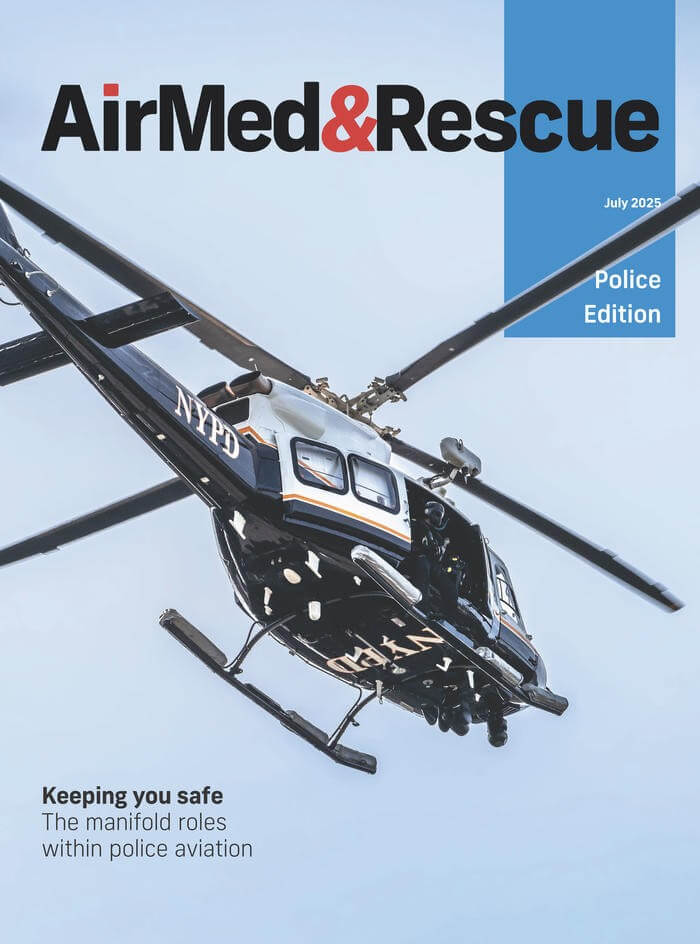
Our July edition highlights police aviation with features on how sensor technology is being used, the other aspects of policing beyond law enforcement, and the challenges of border control. We also have an interview with a police inspector, a gallery from the US Customs and Border Protection, and a provider profile of the US Park Police. Additional features include recruitment and retention, and manikins for special missions and medical training; plus we have more of our regular content.
Oliver Cuenca
Oliver Cuenca was a Junior Editor at the Voyageur Group. He was previously a News and Features Journalist for the rail magazine IRJ until 2021, and studied MA Magazine Journalism at Cardiff University. His favourite helicopter is the AW169 – the workhorse of the UK air ambulance sector! He also led the creation of Waypoint: The AirMed&Rescue podcast, serving as its Production Editor and co-host.