
Provider profile: Neptune Aviation

Oliver Cuenca speaks to Jennifer Draughon, President of Neptune Aviation Services, about her company’s aerial firefighting operations, maintenance, and training
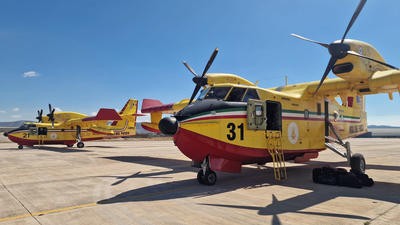
Neptune Aviation Services, founded in 1993, is an aerial firefighting company based in the US state of Montana. It currently operates a mixed fleet of nine BAe 146 airtankers and five Aero Commander 690 turboprops for its aerial firefighting missions, supported by a team of 46 pilots and 103 mechanics.
Over the three decades since its founding, the company has evolved significantly, explained Draughon – not least of all because the severity and length of the US wildfire season has seen the company transform its firefighting operations into a “year-round effort”.
“When [we] started in aerial firefighting, the wildfire environment was very seasonal,” she explained. “It was also based on regional need at the time, rather than the national approach that is necessary now. As the fire season expanded, and the number of large fires increased, that model shifted due to multiple factors – fires had to be tackled at a larger scale, across a greater area.”
This led to several developments at the company, such as the adoption of the 146 airtanker fleet, as well as the creation of a new maintenance control center. The latter, Draughon said, has a “dedicated team whose sole function is to support field operations.
“Our tankers are deployed with road mechanics and they are fully supported by the home-based mechanic team in the maintenance control center. This has been key in our ability to maintain a 99% availability rate for our customers.”
She noted that “the other major evolution was in our crew’s work-life balance”, with pilots in the early days of the company previously taking the same plane out for up to 180 days at a time, as opposed to the rigorous system of scheduling in place currently.
Operations and contracts
Neptune operates a number of contracts, primarily in the USA. “Our largest customer is the US Forest Service (USFS), but we also partner with the State of Colorado, the California Department of Forestry and Fire Protection (CAL FIRE), and the US Bureau of Land Management,” said Draughon.
“We prefer ‘exclusive-use’ contracts over ‘call when needed’ ones,” she continued. “The exclusive-use model provides a guaranteed number of contract days that airtankers are available to fight fire. This provides significantly greater financial stability for contractors [like us], and the assurance of asset availability to the government.”
By contrast, Draughon concluded: “Call-when-needed contracts provide no stability to private industry, are more expensive for agencies, and lack an assurance of airtanker availability to the government.”
Beyond the USA, Neptune has worked in a number of other countries, including Chile, where Draughon said the company “actively seeks contracts”.
We have also completed our Australian aerial work operations certificate – issued by the country’s Civil Aviation Safety Authority (CASA)
“We have also completed our Australian aerial work operations certificate – issued by the country’s Civil Aviation Safety Authority (CASA) – and we have call-when-needed contracts with New South Wales, Queensland, and the Australasian fire and emergency services,” she said, adding that “we are also pursuing an exclusive-use contract in Australia”.

Crew and training
To deliver on its contracts, Draughon explained that Neptune Aviation seeks out pilots with “flying experience that involves serious critical thinking, in hands-on types of flying conditions”. Common careers that they draw from range from “low-level agriculture flying to single-pilot day and night freight, to Alaska mountain flying environments, and other fire-related industries,” she said.
When it comes to the personality of potential crew, Draughon added that, most critically, Neptune looks for people who prioritize “safety and customer services”.
We look for above-average flight skills, critical thinkers, and hardworking team players who have devotion and dedication to our mission
“We look for above-average flight skills, critical thinkers, and hardworking team players who have devotion and dedication to our mission – which is to ultimately protect life and property from the ever-increasing danger of wildfire,” she stated.
The company also seeks out those with at least “a few thousand flight hours, if not more”, as well as “strong instrument flight rules (IFR) skills”.
Training
Neptune’s pilots undergo regular annual training that “complies with the Federal Aviation Administration’s (FAA) requirements, [as well as] the USFS’s contractual requirements,” said Draughon. “We also undergo yearly simulator training and checking, followed by an IFR captain 61.58 check ride, 61.55 check rides for co-pilots, night flying and low-level tactical training with simulated emergencies and water drops used to emulate real-life wildfire as closely as possible.”
Such experience and training is paramount to ensure that Neptune’s pilots can operate safely, Draughon said. “Our mission requires us to fly a heavily loaded aircraft at low altitudes and low airspeeds,” she explained. They may also “return to our destinations in a variety of weather conditions, with visibility down sometimes to half a mile because of smoke or ground fog”.
Our mission requires us to fly a heavily loaded aircraft at low altitudes and low airspeeds
Maintenance
To support its operations, Neptune also has extensive in-house maintenance facilities, allowing it to carry out the majority of the work its aircraft fleet requires. Draughon explained that the only exception to this is when, “due to the length of the fire seasons, we have some overflow maintenance needs that we outsource to keep up with our demanding schedule”.
The company also provides “aircraft maintenance, aircraft management, avionics, non-destructive testing, machine shop services, inspections, and certifications” to a growing customer base of third-party operators.
“We are an FAA Part 145 Certified Repair Station offering world-class maintenance services to government-owned aircraft, as well as individual and corporate aircraft owners,” Draughon said. “We have experience in major repairs and alterations, plus aircraft modifications, with our Designated Engineering Representative (DER) support.”

Modernizing the fleet
While Neptune’s current fleet of aircraft has served it well, Draughon stated that the company is now looking to gradually phase out its 146 over the next decade, in favor of a new set of up to 15 Airbus A319 tankers – the first of which is expected to enter operation in 2027.
“Neptune plans on operating a mixed fleet of BAe 146 airtankers and A319s for the next 10 years,” she said, adding that it will be “very similar to how we successfully transitioned from the P2V to the BAe.” The company previously phased out its P2V (Lockheed P-2 Neptune) aircraft from 2011 onwards.
“Currently, we anticipate operating at a capacity of 15 airtankers,” she continued, adding that Neptune is the first company to convert the A319 for aerial firefighting, and that the upgrade will “increase retardant capacity, improve operational efficiency, and enhance the safety of our crews, firefighters on the ground, and the communities
we protect”.
In the meantime, the 146 fleet is being upgraded to maximize its effectiveness as it approaches retirement.
“We have upgraded the avionics in the majority of our BAe fleet to the Garmin dual GTN 750Xi,” said Draughon. Additionally, she noted that the company is currently working with simulator firm CAE on “visual upgrades to our BAe 146 simulator”.
Future plans
We also intend to improve our tanking system, secure international exclusive-use contracts, and enhance our response times on a global scale
Aside from the fleet renewal, Neptune Aviation plans to expand both its fleet and pilot teams, as well as grow its training programs and support infrastructure. “We also intend to improve our tanking system, secure international exclusive-use contracts, and enhance our response times on a global scale,” Draughon said.
She added that Neptune is also looking to collaborate with other businesses and universities to develop new technologies and techniques: “By partnering, we hope to bring state-of-the-art systems and innovative ideas to our customers.
“The goal is to transform successful research into practical and actionable programs for us to apply that work, save lives, homes, assist firefighters and our customers in ways that are not currently being asked for but that will bring more to the table, advancing our services from a technological perspective.”
May 2025
Issue
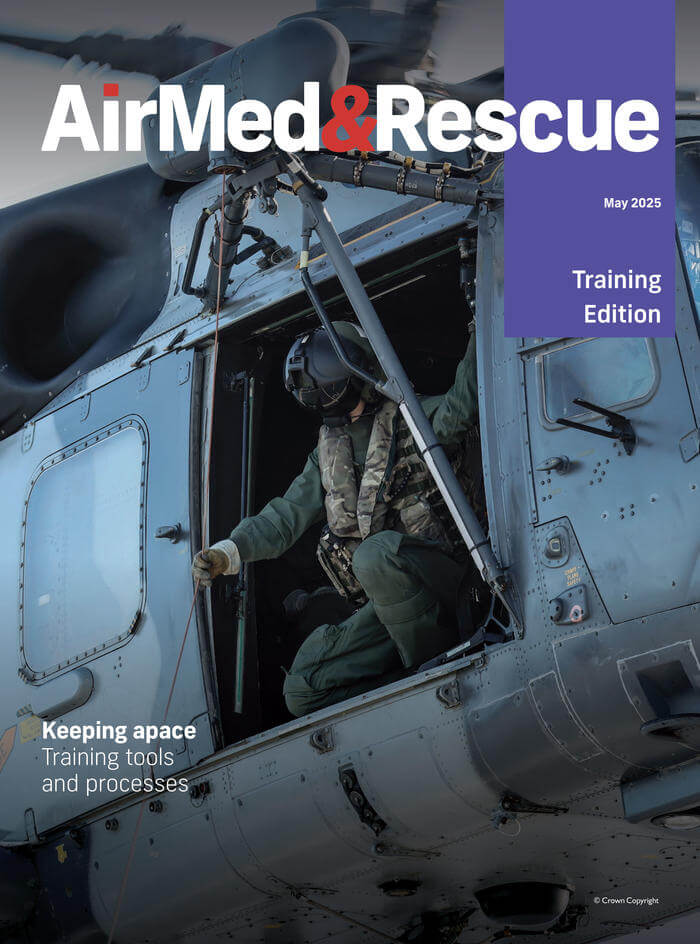
Our May edition is full of articles centered around training, with features covering pilot training, winch and rear-crew training, and air medical training; as well as a feature in the trend towards longer-range air ambulance transfers; plus we have more of our regular content, with lots of articles highlighting different aspects of training, from startle and surprise management to simulation centers and everything in between.
Oliver Cuenca
Oliver Cuenca was a Junior Editor at the Voyageur Group. He was previously a News and Features Journalist for the rail magazine IRJ until 2021, and studied MA Magazine Journalism at Cardiff University. His favourite helicopter is the AW169 – the workhorse of the UK air ambulance sector! He also led the creation of Waypoint: The AirMed&Rescue podcast, serving as its Production Editor and co-host.