
Putting the Guard in Coast Guard

The AirMed&Rescue editorial team look at how state-operated military coast guards manage the complexity of the multiple roles they’re required to perform, beyond armed response and traditional search and rescue functions
Search and rescue (SAR) operations have become a cornerstone responsibility of military coast guard units across the globe, intersecting critical domains such as public safety, maritime security, and humanitarian assistance. Unlike civilian SAR agencies, military coast guards operate within a dual framework that blends rescue efforts with law enforcement, border protection, and environmental oversight.
As modern threats and natural disasters grow in complexity and frequency, the demands placed on these units continue to expand. This evolution is driving the integration of advanced technologies, more agile operational capabilities, and increasingly modular equipment platforms. This article explores the multifaceted role of military coast guard units in SAR operations, highlighting the strategic importance of aircraft interior configuration, sensor systems, and the emerging technologies that are transforming the landscape of rescue missions today.
Wide range of tasks
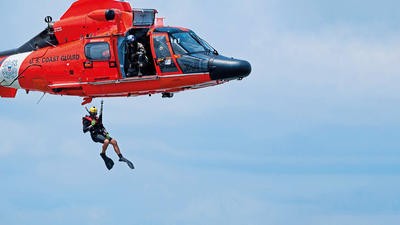
Javier Chamorro, Executive President of Centum, points out that military coast guard units typically perform a wide range of SAR tasks, including maritime rescue, disaster response, support in natural emergencies (floods, storms, etc.), and assistance in locating missing persons in both coastal and inland environments. “SAR is often integrated into their broader mission of ensuring public safety, border protection, and maritime security. Their ability to act rapidly and with flexible deployment capabilities makes them a crucial player in time-critical rescue scenarios,” he said.
Military coast guard operators undertake specific SAR responsibilities within their broader military/public safety role. According to Andrew Munro, Managing Director of Smith Myers, for military coast guards, SAR responsibilities are defined by both international obligations and national operational mandates. “Agencies such as the International Maritime Organization (IMO) and the International Civil Aviation Organization (ICAO) set global expectations under regulatory frameworks such as the Convention for the Safety of Life at Sea (SOLAS) and the International Aeronautical and Maritime Search and Rescue (IAMSAR) Manual,” he said. “However, unlike purely civilian SAR organizations, military coast guards operate with a dual objective, balancing rescue with law enforcement and security.”
With 38 years’ experience in the industry, Smith Myers has found that, for military operators, SAR activities often overlap with border surveillance and security missions, explained Munro. “This means that a military operator’s range of responsibilities is often much broader than that of their civilian counterparts, to include, for example, law enforcement and environmental protection. During SAR operations, Coast Guard teams may encounter and intervene in illegal activities, such as smuggling, piracy, or environmental violations,” he affirmed.
FlySight has a history of collaborations and partnerships with system integrators, airborne manufactures and military and civil organizations, delivering mission-critical solutions tailored to the demands of complex operational environments. Andrea Masini, CEO of FlySight, elaborated on its relationship with the military SAR sector: “A key example is our involvement in the recent modernization of the AW-101/CH-149 Cormorant SAR helicopters, led by Leonardo and the Canadian Department of National Defence. FlySight provides its advanced OPENSIGHT suite, integrated with Leonardo’s HELIAWARENESS avionics system. This system enhances situational awareness through real-time augmented reality (AR), dynamic moving maps, and video processing technologies, all tightly integrated with onboard sensors. For coast guard and SAR operations, this results in:
- Reduced search times
- Improved target identification, even in harsh environments
- Streamlined mission planning, execution, and analysis.”
Masini continued: “On the military side, FlySight’s OPENSIGHT suite includes a powerful Automatic Target Recognition (ATR) system – an advanced artificial intelligence (AI) driven tool that supports detection, classification, and identification of targets in real time. Leveraging state-of-the-art deep learning, the ATR system enhances operational precision across a wide range of surveillance and defense scenarios.
“Military SAR and public safety operators face severe environmental challenges, data overload, communication complexities, and the need for precise identification under pressure. OPENSIGHT, with its AR-enabled displays, AI-driven target recognition, and compact architecture, effectively addresses these pain points – helping teams act faster, safer, and more decisively in critical missions.”
Interior configuration
Munro observed that aircraft interior configuration is a critical and often overlooked factor in SAR and coast guard aviation. “The way aircraft interiors are designed directly impacts operational speed, flexibility and crew safety during high-pressure missions. Interior configuration is not just about equipment, it is also about workflow. Good interior design means shorter transition times between mission phases, safer and faster onboard movement of crew and casualties, and less cognitive load due to intuitive layouts and minimizing clutter,” he said. “For example, coast guard operators might start a flight with a four-person search crew, reconfigure in the field to evacuate two critical patients, and return to a surveillance configuration for night patrol. The interior must become a mission enabler when the aircraft becomes a mobile command post, a floating emergency room, or a lifeline in the event of a storm. These projects not only support SAR activities, but must support border security, environmental response, humanitarian aid and special operations, all from a single platform.”
From a systems integration perspective, modularity and compactness are key, according to Chamorro. “Rescue teams benefit from equipment that can be quickly installed or removed, requires minimal space, and integrates seamlessly into existing mission consoles,” he said. “Systems that provide real-time data to the cockpit or directly to the rescue team, e.g. tablet-based interfaces, audio/visual alerts, or map overlays, improve both crew coordination and decision-making. In time-sensitive operations, this flexibility can make a critical difference.”
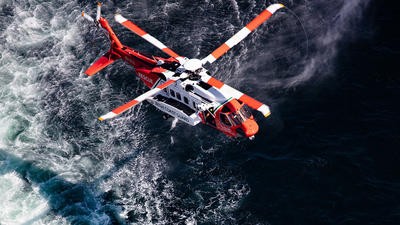
Masini said: “FlySight ensures full versatility for coast guard operations by leveraging a modular, open‑architecture approach designed to meet the unique demands of diverse cabin configurations and mission profiles.”
He explained: “The OPENSIGHT Mission Console is built with flexible open code, allowing bespoke adaptation to specific aircraft setups. Whether installed in a helicopter, fixed-wing aircraft, or multipurpose mission system, the solution can be tailored for rapid integration, customized human–machine interface (HMI) layouts, and mission-specific data layers.
“Through collaborations with different avionics platforms, communication systems and high-performance mission computers, such as with Aitech’s ultra‑compact A172, FlySight ensures exceptional versatility for coast guard operations by leveraging its modular, open‑architecture approach designed to meet the unique demands of diverse cabin configurations and mission profiles.”
SAR tools, sensors, and systems
Military coast guard teams typically rely on a combination of instruments and sensors, according to Chamorro. “These include electro-optical and infrared (EO/IR) cameras, radar systems, automatic identification system (AIS), satellite communications and mobile phone localization systems, such as Lifeseeker developed by Centum, which allow crews on board to locate missing persons via their mobile phones, even in areas without signal or coverage,” he said. “One of the key advantages of Lifeseeker is that it enables detection while flying at normal mission altitude and speed, without the need to adapt flight patterns, a capability that is crucial in time-critical or adverse weather scenarios. Each of these systems plays a complementary role, depending on the mission context and environmental conditions.”
Munro affirmed that the main categories of SAR instruments used by coast guard personnel have remained largely unchanged over the past few decades. “Radar, infrared, radio, and distress beacons have long been the mainstays,” he said. “However, some features have changed dramatically: specifically, accuracy and range have improved, integration and interoperability have advanced, and new technologies have emerged, particularly in cell phone detection, AI, and drones.”
The main instruments or sensors are EO/IR cameras, mounted on helicopters, drones, and fixed-wing aircraft, explained Munro. “These sensors detect heat signatures and provide real-time images in low-light or low-visibility conditions. In addition, radar systems, maritime surveillance radars, can detect vessels, debris, or people in the water from long ranges and in low-visibility conditions,” he said. “Surface search radar identifies targets on the surface of the sea. Synthetic aperture radar provides high-resolution images regardless of weather conditions. Mobile phone detection and localization systems (MPDLS), like our ARTEMIS MPDLS, allow coast guard operators to detect, geolocate and communicate with mobile phones, even in areas without cellular network coverage or during natural disasters. This is a relatively new technology in the field of SAR technology, but it is quickly becoming a de facto standard for any SAR sensor suite.”
Terrain and weather conditions have a significant impact on both flight safety and the performance of detection systems, affirmed Chamorro. “For example, mountainous areas can hinder radar or visual contact, while adverse weather conditions (fog, snow, strong winds) can limit visibility and compromise flight stability. Systems like Lifeseeker can mitigate some of these challenges by helping crews detect and locate people even in areas with no line of sight, in difficult terrain or in adverse weather conditions, providing precise coordinates directly to the rescue team,” he said.
AISs are used to track vessels by transmitting their identity and position, while Cospas-Sarsat systems, such as Inmarsat or Iridium, provide global coverage for emergency radio beacons, either emergency position-indicating radio beacons (EPIRBs), or personal locator beacons (PLBs), explained Munro. “Finally, software and planning tools for SAR missions, such as the Search and Rescue Optimal Planning System (SAROPS) used by the US Coast Guard, are deployed to predict drift, estimate search areas and assign search paths based on wind and current data,” he said. “SAR missions are shaped not only by technology, but also by harsh geographical and climatic realities. Sensor performance and flight crew safety are profoundly affected by environmental conditions.”
Masini was enthusiastic to explain how versatile OPENSIGHT is when integrated with the other mission systems used on board coast guard aircraft: “FlySight’s OPENSIGHT Mission Console is engineered to integrate all these assets into a unified operational picture. Thanks to its open architecture and modular design, OPENSIGHT enables deep interoperability with both legacy and next-generation systems. This includes:
- Real-time fusion of sensor data, displayed on a 3D moving map with data mission overlays
- Custom HMI layouts adapted to the operator’s workflow and aircraft configuration
- Integration with multiple data sources, including tactical radios, mission planning tools, and navigation systems
- Support for AI-powered ATR and enhanced reality features, improving situational awareness and decision-making.”
The flexibility and customizability of a system like this means that operators are able both to perform the wide range of duties and to enhance performance, said Masini: “This [interoperability] ensures that coast guard personnel – whether flying fixed-wing aircraft, helicopters, or operating from mission control centers – can rely on a single, integrated system that enhances safety, performance, and efficiency.”

Emerging technologies
Core technologies continue to improve and military coast guard operators are evolving, not only in how they conduct SAR operations and the technologies they can leverage, but also in the missions they must undertake, according to Munro. “Military coast guard operators are no longer limited to traditional SAR or maritime patrol. Their mission profile is expanding in response to geopolitical, environmental and humanitarian factors, such as climate change/disaster response, migration/maritime humanitarian operations,” he said.
According to Chamorro, there is a clear interest by military coast guard operators in integrating more autonomous systems, e.g. uncrewed aerial vehicles (UAVs), AI-supported search technologies and advanced data fusion capabilities. “The scope of missions is indeed evolving, and coast guard units are increasingly involved in inland search and rescue, civil protection and cross-border collaboration in emergencies,” he said. “As a result, they are looking for tools that offer greater agility, interoperability and real-time intelligence. In this context, the adoption of technologies such as geolocation via mobile phones on board aircraft is growing.”
The current shift is fueling increased investment in emerging technologies that improve speed, accuracy, survivability and range, affirmed Munro. “Tools such as AI-assisted search and pattern recognition, unmanned systems (including air, surface and swarm platforms) and mobile-based SAR are already demonstrating real impact, resulting in more lives saved,” he said. “Importantly, these technologies also bring secondary but significant benefits: by speeding up rescue times, they reduce flight hours, which in turn increases aircraft mean time between failures (MTBF) and reduces the environmental impact of operations, an [unintended] but entirely positive outcome,” he said.
Masini said that FlySight is actively addressing this evolution of emerging technologies by designing its solutions with platform-agnostic versatility: “[This ensures] seamless integration across both traditional crewed aircraft and next-generation uncrewed systems. FlySight supports evolving mission requirements by integrating with advanced sensors, satcom, and tactical data links, ensuring readiness also for multi-domain.
“In this evolving landscape, FlySight’s commitment is to provide flexible, future-ready technology that empowers coast guard forces to operate effectively across a broader mission spectrum – spanning surveillance, SAR, interdiction, and environmental monitoring – regardless of the platform or domain,” he concluded.
More than just a coast guard
Military coast guard units are no longer confined to traditional SAR roles; they are rapidly becoming multifaceted responders equipped to handle a broad spectrum of scenarios, ranging from natural disasters and humanitarian requirements to maritime law enforcement and environmental surveillance. Their effectiveness hinges on a synergy of technology, mission adaptability, and systems integration, enabling crews to respond quickly and decisively in operationally challenging environments.
As the operational scope continues to expand, so too does the demand for advanced tools such as mobile phone geolocation systems, AI-enhanced sensors, and modular interior platforms. With increases in SAR innovation, military coast guards are well positioned to remain leading actors in safeguarding lives and upholding security.
September 2025
Issue
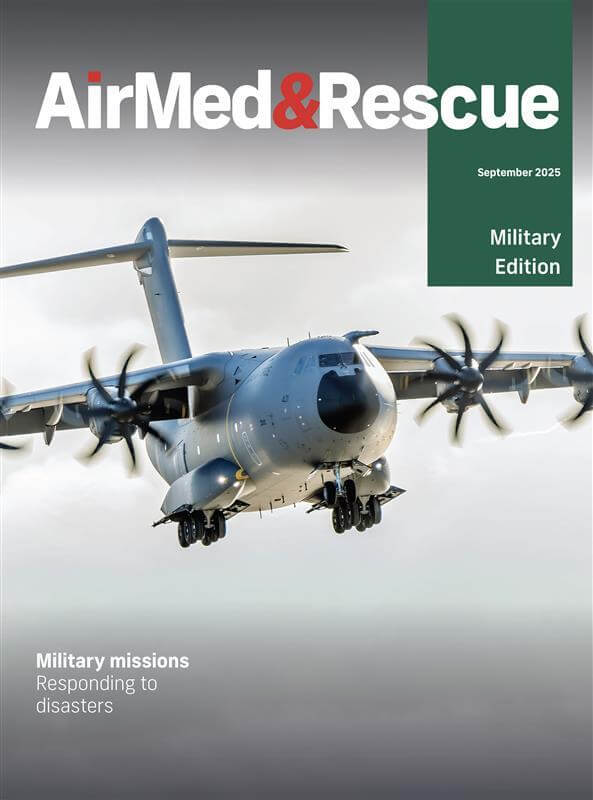
Our September edition is the special military issue, bringing together news, features and other articles that showcase military contributions to special missions. We have themed features on air forces helping with disaster response, the stretchers and baskets that make combat search and rescue possible, and the varied duties of military coast guards, and we have an extra non-themed feature on the medical equipment used in air ambulances.
Editorial Team
The AirMed&Rescue Editorial Team work to ensure timely and relevant news is online every day. With extensive experience and in-depth knowledge of the aerial special missions sector, the team are ready to respond to breaking industry news and investigate topics of interest for our readers.