

Reinforcement learning

The trend in training towards mixed and virtual reality could be matched in years to come by the adoption of artificial intelligence. Rob Coppinger investigates
The challenge we face for the 21st century is how to deliver increasing levels of service while maintaining the safest, most efficient aerospace system in the world,” Federal Aviation Administration (FAA) Associate Administrator for Aviation Safety David Boulter said. “Technology and innovation present tremendous opportunities and challenges for sustainability of the aerospace system.”
The technology and innovation that the FAA has focused on is artificial intelligence (AI), and the agency produced a report in July last year called Roadmap for Artificial Intelligence Safety Assurance. The roadmap links AI to virtual training environments.
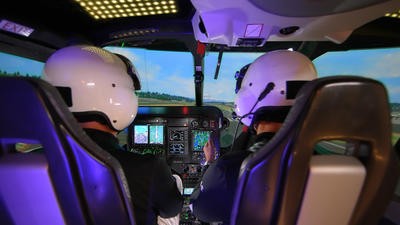
Training providers have been adopting mixed reality (MR) and virtual reality (VR) for pilots and crew operating equipment such as hoists. Atlantic Airways, the national flag carrier of the Faroe Islands, uses MR for hoist training at its new training center. “It’s very, very realistic,” said Atlantic Airways’ Head of Training, Hans Erik G Jakobsen. “The picture that the rescuer has is via the mixed virtual reality goggles, which is the same picture as we have in the AW139 simulator.”
Sky Aviation helicopter services, located west of Milan, Italy, provides training and has also embraced VR. “We’ve already done this, and we are very excited to be able to use the new simulator [with VR] for our training programs,” the firm said.
AI can be trained in virtual environments as well as contributing to the realism in them for pilot and crew training. The FAA report said: “FAA looks forward to working with the aviation industry, other aviation regulators, and US government agencies in executing and refining this roadmap.”
Another regulator is the European Union Aviation Safety Agency (EASA) and it sees AI as being useful for “adaptive training solutions”. In its Artificial Intelligence Roadmap 2.0, published in May 2023, it states: “The use of AI gives rise to adaptive training solutions, where ML [machine learning] could enhance the effectiveness of training activities by leveraging the large amount of data collected during training and operations.”
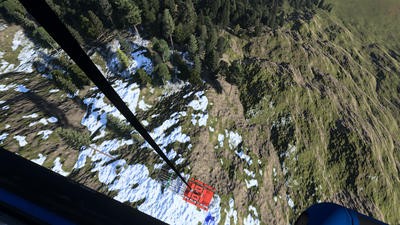
Pilots participate in VR sessions to help them visualize the fire traffic area ahead of getting out there in it
The advantage in using AI for adaptive training solutions can be illustrated by the complexity that aerial firefighting simulations involve. “VR goggles help simulate the cockpit, enhanced by augmented reality, with pilots performing flights including drops and communications with air traffic control, incident controllers, lead planes, helicopters and other aircraft in the fire traffic area,” said Rob Dewar, Director of Training at Spokane, Washington-based Aero-Flite Aerial Firefighting. “VR training is also incorporated into our training program. Pilots participate in VR sessions to help them visualize the fire traffic area ahead of getting out there in it. [This] VR training differs from simulator-type training in that it’s not procedural to the aircraft, it’s procedural to the fire traffic area.” Aero-Flite is a division of Canadian aerial firefighting firm Conair and its staff use the parent company’s full-motion Avro RJ85 Level D simulator at Conair’s Training + Tactics Centre.

Networked brains
“Our Mission Training System (MTS) will continue to evolve,” said Conair’s Business Development Vice President, Jeff Berry. “For instance, pilots in flight training devices (FTDs) around the world could be linked together into the same mission, enabling groups to fly together, practicing over the same virtual fire at the same time. The ability to train together in this type of a virtual setting will help address the challenge of standard operating procedures (SOPs), making it easier for operators to support new regions or integrate as a shared resource between countries.
“We actively listen to our government agency needs and innovate solutions to address those gaps. Incorporating new technologies into our operations, and our training, is part of this process,” he added.
While individuals using a simulator FTD could be in different parts of the world, they would be flying over the same virtual, but accurate, images of a particularly fire-prone region, for example. There has been a lot of publicity around AI generating static and moving images. At Finnish independent helicopter training company CopterSafety, unique scenery has been a selling point for the company’s services. “Based on customers’ needs, Coptersafety’s in-house visual modeling team can create a customized visual scenery which makes the training even more realistic, which, especially for recurrent training, is useful,” explained Coptersafety’s Head of Training, Mikko Kallio.
CopterSafety is yet to adopt VR, but Kallio said: “We are always monitoring the development of training platforms, and are open for new technologies to use as part of a pilot’s training, such as VR. However, thus far our customers have not enquired about the need for additional training platforms.” At Coptersafety, they are seeing the “continued benefits” of Level D full-flight simulators, “and do not see that changing”.
The application of AI and ML to Level D full-flight simulators is obvious to the manufacturers of these high-fidelity FTDs. On its website, simulation technology company CAE states: “As a high-tech company, CAE combines leading-edge digital technologies that use AI and ML algorithms to provide systems the ability to automatically learn and improve from continued use and experience.”
The biggest challenge we face is how quickly we can have our crews certified
While the trend towards VR and MR and their convergence with AI and the use of ML is one that centers of pilot training will see grow, it will not be able to help all the practical challenges the industry faces. “The biggest challenge we face is how quickly we can have our crews certified,” said Aero-Flite General Manager Chris Neimann. “The US Forest Service (USFS) currently cards, or certifies, pilots for aerial firefighting. There are a limited number of USFS pilot inspectors in the country qualified to card all large airtanker pilots. It’s a significant workload, requiring specific criteria and check rides, and therefore a lengthy process.”
Pilot shortages are another practical challenge, as Kallio explained: “It seems that there still is a pilot shortage in both the airline industry and the helicopter industry.” He cited, as causes for the shortages, the large numbers of pilots retiring and helicopter pilots switching to fixed-wing commercial airline piloting. At the same time an expansion in the range of rotary-wing operations has increased helicopter pilot demand, he said.
Investment
Training centers are investing in the latest classroom tools and simulators to address the demand for a wider range of special mission instruction for rotary-wing operations. Sky Aviation uses the Loft Dynamics simulator for the Airbus H125. Sky Aviation said: “The 2025 news is the Loft Dynamics simulator … that can be used for type rating, revalidation, renewal and HESLO (helicopter external sling load operations) 1 training with extended features about HESLO 2, 3, 4 and flying in low-visibility conditions, and all other types of emergency training that are prohibited on [an actual] aircraft.”
Atlantic Airways has conducted its own training since 2016 and had an AW139 simulator provided by Thales. Being so far north with six months of constant daylight, Jakobsen explained, the simulators meant they could now train on night vision all year round. “We decided to build our own AW139 simulator center in the beginning. After a while it became a simulator center where we also included an Airbus A320 and a hoist,” he said. “It is the latest and greatest AW139 with the search and rescue package.”
Atlantic Airways has been building its special simulator center in an adjacent building, and the construction was finished in the beginning of March. “The AW139 simulator was certified in mid-December last year, and the Airbus A320 simulator, which covers the A320 series that is the A319, 20 and 21, was certified [on 17 January 2025].” Jakobsen is particularly pleased with the AW139 simulator as it “reflects totally our helicopters’ abilities”. He meant it has that night vision capability, a hoist, a sling and the cameras used with the sling, a laser pointer, “and many other features”.
Conair has invested heavily for many years in special missions training capabilities, including VR and augmented reality technology. “Our Training + Tactics Simulator Centre is one example of this ability. The investment into this center has exceeded CA$20 million and has taken years to execute,” said Berry. “Over 150 Conair and Aero-Flite pilots train in our specialized simulators, often alongside government agency air attack officers in lead planes.”
Could the AI now in daily use, like ChatGPT or Microsoft Copilot, become guides for students working through technical aircraft systems training?
While VR and MR have been used in conjunction with simulators, they have also had a role in classroom training and so will AI. The e-learning modules on offer today cover every aspect of specific aircraft models, and students can study and train at their own pace while inside and outside the classroom. For ground courses, Coptersafety uses desktop trainers in a classroom training setting for both the Airbus H145 and Leonardo AW139 to familiarize students with the avionics and other systems. Big players in fixed-wing training, such as Lufthansa Aviation Training, are already incorporating AI into their training programs. Lufthansa Aviation Training is testing the use of AI in safety emergency procedure training. Could the AI now in daily use, like ChatGPT or Microsoft Copilot, become guides for students working through technical aircraft systems training?

When AI does start to be applied to simulator systems and desktop learning software, existing regulatory obstacles between the FAA and EASA may point to future challenges for the industry adoption of AI. Under EASA regulations, operators and training organizations have to follow the European agency’s Operational Suitability Data (OSD) flight crew data, which sets requirements for conversion training. But the FAA does not recognize the EASA OSD for helicopters. From the training sector’s side, the roadmaps that the FAA and EASA have drawn up could be challenged by industry players wanting to offer AI features as part their e-learning modules.
From the training sector’s side, the roadmaps that the FAA and EASA have drawn up could be challenged by industry players wanting to offer AI features as part their e-learning modules
Just as changes in aircraft systems can require pilot retraining, AI will also have to undergo regular retraining. The EASA Roadmap 2.0 states: “[T]he continuous safety management process that is introduced in the EASA AI Concept Paper Issue 02 creates a set of additional requirements on the operational phase of the product life cycle which goes beyond existing requirements (and may trigger the need for re-training of AI/ML models).”
While a lot of recent investment across the search and rescue sector has focused on simulators, the FAA and EASA have identified pilot training as an application for AI and so those electronic brains are on their way, they are not science fiction anymore. The certification and safety-first requirements of aviation will mean AI is introduced into the classroom and simulators slowly, but it is coming and, just like VR and MR, in the industry’s next cycle of investment it could become a competitive advantage for training providers.
May 2025
Issue
Our May edition is full of articles centered around training, with features covering pilot training, winch and rear-crew training, and air medical training; as well as a feature in the trend towards longer-range air ambulance transfers; plus we have more of our regular content, with lots of articles highlighting different aspects of training, from startle and surprise management to simulation centers and everything in between.
Rob Coppinger
Rob Coppinger is a veteran aerospace writer whose work has appeared in Flight International, on the BBC, in The Engineer, Live Science, the Aviation Week Network and other publications. He has covered a wide range of subjects from aviation and aerospace technology to space exploration, information technology and engineering. In September 2021, Rob became the editor of SpaceFlight Magazine, a publication by the British Interplanetary Society. He is based in France.