
The vital role of HEMS for islanders

Helicopter emergency medical services (HEMS) represent a vital lifeline for island residents or holidaymakers who are critically ill or injured. HEMS providers share with Lauren Haigh the challenges specific to islands and the protocols and equipment that enable them to deliver effective care in these environments
Remote islands can be idyllic and peaceful settings for residents and holidaymakers alike, but, in emergency medical situations, the secluded nature of these environments can work against them. When road transport is limited, boats are slow and can be unreliable, and medical facilities are hundreds of miles away, HEMS represent a vital bridge between island life and essential healthcare access for seriously ill or injured people.
For HEMS providers, these isolated environments come with unique challenges. “Unlike mainland operations, the geographical and environmental factors of islands demand tailored approaches to ensure effective emergency response,” stated Michael Haines, Helimed 76 Lead Paramedic at Scotland’s Charity Air Ambulance (SCAA). “HEMS serves as a crucial lifeline, significantly reducing response times and providing rapid access to essential care that would otherwise be delayed by lengthy road and ferry transfers.”
Supplying critical care
By providing rapid and direct access to healthcare, HEMS saves lives in time-critical situations, which is crucial for residents and holidaymakers on remote islands where geography, weather and both health and logistical infrastructure can present significant hurdles. Ken Franklin is CEO of HEMS New Zealand, which operates five bases across its South Island, New Zealand, territory. “This is a region that stretches 900km north to south with an average island width of 250km running between the Tasman Sea to the west and the Pacific Ocean on its east,” he told AirMed&Rescue. “With over 5,000km of coastline, the region’s geography is further complicated with a spine of mountains exceeding 3,700m in height tracking along its western edge.”
Franklin shed light on the typical challenges faced by the helicopter air ambulance service: “They include climate, mountainous terrain, extensive coastal territory on the edge of the southern ocean, and a widely distributed population, with many communities remote from tertiary healthcare, which creates an average mission flight time of 1.6 hours.”
Graeme Hedge, CEO and Flight and Rescue Paramedic at HeliPro Fiji, has lived and worked in Fiji since 2000. “Fiji’s healthcare system struggles with a lack of essential medications, outdated equipment and insufficiently trained personnel, leading to suboptimal care,” he asserted. Indeed, HeliPro Fiji is working to enhance Fiji’s healthcare infrastructure and emergency response capabilities, including developing specific protocols tailored to the unique needs of island operations, such as pre-established coordination with local authorities and establishing a medical professional volunteer program to address the shortage of skilled resources.
These island communities have varying levels of healthcare provision, but all require the insertion of critical care teams in cases of serious illness or major trauma for retrieval to definitive care
On the other side of the world, a spokesperson from the Emergency Medical Retrieval Service (EMRS), part of the Scottish Ambulance Service, also highlighted the need for HEMS teams to fill a critical care gap: “These [island] communities have varying levels of healthcare provision, but all require the insertion of critical care teams in cases of serious illness or major trauma for retrieval to definitive care. The clinicians based in these communities are often primary care focused and may be working solo, which means they need rapid support from an expert team should they be called upon to deal with major incidents or substantial accidents.”

Logistical hurdles
A spokesperson from Hawaii Life Flight, a critical care air ambulance provider in Hawaii that operates under the broader umbrella of Global Medical Response (GMR), said that supply chain demands and increased maintenance needs can present challenges unique to providing HEMS services in an island environment: “Due to distance and topography of a tropical location, acquiring supplies, specifically aircraft parts, can have a longer lead time.”
Haines noted that refueling logistics can also prove challenging. “Many islands lack the infrastructure required for helicopter refueling, making longer missions difficult to sustain,” he underlined. “Without prior planning, fuel constraints may restrict the range and duration of HEMS operations, impacting the ability to carry out multiple or extended missions effectively.”
This planning is also necessary for overcoming adverse weather conditions. “High winds, heavy rain, dense fog and storms frequently occur, creating hazardous conditions for flight operations,” stated Haines. “These weather patterns can force delays or cancellations, limiting the availability of HEMS during critical moments. The need to constantly monitor and adapt to these conditions adds a layer of complexity to every mission.”
Preparation is (almost) everything
Overcoming these challenges requires aircraft, equipment and protocols that are tailored to the unique needs of remote island environments. First and foremost, strategy and preparation are essential. “Emergency medical services (EMS) emphasizes meticulous planning and rigorous training,” Hedge highlighted. “The organization develops detailed operational plans for unpredictable island weather and the logistical challenges of reaching remote areas. Scenario-based training ensures that EMS teams are fully prepared for real-life emergencies.”
Haines agreed that strategy is paramount. “These environments, with their unique challenges of remoteness and unpredictable weather, require a strategic approach to ensure successful outcomes. Overcoming these hurdles involves a combination of planning, specialized training, effective communication and resource management,” he verified. “Strategic planning begins well before the helicopter ever leaves the ground. Every day at SCAA, crews on shift conduct detailed briefings, focusing on the latest weather conditions to anticipate potential hazards like high winds, heavy rain or fog. In addition to weather updates, landing sites are carefully identified, ensuring safe areas for the helicopter to land near the incident. On islands where formal helipads may not exist, this planning becomes even more crucial.”
Franklin provided an insight into crew training at HEMS New Zealand. “It includes alpine rescue, marine rescue, multiple-scenario winch training, alpine survival, helicopter underwater escape training (HUET), clinical capability in pre-hospital emergency anesthesia, ultrasound scanning, manikin-based simulation training, in-hospital theatre and intensive care placements, and the administering of blood products,” he stated.
HUET is key in the event of a water crash and this training is important in the context of island emergencies, given that remote islands are often separated from the mainland by significant stretches of water: “With 90% of our missions involving overwater operations, the risks and complexities of HEMS missions increase substantially,” asserted Hedge.
With 90% of our missions involving overwater operations, the risks and complexities of HEMS missions increase substantially
Proximity to water also necessitates thorough aircraft maintenance. “To mitigate corrosion and premature wear to the aircraft due to saltwater, all Global Medical Response (GMR) air assets are routinely cleaned and inspected, and this fleet downtime could cause availability issues for EMS providers if not properly managed,” commented the spokesperson from Hawaii Life Flight. “A robust inventory of supplies, along with an expansive fleet of both rotor-wing and fixed-wing air resources, mitigates challenges and ensures patients have access to critical care air medical transport when needed.”
Close coordination
Comms and coordination are crucial to expediting the delivery of patient care. “Close coordination between air and ground teams is essential in reducing the time it takes to get patients from remote island locations to definitive care,” Haines underlined. “Technical crewmembers (TCMs) are trained to evaluate terrain quickly, allowing the aircraft to land in areas that may be unconventional but safe. In flight, the TCM maintains constant communication with dispatchers or ground crews, coordinating rendezvous points (RVPs) to streamline patient care.”
The spokesperson from EMRS described the Service’s liaison system: “A nominated consultant within our service is responsible for a particular island or remote healthcare location. They act as a point of contact to discuss cases or issues and conduct an annual visit providing feedback, training and education to the rural healthcare team. This often utilizes NHS Education for Scotland’s skills bus [a mobile clinical skills training unit], which can be useful to the local healthcare team to access.”
Advanced communication technologies are essential in maintaining constant contact with ground teams, hospitals and authorities
Key to maintaining communication is the right tech, asserted Hedge: “Advanced communication technologies are essential in maintaining constant contact with ground teams, hospitals and authorities, ensuring effective coordination during missions and the ability to adapt to changing conditions.”
Ben Bradley, CF NTOPS Senior Coordinator, CareFlight, agreed: “CareFlight logistics coordinators will make use of phone communication, both standard and satellite, as well as text-to-email platforms to communicate with patients and crew. Coordinators also have access to annotated satellite maps of the Top End [in Australia’s Northern Territory] to establish potential landing areas and the distance from patients.”

All the gear
Reflecting on the additional equipment utilized in remote rescues, Franklin reported that HEMS New Zealand has invested heavily in flight-assist infrastructure. “This includes dedicated helipads and landing zones, instrument flight rules (IFR) low-level routes, electronic flight bags, Entrol simulator, night vision goggles (NVG) utilization, long-range fuel auxiliary tanks, IFR performance-based navigation (PBN) certification across the fleet, and committing to an ongoing fleet renewal program.”
The spokesperson from EMRS underlined the importance of self-sufficiency, which is facilitated by equipment: “Our equipment is tailored to remote and rural critical care, and we can be entirely self-sufficient. We carry the capability to deliver emergency anesthesia, invasive lines and monitoring, inotropic support, emergency red cell transfusion, mechanical cardiopulmonary resuscitation (CPR) and surgical interventions. Particularly helpful technical solutions in our practice are portable ultrasound (weighing 250g) for chest, abdominal, echo and vascular scans, and point-of-care blood testing (weighing 1kg), giving blood gas, electrolyte and hemoglobin measurements in two to three minutes.”
These systems are vital for navigating Scotland’s often harsh weather and rugged landscapes, especially in coastal or island regions, where conditions can shift rapidly
Haines highlighted the avionics utilized by HEMS helicopters at SCAA: “These include GPS, terrain awareness warning systems and weather radars. These systems are vital for navigating Scotland’s often harsh weather and rugged landscapes, especially in coastal or island regions, where conditions can shift rapidly. Real-time data from mobile weather stations further enhances flight safety, providing pilots [with] real-time information to assess whether landing is possible in challenging elements.”
Haines added that, as well as day missions, many HEMS teams are fully equipped for night flights: “Pilots use NVGs to safely fly in low-light conditions, which is essential when transporting patients from isolated islands where medical transport is needed urgently, regardless of the time of day.”
What next?
After missions, follow-up and reflection are key. “All of our cases get followed up at approximately 24 hours with a call back to the referring center to update them on diagnosis, progress, and the opportunity to discuss the case or retrieval away from the pressure of the clinical event,” said the EMRS spokesperson. “Rural clinicians find this very helpful, not least as hospital discharge paperwork, etc., could be several weeks away.”
Haines agreed: “By combining rigorous pre-flight planning with reflective post-mission analysis, HEMS teams are able to operate more efficiently in the most remote and challenging environments.”
By combining rigorous pre-flight planning with reflective post-mission analysis, HEMS teams are able to operate more efficiently in the most remote and challenging environments
Considering future innovations, Franklin shared the importance of evolving satellite technology, which is key for facilitating operations in areas with limited comms infrastructure: “Increasing the reliability of satellite technology should enable high-speed data and voice transmission, which is beneficial for both aviation and patient-clinical outcomes,” he stated.
Bradley agreed: “Communication innovations such as Starlink are already improving communication with remote areas and will allow increased telehealth services.”
With meticulous planning, seamless comms and advanced equipment, emergency situations on remote islands can be handled in a timely and effective manner.
“Whether it’s working through unpredictable weather, finding a landing site in challenging terrain, or ensuring seamless communication between the teams, overcoming these challenges requires flexibility, decision-making and teamwork at every stage of the mission.” concluded Haines.
January 2025
Issue
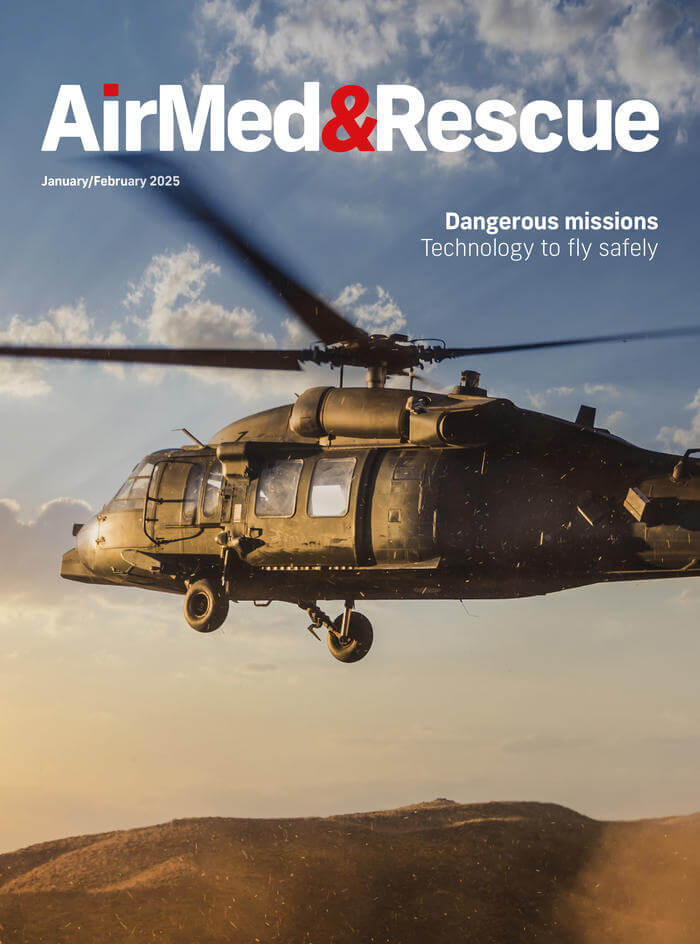
In our combined January/February edition, explore how islanders get emergency medical aid; find out about the way technology is being used to improve safety through increased situational awareness; discover all about hoist systems used in special missions; and see what is coming to the world of aviation in new platforms, technology and equipment; plus more of our regular content.
Lauren Haigh
Lauren has worked in the publishing industry for eight years and reads and writes about healthcare, science and travel insurance on a daily basis. Her favourite aircraft is the plane from the title sequence of British educational children’s TV series Come Outside.