
Special missions engineering for the future

Rotorcraft make highly versatile platforms for special missions operations thanks to their ability to operate at locations without a traditional runway. Chris Croot takes a look at the new systems under development and continuous improvements to existing models
ERC System is a startup aircraft designer and manufacturer hailing from Munich, Germany. The company was formed five years ago with the goal of developing a utility electric vertical takeoff and landing (eVTOL) platform. The system is aimed at providing a rotorcraft that outperforms traditional helicopters in efficiency and operating costs, while offering speed advantages over ground transport options.
AirMed&Rescue joined Dr David Löbl, ERC’s Chief Executive Officer, and Maximilian Oligschläger, Chief Commercial Officer, for an insight into the venture.
ERC was established as a joint venture with the German analysis and test engineering company IABG (Industrieanlagen-Betreibsgesellschaft), which was the founding investor, and German air ambulance provider DRF Luftrettung. The latter is a major helicopter emergency medical services (HEMS) organization with a fleet of 40 Airbus H145s, and, according to ERC’s website, is its “ideological partner whose operational expertise and growing commitment now accelerate our mission”. The third partner is Prof Florian Holzapfel from the Technical University of Munich (TUM), who provides research input and R&D (research and development) guidance.
Nova Systems, an international company founded in 2000 by two Australian veterans – Jim Whalley, a former Royal Australian Air Force fighter pilot, and Peter Nikoloff, a Senior Weapons Systems Engineer – delivers a range of aerospace solutions: “At a big-picture level, Nova Systems is a global provider of services, integration, and products, delivering solutions to make our world safe and secure,” said Gareth Dyer, Nova Systems International Managing Director.
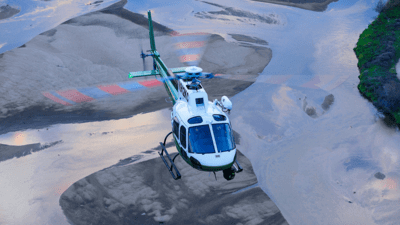
He continued: “We are leaders in systems integration and aircraft modifications; test and evaluation, certification and systems assurance; software and digital solutions; advanced training; and advisory services.” The company works across multiple markets, including defense, emergency and parapublic services, space, mining, utilities, and commercial aerospace. The search and rescue (SAR) sector is a key focus, with major clients including the Dutch Caribbean Coast Guard (DCCG), the UK Search and Rescue Second Generation (UKSAR2G) service, and the Irish Coast Guard (IRCG).
Leonardo is one of the world’s leading aerospace companies with a major division focusing on the design, development, and manufacture of helicopters. Many of the models carry the ‘AW’ prefix, a reference to the former Anglo-Italian company AgustaWestland. Once a subsidiary of Leonardo, it was merged with its parent organization in 2016.
With the exception of the AW249 Fenice, a dedicated attack helicopter currently under development as a replacement for the Italian Army’s fleet of Agusta A129 Mangustas, all of Leonardo’s current products can be adapted for a range of special mission operations. Notably, although marketed as a VIP/executive transport helicopter, the AW139 was modified to meet the demands of the Irish Air Corps, which uses the aircraft not only for traditional military roles, but also to provide a dedicated HEMS service.
AW139 was modified to meet the demands of the Irish Air Corps, which uses the aircraft not only for traditional military roles, but also to provide a dedicated HEMS service
Full-electric and hybrid-electric power options
Following the successful testing of a proof-of-concept system named the Echo, ERC unveiled its first technology demonstrator, the Romeo, in July 2024. A second Romeo is under construction and is planned to begin flight in the second half of 2025. Attention will then turn to the production model, the Charlie.
The Charlie’s design features a crewed and uncrewed option, primarily for military operations. Löbl explained the rationale: “The military has different regulations and criteria when it comes to the mission that you want to serve. But we’re trying to build a company around one aircraft platform; the overall aircraft for multi-piloted manned and unmanned will be very similar.”
ERC’s platform has been designed to penetrate the industry spaces currently occupied by traditional rotary-lift platforms powered by conventional fuels. Oligschläger explained the concept: “It’s a vertical takeoff aircraft, so it takes off like a helicopter, but it flies forward like an airplane. Because [it] has wings, [it’s] a lot more efficient than a helicopter when it comes to forward flight.”
These efficiencies are more notable thanks to the full-electric or hybrid-electric power options. ERC claims electric-powered operating costs are 70% lower than those of helicopters currently employed in the special missions sector: “An electric motor is 50 times cheaper than a turbine, with a lot less operational maintenance. That’s really why we started and said, ‘Okay, let’s build an electric aircraft,’” said Oligschläger. Direct operating costs (without crew) are estimated to be €600–€800 per flight hour.
The aircraft will be primarily manufactured from components adapted or specially developed for ERC, owing to a shortage of eVTOL off-the-shelf products. Cockpit avionics and flight control systems will be sourced from existing technology.
The platform’s primary targeted role is hospital-to-hospital patient transport, but it also has military and civilian cargo transport, and small urban passenger carrier applications. DRF Luftrettung approached ERC after identifying a growing issue across Europe, one which is already established in the USA: the increased centralization of hospitals. This creates larger distances between major healthcare centers for patient transfer, either requiring lengthy road journeys or the use of helicopters. The aircraft is designed to carry one patient, one medical staff member, and the necessary medical equipment. Clamshell doors aid patient ingress and egress.
“Helicopters are already quite constrained because they’re used for primary missions to save patients, and road transport is already suffering, so they (DRF Luftrettung) were looking for an alternative to transport patients very quickly while not using an expensive helicopter,” explained Oligschläger.
DRF Luftrettung were looking for an alternative to transport patients very quickly while not using an expensive helicopter
An aging population is another factor, with an estimated 12 million more patients needing intrahospital transport in the USA and Europe over the next 10 years. “Those two reasons make the medical market very strong and growing, and we saw that there was nobody building an electric aircraft that’s really suitable for transporting a patient,” Oligschläger said.
Due to the dangers of their operating environment, military aircraft are usually modified with ballistic protection, weapons stations, and self-defense suites. These items incur a weight penalty, reducing range, payload, altitude, and speed, or a combination of all. To ensure efficiency remains high, ERC does not intend its aircraft to operate on the front line of a conflict zone; rather, it will provide logistical support, alleviating demand on combat systems. That said, a low noise and thermal signature reduces exposure to small arms and MANPADS (human-portable air defense systems).
The aircraft is being developed with an uncrewed flight capability, eliminating risk to the flight crew. This, alongside its planned low maintenance and reduced personnel requirements, has the potential to significantly enhance the combat effectiveness of military logistical pipelines. It is envisaged that the Charlie’s other major military/parapublic application will be in support of international crisis management: “Anything where you need to transport large amounts of cargo or people within a situation of crisis,” said Oligschläger.
All-weather search and rescue
As previously mentioned, the majority of Leonardo’s products can be configured for a number of special missions operations. Norway’s AW101 All-Weather Search and Rescue Helicopter (NAWSARH), which carries the moniker ‘SAR Queen’, has been engineered to meet the varying demands of the country’s geography and climate. The Scandinavian nation is famously mountainous, and around half of it falls within the Arctic Circle. With more than 63,000m of coastline, Norway has a coast guard responsible for a vast amount of water. Therefore, the Royal Norwegian Air Force (RNoAF) required a platform with endurance, speed and high-altitude performance. To achieve this, Leonardo took its SAR-proven AW101 and upgraded it with all-new systems. At its heart is the Leonardo Osprey 30 active electronically scanned array (AESA), tailored to identify small targets over a wide search area. The radar can operate in two modes simultaneously, allowing the sensor crew to search for maritime targets while the flight crew maintain situational awareness.
The Royal Norwegian Air Force required a platform with endurance, speed and high-altitude performance
The aircraft has also been fitted with a Smith Myers ARTEMIS Mobile Phone Detection & Location Sensor (MPDLS), a generational change in search capability. Even when there is no signal coverage, the technology effectively turns the helicopter into an airborne phone mast and provides a location of the device at ranges of up to 30km. This negates the need for crews to conduct low-level, potentially long-endurance search patterns. This keeps the aircraft at higher altitudes out of the worst weather and reduces the chances of controlled flight into terrain (CFIT). It is also possible to send a text message to the casualty’s phone directly from the helicopter.

Bespoke missions systems
Nova Systems’ next-generation SAR mission system has been installed on 26 aircraft across the DCCG, UKSAR2G, and IRCG contracts. The system uses several onboard sensors to provide real-time information to crewmembers using multiple high-definition touchscreen monitors and cockpit displays. Augmented reality (AR) technology layers vital information on top of video displays, making it simpler for crews to control complex situations and locate those in distress faster.
Special missions operations routinely put aircraft in a range of harsh and variable conditions. Dyer identifies some of the key challenges and stresses as high operational tempo with little downtime; unpredictable environments, including maritime, exposing aircraft to salt-laden or dusty conditions; and extended hovering, increasing strain on power plants and gearboxes.
He also highlighted that special mission aircraft could be equipped with sensors, radar, and communications suites, and mission consoles, which are all exposed to these stresses and challenges. “To manage this, we carry out ground and flight testing and, ultimately, customer acceptance to ensure the mission system is operationally ready.”
To manage this, we carry out ground and flight testing and, ultimately, customer acceptance to ensure the mission system is operationally ready
In 2023, Nova Systems opened a site at Corsham Science Park, Wiltshire, providing a design, production, maintenance, and testing facility. Within the facility is a Systems Integration Laboratory (SIL), which ensures “all equipment selected is robust and mature enough to handle the environment that special mission aircraft operate in”, said Dyer.
The SIL was opened as Nova Systems was developing bespoke SAR systems for Bristow, supporting its contracts for the DCCG and UKSAR2G programs. Nova Systems produced a bespoke missions system for the DCCG and its two Leonardo AW139 helicopters, including an operator-centric console, a modular mission computer providing a “consolidated, fused local operating picture, integrating sensor information from the onboard surveillance camera system”, and an automatic identification system using machine vision camera systems.
This equipment was tested in the SIL and with a dedicated flight test crew before aircraft integration, ensuring it met the requirements of sustained SAR operations. The company says its mission system architecture allows the solution to be compatible across Bristow’s fleet of SAR helicopters, irrespective of aircraft type. “We’re committed to the products we deliver, so we offer systems-level training for operators and maintenance staff alongside a full life-cycle support package for the mission system for up to 15 years as an option for our customers,” Dyer said.
Future growth
Although unable to disclose specifics due to commercial sensitivities, ERC has signed letters of intent (LOIs) with operators within the HEMS community. This should provide the orders needed to sustain the start of manufacturing. “We are working to find the right suppliers and are deep within the concept development for our product, with the timeline for certification and entry to service in 2030,” said Löbl.
Nova Systems seeks continual development and growth of its product offerings. Dyer said: “Nova’s lifesaving search and rescue mission systems, solutions, and geospatial software solutions are significant areas of growth and opportunity. As a global company, we have the benefit of reaching back to Australia and our other locations to share the latest developments and best practice.”
Nova is working on new and improving technologies to further develop its SAR and systems integration work for various airborne law enforcement (ALE) and parapublic special missions aircraft mission system solutions.
These new developments include advanced data communication for more effective means of data communication to and from ground stations and the aircraft, improving situational awareness for all parties and maximizing on-station effectiveness. Operator-centric design improves the ergonomics of both system components and seating consoles to give a better operator experience. The latest and future special missions rotorcraft have/will be capable of conducting longer sorties than previous generations. Therefore, crew stations need to evolve to reduce fatigue during extended missions.
Other developments are the enhanced mission system software: “Our integration of mission system software focus is geared toward more intelligent data fusion, enabling operators to interpret complex information quickly and make better-informed decisions that improve mission outcomes,” said Dyer.
The company continues to seek reductions in equipment weight, preserving the lifting capability and service life of helicopters and improving sensor performance to enhance the quality and availability of data, supporting a wider range of scenarios and contributing directly to mission success. “These improvements are intended to deliver more agile, capable, and user-friendly mission system solutions that adapt to the evolving demands of SAR, ALE, and parapublic missions,” said Dyer.
These improvements are intended to deliver more agile, capable, and user-friendly mission system solutions that adapt to the evolving demands of SAR, ALE, and parapublic missions
Leonardo is not alone in the rotary world and so, like other manufacturers and mission systems providers, must continue to develop its platforms. The company continues to work closely with the RNoAF, refining and advancing the SAR Queen’s capabilities. The aircraft’s automatic flight control system (AFCS), which was specifically designed for the Norwegians, is improved following operator feedback. The results are also shared across other Leonardo platforms operating a similar autopilot.
All new-build AW101s are powered by three General Electric CT7-8E engines (aircraft were previously available with the Rolls-Royce Turbomeca RTM322), providing redundancy during long-range missions. Three engines also aid hot and high operations. As part of its ongoing improvements for the AW101, in 2021 Leonardo launched a performance improvement program aimed at increasing the amount of takeoff power available to pilots. Certification from Italy’s Directorate for Air Armaments and Airworthiness (DAAA) came in May 2024, approving an increase in main gearbox torque rating at takeoff to 117%, up from 112%. The enhancement comes in the form of a software update and is due to begin rollout on RNoAF aircraft in mid-2025 as part of the Norway Software Suite 9 (SS9). Access to an additional 5% torque will be of benefit to RNoAF crews when conducting rescues in mountainous regions.
November 2025
Issue
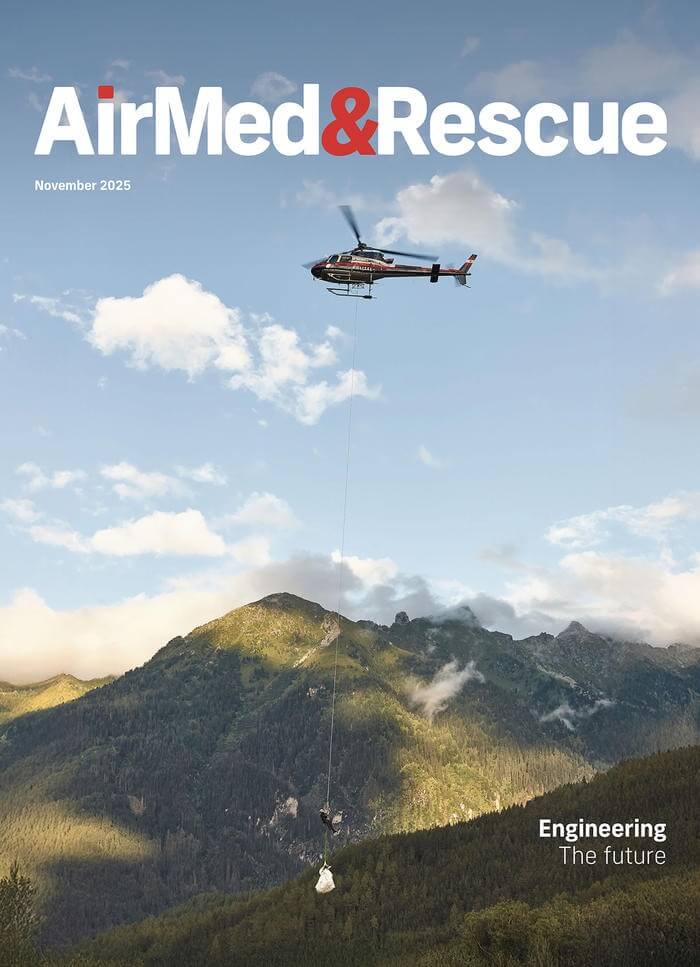
Our November edition is packed with content relating to special missions from around the world. We have features that explore the design and engineering that go into modern rotorcraft; the interactions between ground and air teams on helitack operations; the tools and attire needed for successful water rescues; and the new onboard technology that is revolutionizing special missions by detecting and communicating with cell phones.