

Special report: Grand opening of Atlantic Airways Aviation Academy training center

Adjacent to Vágar Airport, Atlantic Airways’ brand new training and simulation center has had its grand opening. Jon Adams toured the facilities – which boast two full-flight simulators, with a linked rear-crew trainer – and experienced much that the Faroe Islands have to offer
Famed for its beautifully stark and austere geography, the Faroese archipelago is also known for its changeable and severe weather. Ironically, and blessedly, the day of the grand opening of Atlantic Airways Aviation Academy’s training center was a gloriously calm and sunny day, a perfect christening for the center and the simulators, one Airbus A320 full-flight simulator (FFS) by SIM International, and one Leonardo AW139 FFS with linked mixed reality (MR) rear-crew training simulator by Thales. As part of the opening ceremony, guests were treated to cake and champagne, a flight in one of its AW139s, and a tour of the facilities, as well as a tour of several local points of interest and the new Hotel Vágar that will house trainees while attending the academy.
Atlantic Airways
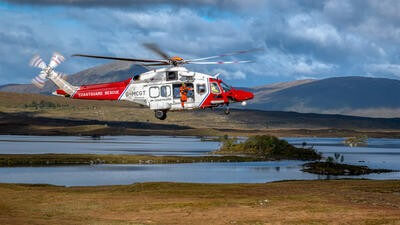
Atlantic Airways was brought about to provide services to the Faroese people by the Faroese people, responding to and supporting their needs. Established in the late 1980s, Atlantic Airways offers international commercial passenger services on its fleet of A320s and local domestic island-hopping flights, as well as emergency medical and search and rescue (SAR) services for missing or injured hikers and people in maritime difficulties, with its AW139s.
In establishing the airline to support a reliable and consistent service for the Faroese people, as well as protect their safety, troubles with ensuring that its pilots and crew were sufficiently trained and kept their flight currency up meant that the decision to create a facility to train its staff in-house was made. The decision was a bold one, as the Faroese Minister for Justice and Internal Affairs, Bjarni K Petersen, said at the ceremony: “To see what was once a dream, and now from the hard work of dedicated and ambitious people come to life, is to me a remarkable feat, and a great leap forward in the history of this resilient and innovative company.”
Highlighting the unforgiving m
To see what was once a dream, and now from the hard work of dedicated and ambitious people come to life, is to me a remarkable feat, and a great leap forward in the history of this resilient and innovative company
arket in which Atlantic Airways operates, Petersen added: “Continuous improvements and innovations are prerequisites for continuous growth in a field which is notorious for its competitive and aggressive nature … Being competitive in the airline industry means you need a skilled workforce and an environment where the best and most skilled pilots want to work. Therefore, I am pleased that [Atlantic Airways] is taking this bold step to establish the Atlantic Airways Aviation Academy, where [its] pilots are ensured optimal training facilities for both helicopter and airliner training.”
Petersen concluded: “It is my hope that the Aviation Academy can carry the torch onwards from our proud maritime history, and develop the aviation workforce, pilots from home and abroad.”

Atlantic Airways Aviation Academy
The rugged location with hundreds of nautical miles of sea border, as well as the changeable and often extreme weather conditions, makes for a challenging environment in which to fly. Atlantic Airways pilots and crew have to be experts in navigating and operating in the worst situations possible, and so they need the best training they can get. Having had to rely on other training sites around the world has put pressure on the crew, so a center of their own makes sense. But having a local center is not the only resource they have. The wealth of experience of their particular geography and climate makes Atlantic Airways well suited to train other people who also need to be at the top of their abilities.
Jóhanna á Bergi, CEO of Atlantic Airways, said: “Today, aviation is not just about defying gravity. Aviation is one of the most extraordinary achievements of humankind. It does more than take us from one place to another. It connects families, drives economies, creates opportunities, and strengthens global understanding. Getting the Faroe Islands flying is more than a convenience, it’s a lifeline. Our airliners link our islands to the world, while our helicopters connect the outer islands, and provide critical emergency services for search and rescue and for medical transport.”
Our airliners link our islands to the world, while our helicopters connect the outer islands, and provide critical emergency services for search and rescue and for medical transport
A Bergi continued: “Today we take an even greater step forward by placing the Faroe Islands on the global aviation training map. To advance and create new opportunities, we have established Atlantic Airways Aviation Academy, a testament to our commitment to excellence, self-sufficiency, and cutting-edge training. This academy will train our Faroese helicopter and fixed-wing pilots, while also welcoming aviation professionals from all over the world.” She added: “At Atlantic Airways, we believe training is not just about learning technical skills, it’s about saving lives.”
AW139 simulator
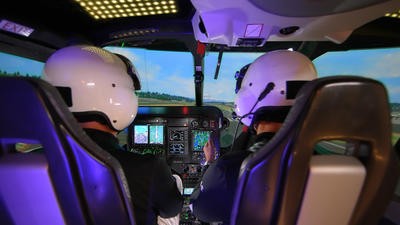
The Thales Reality H AW139 helicopter FFS is a Level D flight simulator training device (FSTD) – the highest level of flight simulator – and has been built to realistically reflect the specific aircraft that Atlantic Airways owns and operates, meaning that crew can train for and replicate missions that occur in visual flight rules (VFR) and instrument flight rules (IFR) conditions, with night vision goggles, and conduct hoist missions, as well as a variety of other situations. There are high-definition visuals for all of Northern Europe, including the UK, Iceland, Scandinavia, Finland and Russia, with specific extra-high-resolution visuals for the Faroe Islands, Stavanger, southern France, and a windfarm.
Additionally, the advanced FFS has the Thales Hexaline system, a six-axis electrically operated motion system that provides three degrees of freedom in all directions, with a high response rate to pilot control inputs, smooth movements, accurate feel and fidelity completing the immersive quality of the simulator.
What also sets this simulator apart is the combined rear-crew trainer that allows the pilots and winch crew to train on the same simulated scenario with linked communications, providing a holistic training experience. The rear-crew trainer is a mixed reality simulator, where crew wear a virtual reality (VR) headset and are able to physically manipulate a hoist line in the simulated environment. The ThalesView image generation system enables the winch crew to lean outside freely and see all around themselves; its view is synchronized with the Reality H FFS’s movement, which means trainees get a consistent combined training experience that improves coordination between pilots and hoist operators.
The ThalesView image generation system enables the winch crew to lean outside freely and see all around themselves; its view is synchronized with the Reality H FFS’s movement, which means trainees get a consistent combined training experience that improves coordination between pilots and hoist operators
The simulators are not only supplied by Thales, but are under a one-year software and two-year hardware guarantee with an optional full support package thereafter for upgrades and servicing.
The construction and installation process was relatively swift and Atlantic Airways reached out to Thales for this project because of Thales’ vast experience in the field, said Remi Du Peloux, COO of Thales Training & Simulation: “We have a lot of experience with helicopter simulators, and also fixed-wing simulators. We have simulators that have been in operation for over 20 years all over the world, and we are known for our FFSs. It was a very good project, and very fast. We only spent two years from [the start of the project] to the end of certification, which is quite short.”
Explaining how this project was able to progress so quickly with Atlantic Airways, Du Peloux said: “It all depends on how we are able to catch the data. It’s important to be able to do some retro-engineering in order to be as close to [replicating] the real helicopter. There was a lot of facility to allow us to capture data. There was also very good cooperation with Leonardo providing data.”

He continued: “We had good access to [Atlantic Airways’] helicopters, but we also have experience because we have other AW139 simulators in Australia and in Norway, so we knew the baseline.”
During the process of the build, Du Peloux said that it was very much a partnership between the two companies, where requirements and adjustments were continually attended to, ensuring that the scenarios and situations were “as close as possible to the reality of the flights that might happen”. Du Peloux also wanted to point out that it wasn’t just transportation, but the simulator was also capable of special operations, enhanced by the mixed reality trainer.
Benoit Broudy, Vice President of Training & Simulation at Thales, agreed: “We are proud that Atlantic Airways has entrusted us with delivering our AW139 Reality H Level D FFS, featuring the innovative integrated hoist trainer powered by mixed reality technology. Developed hand in hand with their flight operations experts, these systems will provide pilots and crewmembers with highly immersive and realistic training, enhancing their proficiency to handle the most complex missions. This successful delivery further strengthens Thales’s position as a leading provider of helicopter simulation and training devices, reaffirming our unwavering commitment to safer skies for all.”
A Bergi added: “The Thales FFS provides our pilots with an unparalleled cockpit experience, essential for mastering the operational challenges they may face in real-world scenarios. We’ve been confident from the beginning that partnering with Thales was the right decision. Their expertise, professionalism, and close collaboration with our team have been instrumental in bringing our vision to life. The AW139 simulator and integrated hoist trainer are key pillars of our Aviation Academy and will ensure world-class, mission-ready training for pilots and crews right here in the Faroe Islands.”
With the new simulator center, we’ve brought all pilot training for fixed- and rotor-wing and world-class SAR/HEMS training to the Faroe Islands
She concluded: “With the new simulator center, we’ve brought all pilot training for fixed- and rotor-wing and world-class SAR/HEMS training to the Faroe Islands. We’re developing a new economic driver for ourselves while also putting the Faroe Islands on the global map by offering pilots worldwide access to the world’s most advanced flight training.”
May 2025
Issue
Our May edition is full of articles centered around training, with features covering pilot training, winch and rear-crew training, and air medical training; as well as a feature in the trend towards longer-range air ambulance transfers; plus we have more of our regular content, with lots of articles highlighting different aspects of training, from startle and surprise management to simulation centers and everything in between.
Jon Adams
Jon is the Editor of AirMed&Rescue. He was previously Editor for Clinical Medicine and Future Healthcare Journal at the Royal College of Physicians before coming to AirMed&Rescue in November 2022. His favorite helicopter is the Army Air Corps Lynx that he saw his father fly while growing up on Army bases.