
Australia’s firefighting surge capacity

A few years after the worst fires in modern Australian history, new capacity and technology have been put in place. Rob Coppinger reports
“What it is trying to do is provide some level of surge capacity across the country and a level of resilience so to speak, such that if the total amount of aircraft that have been directly contracted by the states and territories is exhausted, there’s a way to surge that to provide additional capability,” Aerotech Group CEO Chris Boyd explained, commenting on the changes since the disastrous 2019/20 fire season that saw more than 18 million hectares burn by mid-January 2020. Thirty-three people died, more than 5,900 buildings, including more than 2,800 homes, were destroyed, and an estimated three billion animals were killed or displaced.
Following this historic level of destruction, Australia’s government, its state governments, and its federal government in Canberra held their own inquiries into the disaster, as well as a Royal Commission, which is an independent public inquiry and deemed the highest form of inquiry. An outcome of those inquiries was a decision that Australia needed a sovereign aerial firefighting fleet. This means a fleet that is owned and operated by Australian organizations without any need for third-country involvement. The Australian government is not shying away from the expense this requires and throughout 2024 and 2025, it spent more than A$100 million on the national aerial firefighting capability. These funds are to support Australia’s states and territories to respond to crises within their jurisdictions.
Since those inquiries, the national aerial firefighting capability now comprises about 163 aircraft, including five aircraft contracted and operated on behalf of the Australian government. They are the National Large Air Tanker, the National Lead Plane, one Sikorsky S-61N helicopter, and two Black Hawk helicopters. The government works together with states and territories through the National Aerial Firefighting Centre (NAFC) and the Commissioners and Chief Officers Strategic Committee (CCOSC) to coordinate the national aerial firefighting capability and shape its future. But it is the states and territories that have the primary responsibility to maintain their crisis capabilities.
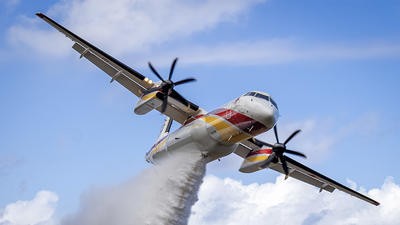
In February, the NAFC required submissions for a tender for the provision of Type 2 and Type 3 rotary-wing services in New South Wales and Victoria. These types are for helicopters able to deliver fire suppressant or retardant to bushfires. These helicopters would be operating during the next fire season at the end of 2026 and beginning of 2027. The NAFC website lists the aircraft contracted to the Centre on behalf of states and territories for this and last year’s season, as of 12 December 2025. They include a lot of helicopters and fixed-wing aircraft, such as the Lockheed Martin Hercules, British Aerospace RJ85, Cessna Caravan and Citation, the crop-duster-style Air Tractors, Beechcraft King Air, and many others.
National fleet
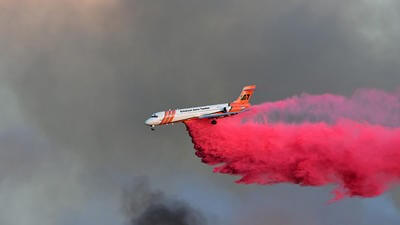
Those aircraft are operated by dozens of companies, including Kestrel Aviation, Pay’s Air Charter, United Aero, Field Air, Kennedy Air, McDermott Aviation, Aerotech, Sydney Helicopters, and Coulson Aviation. One company not listed on the NAFC’s fleet web page is Canadian operator Conair, but it has been there from the start. “In 2021, we partnered with both Queensland and Victoria on separate, but complementary, contracts to create what is essentially the start of a sovereign fleet,” explained Conair’s Director of Business Development, Michael Benson. “The multi-year 168-day exclusive-use joint commitment provided Conair the ability to keep a Dash 8-400AT in the country year-round, without needing to ferry the aircraft back and forth to Canada to operate the North American fire season.”
On the firebombing side, the Black Hawks have been excellent
Aerotech provided two of its Black Hawks for the 2024/25 summer season. Announcing the provision in October 2024, these new helicopters brought the Aerotech Black Hawk fleet to a total of seven. The Black Hawk can drop 4,000L of water per load. “On the firebombing side, the Black Hawks have been excellent,” reported Boyd. Founded in 1968, Aerotech employs 140 people and has a fleet of 40 fixed-wing and rotary aircraft. In October 2024, Boyd said: “The majority of our fleet are based in South Australia over summer, including Parafield Airport, Adelaide Hills, the Mid North, Mount Gambier, and Port Lincoln.” At the time, Aerotech had several aircraft fighting fires in Queensland and the Northern Territory.
McDermott Aviation Founder and CEO John McDermott summarized recent fire activity as “a very mundane fire season up north; in Queensland and New South Wales [it] was relatively quiet as well – certainly the northern part of New South Wales. Victoria has had a couple of very big runs of big fires and Victoria is very well set up to respond to initial attack. Tasmania’s been quite busy. Not crazy flat out, but it’s an every-couple-of-years sort of season with Tasmania. And Western Australia’s just been steady; not a lot happening, but there always seems to be something happening. They’re very well set up with their aerial firefighting program.” McDermott sees the whole of Australia as being in a better position following the disastrous fires of 2019/20. “I think we’re all better prepared now. There’s been an emphasis on longer service periods – that is the amount of days in the year that we’re on contract. And I think Australians are very generally very proactive with their aerial firefighters.”
I think we’re all better prepared now. There’s been an emphasis on longer service periods – that is the amount of days in the year that we’re on contract. And I think Australians are very generally very proactive with their aerial firefighters
Conair has been operating in Queensland and Victoria. “This season Conair is operating three airtankers in the country under four long-term, multi-year contracts: two Dash 8-400AT plus one RJ85,” Benson said. “The season started 1 September 2025 with a Dash 8-400AT beginning operations in Bundaberg, Queensland. This aircraft finished its contract at the end of November, moving to Avalon, Victoria, until the end of February.” Conair works with Field Air, which has a maintenance arm and has opened a large hangar in Ballarat, Victoria, providing space for aircraft like the Dash 8-400AT. This new facility is for maintenance personnel to perform inspections, repairs, and systems checks, months and hundreds of hours in advance of regulatory or original equipment manufacturers’ thresholds.
Maintaining the advantage
McDermott Aviation has recognized the need for increased maintenance for the industry. “We’ve employed about an additional 15 apprentices over the last 12 months to make up for a world shortage in engineering support, and that’s mainly in Australia,” said McDermott. He has also expanded the company’s footprint in Canada. “We bought TransWest [Helicopters] purely as a maintenance organization. The fact that they can do aerial firefighting is just an add-on and an advantage, but that [firefighting] was not the criteria to expand our maintenance repair organization’s capabilities into Canada.”

Meanwhile Canada’s Conair is aiming to “start filling this new [Field Air] hangar with more Dash 8-400AT airtankers in the future, growing the aerial firefighting fleet in Australia, with logistics, maintenance and crewing performed in country,” commented Benson. “Performing this critical maintenance, which often lasts four to six weeks, indoors is vital as many of the non-destructive testing, structural work, and detailed inspections require a controlled environment, proper tooling, and engineering support. Performing this work on a ramp, in dust, wind, or limited visibility due to smoke or daylight, can be unsafe for both technicians and aircraft.”
The growing aerial firefighting fleet has a big advantage, as Boyd explained: “What it does do is that it enables aircraft that are permanently based in a particular state, they can now go and be fully committed to a fire, and other aircraft from the national fleet can backfill them. So that now, you’ve managed that risk that has now become exposed because those aircraft are off working.” Speaking in February, he said of the remainder of the 2025/26 season, “we’ve probably got another month of hot weather ahead of us. But really, we’ve got another two months of dry weather ahead of us. So, yeah, the season still goes on for quite a while.”
Commenting on how the season had progressed, he added: “We had a couple of other fires early on in the season. So, more than average I would say.” He found that South Australia had been “busier than usual”. In February, Aerotech was ending its work helping to put out a major fire in the Deep Creek area of South Australia. “We’re just about to finish up or have wrapped up the Deep Creek fire down on the southern peninsula in South Australia. And that’s been very busy. At one stage, we had five Black Hawks working simultaneously on that, so about five fixed-wing and rotary-wing platforms doing the air attack supervision and also aerial intelligence gathering with infrared (IR) camera systems.”
You can actually see street names in front of you. You can tell the camera where to pan directly to whatever assets are under threat. And then all of that is being live-streamed either through a satellite or a cellular connection back into the headquarters
Boyd described the camera systems that are available and those his fleet use as “phenomenal”, with the ability to provide “really clear” pictures and add augmented reality overlays. “So, you’ve got your picture there, but you can actually see street names in front of you. You can tell the camera where to pan directly to whatever assets are under threat. And then all of that is being live-streamed either through a satellite or a cellular connection back into the headquarters.” That real-time connection also means those fighting the fire in the air and on the ground can know where everyone is.
“FireMapper is a program that’s used quite a lot now in the industry. It’s a tablet-based application and most of the time now we’re fighting fires where there’s really good cellular connection,” Boyd explained. “We’ve got 4G, 5G most of the time now, so you can have everyone on that, and when I talk about ‘everyone’ I mean the air attack supervisor, air observers.” While aircraft dropping retardant and suppressants are focused on flying at low level and are unable to look at a tablet, their situational awareness can still benefit. “You can be saying [to them], ‘Okay, I’m over on the eastern side of this fire and I can see there is an asset under threat.’ I can mark that there and then convey that to the air attack supervisor to direct resources over there,” Boyd added.
Five years ago, Australia faced a global warming worst-case scenario as tens of millions of hectares burned, taking homes, businesses, and lives with it. Today, while the bushfire threat has not been as great this year, the decisions made have provided the country with a privately owned and operated, government-funded, national fleet to meet the future challenge. Combined with improved networking capabilities to direct those augmented resources at the emerging threats, “all of that information is now really readily available”, commented Boyd. “It’s the crews, as we all know, on the ground that put the fires out. So, if you’ve seen something or there’s a strategic break that needs to be put in or there is a strategic break that’s being put in, and you don’t want to put it out because it’s a back burn,” that information is on the tablet. “Previously to [do] that you had to give that situational awareness, that mental picture, over the radio. And that can be done, but it’s nowhere near as efficient as having a picture right there.” The picture has certainly improved.
June 2026
Issue
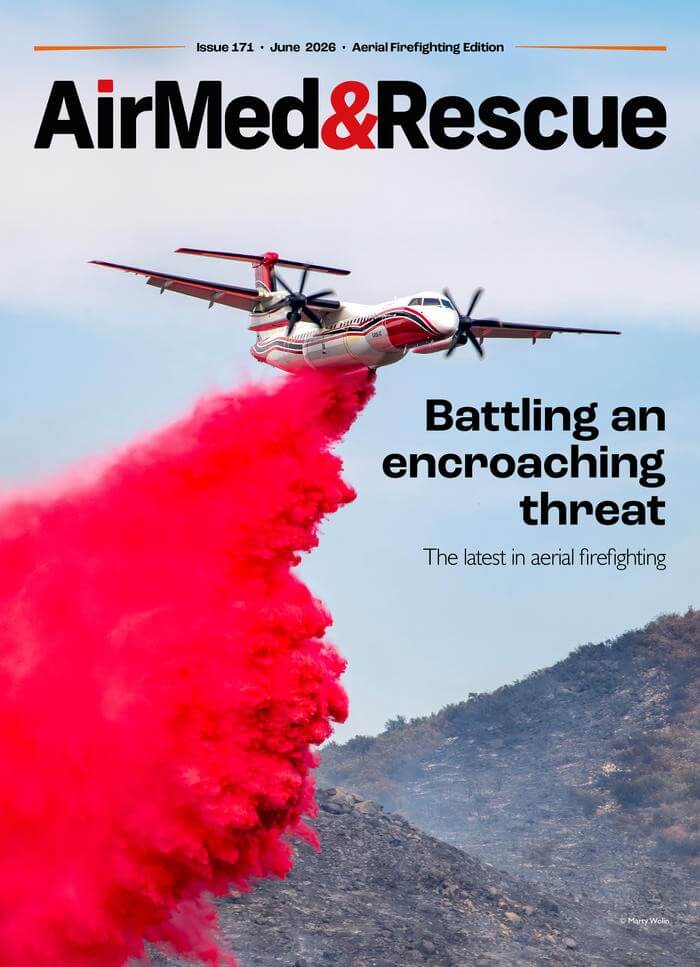
As the northern hemisphere heats up for another hot summer, I’m pleased to bring you the aerial firefighting edition of AirMed&Rescue. We have features on how climate change is accelerating firefighting technology; the improvements in Australian firefighting capacity; and getting ahead of wildfires before they become unmanageable.
Rob Coppinger
Rob Coppinger is a veteran aerospace writer whose work has appeared in Flight International, on the BBC, in The Engineer, Live Science, the Aviation Week Network and other publications. He has covered a wide range of subjects from aviation and aerospace technology to space exploration, information technology and engineering. In September 2021, Rob became the editor of SpaceFlight Magazine, a publication by the British Interplanetary Society. He is based in France.