

EU to the rescEU

Chris Croot reports on the reshaping of the European Union’s rescEU aerial firefighting fleet with new, dedicated aircraft
Wildfires in Europe are growing in both scale and intensity. The fire season is starting sooner and finishing later, and its geographical range is growing.
Mediterranean nations have been using aircraft to attack fires for many years, but states are beginning to see their resources stretched as they respond domestically and in support of their neighbors.
RescEU background
In 2019, the European Union (EU) strengthened the collective European response to disasters with the development of a strategic reserve called rescEU. “It provides an additional layer of protection for citizens when member states’ capacities are already fully used, and no assets are available in the European Civil Protection Pool,” said European Commission Spokesperson for Preparedness Eva Hrncirova.
This reserve includes firefighting aircraft, generators, medical and personal protective equipment, medical evacuation capacities, and a medical team trained to establish a field hospital.
Hrncirova highlighted that epidemics, flash floods, storms, earthquakes, human-induced disasters, and wildfires continuously put pressure on EU member nations’ crisis response capacities. In response to the Covid-19 pandemic, utilizing rescEU distribution centers, the EU distributed tens of thousands of protective masks, medical gloves, and ventilators to countries most in need.
Following the Russian invasion of Ukraine in 2022, the EU deployed medical evacuation services, supported by rescEU and its medical (including chemical, biological, radiological and nuclear (CBRN) medical countermeasures and equipment), energy, and shelter stockpiles in various locations across the Union. Power generators and thousands of shelters were also sent to Ukraine and the surrounding region to aid those displaced by the conflict.
Wildfire support
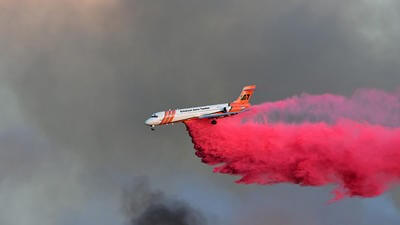
To fight wildfires, the European Commission formed teams of firefighters and a fleet of 18 firefighting planes and four helicopters across 10 member states, to respond when needed. These are part of a participating nation’s respective fleet and do not belong to rescEU, though their operational costs are covered by the Commission.
When a nation faces a wildfire it is unable to contain with its own assets, a request for assistance is submitted to the EU’s Emergency Response Coordination Centre (ERCC). These requests outline the threat being faced and what additional assets the nation believes it requires to tackle the fire. Fellow nations review those requests and pledge what support they can. When assets are deployed to support, up to 75% of the operational cost can be covered for the requesting nation. If no nations are able to support, the standby
fleet is activated. The ERCC then directs member nations accordingly, ensuring a coordinated and efficient response. Hrncirova added: “This initiative complements other measures under the EU Civil Protection Mechanism, including the use of pre-positioned ground firefighting teams to ensure a prompt response in wildfire-prone countries.”
The EU Civil Protection Mechanism (UCPM), with the ERCC at its core, is available to all member states and 10 participating states (Albania, Bosnia and Herzegovina, Iceland, Moldova, Montenegro, North Macedonia, Norway, Serbia, Turkey, and Ukraine). Hrncirova told AirMed&Rescue that interest in rescEU was high not only within the Union and participating states, but also among other countries who were “eager to enhance best practices and lessons learned on rescEU implementation since 2019”. While any nation can request assistance from the Mechanism, only EU members and participating states can host capacities under rescEU.
“The European Commission attaches great importance to preparedness and considers the risk landscape,” she said. “RescEU capacities are developed based on projects put forward by relevant EU member states or participating states in response to an invitation to submit proposals launched by the Commission. All EU member states and participating states are informed about relevant rescEU implementation activities via regular meetings of the Civil Protection Committee.”
The European Commission attaches great importance to preparedness and considers the risk landscape
In 2025, the UCPM was activated 64 times, of which 19 were in response to wildfires. “2025 saw Europe’s worst wildfire season in 19 years. No country can contain disasters of this scale alone. When a wildfire-hit country needs assistance, firefighters from across the continent can step in to reinforce local crews on the front line. Those who risk their lives on the front line deserve the full weight of European solidarity behind them,” Hrncirova said.

European fleets
Many continental European nations maintain their own fleets of either dedicated or aerial firefighting-capable aircraft. Notable fleets include France’s Sécurité Civile (Airbus Helicopters EC145, Bombardier CL-415 and Dash 8-400MRE), the Spanish Air and Space Force (Canadair CL-215T and Bombardier CL-415), the Hellenic Air Force (Canadair CL-215, Bombardier CL-415, PZL Mielec M-18, Sikorsky S-64 Skycrane, and Eurocopter AS332 Super Puma) and the Croatian Air Force (Air Tractor AT-802 and Bombardier CL-415). Other platforms can be utilized to support aerial firefighting operations; for example, the Romanian Air Force uses its Leonardo C-27J Spartans to dispense boxes of water or retardant.
Conair Group is a Canadian organization with a fleet of more than 70 aerial firefighting aircraft, operating under contracts across the globe. It also manufactures large airtankers, notably the Dash 8-Q400. The Sécurité Civile operates eight of these multi-role aircraft, delivered between 2005 and 2023: “In addition to sales, we’ve supported France through contracted services, sending a Dash 8-400AT from our fleet to bolster their response when needed,” said Michael Benson, Director of Business Development at Conair.
In 2023, Conair provided a Dash 8-400AT from its own fleet to France, in order to support the wildfire season: “It operated in the nation with our crew and maintenance team. We worked seamlessly with France under their direction, an extension of their own team, with a translator positioned in the cockpit to ensure accurate and efficient communications between the agency, other aircraft, and ground crews,” said Benson.
Portugal-based Avincis is the largest commercial provider of aerial emergency services in Europe. The company provides aerial firefighting capabilities in Spain, Portugal, and Italy, but routinely deploys its fleet across Europe in support of rescEU missions.
Avincis is the largest private operator of Canadair aircraft globally, with five CL-215s and 18 CL-415s. The CL-415 fleet is contracted to Italy’s Vigili del Fuoco, while three CL-215s provide national coverage for Portugal.
Rotary firefighting is provided by the Airbus Helicopters AS332 L2 Super Puma and Bell 212 and 412s. Smaller AS350s and AS355s are used for fire reconnaissance, assessment, and coordination; one AS350 fulfills this role in Portugal. In 2025, the company was awarded three new contracts in Spain, utilizing Super Pumas and Bell 412s for personnel transportation and waterbombing in support of the country’s Ministry for Ecological Transition and the Demographic Challenge (MITECO) and the regional government of Castilla-La Mancha.
Dedicated rescEU fleet
In response to increasing demand, the EU has strengthened its collective readiness by doubling the rescEU aerial fleet in addition to the pooled resources from 27 member states and 10 UCPM participating countries.
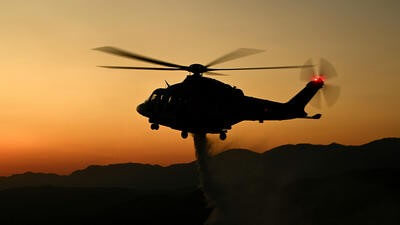
The European Commission has provided €600 million to fund the acquisition of a dedicated fleet. In total, 12 new De Havilland Canadair 515s are to be based in Portugal, Spain, France, Italy, Croatia, and Greece, along with five new Sikorsky S-70 Black Hawks. One helicopter each will be based in Slovakia, Czechia, and Romania; the basing location for the remaining two is still to be decided. The first 515s are due to be in place for the 2028 fire season; the first Black Hawk was delivered to Romania in December 2025 and is due to be operational later in 2026. The aircraft will form a permanent rescEU fleet and be in place to respond to support requests when no other national assets are available. As the EU funds all operational and training costs, availability is guaranteed (excluding serviceability or weather restrictions).
Romania’s Ministry of Internal Affairs will operate the rescEU-funded S-70M Black Hawk based in the country, alongside its state-owned fleets of 12 S-70Ms and Airbus H135s and H145s.
“The Black Hawk was delivered faster than expected,” said Dr Raed Arafat, Secretary of State at the Romanian Ministry of Internal Affairs, Head of the Department for Emergency Situations. The aircraft will be a welcome asset for the region; Dr Arafat described difficulties tackling wildfires in Bulgaria in 2024, with efforts by ground firefighters hampered by difficult terrain. He added that the Black Hawk was a durable and tested helicopter, with the performance required to lift medium loads in hot and high conditions.
The rescEU Black Hawk will be based at Bucharest International Airport, with other domestic rotary assets tactically deployed across Romania. When employed in support of either firefighting efforts in-country or when deployed to fellow rescEU member states, the Black Hawk will typically fly from airfields or airports. However, should a fire site be remote, fuel tankers will establish refueling points. Water will also be brought to the site, filling man-made pools, and allowing the aircraft to remain closer to the fire.
Should a fire site be remote, fuel tankers will establish refueling points. Water will also be brought to the site, filling man-made pools, and allowing the aircraft to remain closer to the fire
Dr Arafat explained that until the new rescEU fleet was fully operational, some assets across Europe would temporarily be brought under the umbrella, the transition process being managed by the ERCC.

RescEU integration
Although not state-owned assets, Avincis’ aircraft are available to support firefighting tasks outside of their national contracts: “The fleet regularly supports rescEU missions,” said an Avincis spokesperson. “In 2024/25, Avincis deployed aircraft in support of rescEU to Albania, Greece, Israel, Montenegro, Portugal, and Spain. The rescEU has proven to be an effective mechanism for pooling rescuers and combating wildfires that local teams are unable to control on the ground. We are very proud to support this initiative.”
Conair will continue to offer contract support to European nations in addition to growing fleets, as Conair explained: “As European wildfires grow more frequent and intense, we anticipate more countries will add airtankers to enhance their waterbomber fleets, using all the tools available for effective operations.”
As European wildfires grow more frequent and intense, we anticipate more countries will add airtankers to enhance their waterbomber fleets, using all the tools available for effective operations
Technological assistance
The European Forest Fire Information System (EFFIS) uses a combination of data sources to provide comprehensive information throughout the wildfire cycle. It integrates data from meteorological models to generate daily fire danger forecasts and to help in proactive prevention.
Satellites are used to provide early fire detection by spotting thermal anomalies. These sun-synchronous, near-polar orbit moderate resolution satellites offer near real-time tracking of fires and mapping of burnt areas, a valuable tool for response coordination.
Data from the EFFIS suggests Europe’s wildfire reality is changing, as Hrncirova explained: “The data gathered so far for the 2025 fire season further confirms the growing trend. 2025 was the worst wildfire year since records began in 2006.”
Support with tanks
Kentucky-based Recoil Aerospace designs and develops aerial fire suppression systems (AFSS), multi-mission internal utility tanks, and auxiliary fuel systems.
The company offers two versions of its Tsunami system for helicopters: an external belly tank capable of delivering up to 1,000gal in five to seven seconds and refilling in 35–40 seconds, and an internal AFSS 790gal tank with a five-second release and 25–30-second refill time.
The Tsunami system is certified for use with Super Puma and Black Hawk family aircraft. “Recoil is actively working with European agencies to incorporate our Tsunami systems to Super Pumas and UH-60/S-70s. Recoil stands ready to support the mission of the rescEU,” said Ray Whaley, Customer Service/Product Support Manager at Recoil Aerospace. Current European operators of the system include the Portuguese Air Force, Heli Austria, Lions Air Group, and Kitz-Air.
Recoil identifies the increasing demand of European wildfires as a key area for business growth: “We want to be the first choice in the European firefighting sector as our focus is delivering a quality product and backing it up with superior customer service,” said Whaley.
He pointed to the requirement to support growing aerial firefighting fleets with water dispensing systems: “As new aircraft are being procured for the aerial firefighting mission, tanks will be needed to accompany those aircraft. As missions are being flown and new feedback is received, we will support our customers either through modifications to existing systems or the development of new systems in the future.
April 2026
Issue
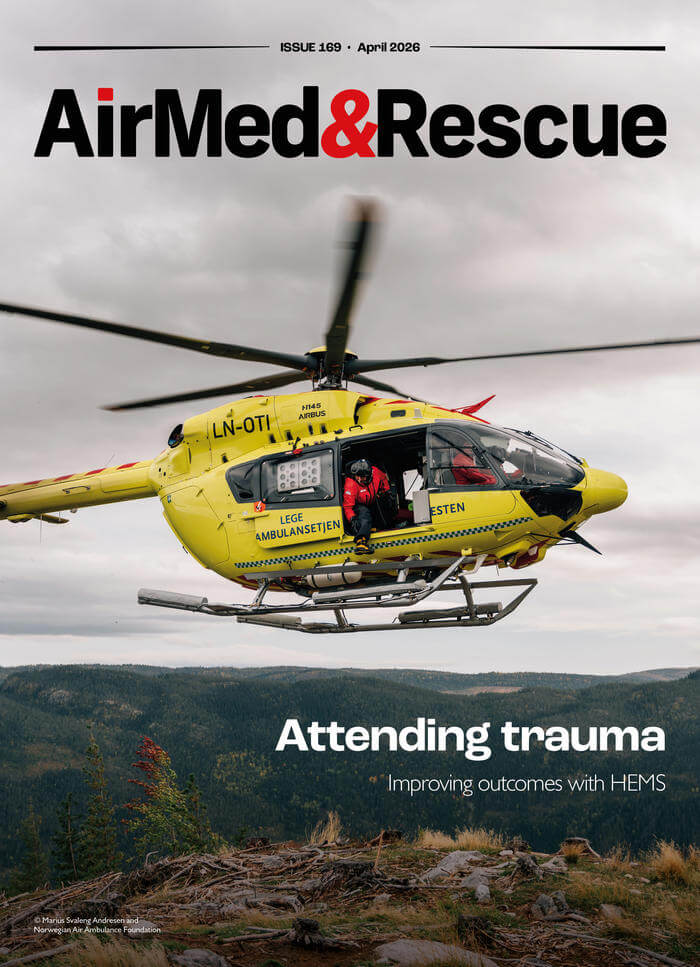
Launching into spring, we have another great edition covering the world of airborne special missions. We have features on the European approach to aerial firefighting; how maintenance, repair, and overhaul companies are still managing the complex supply chain environment; neonatal transfers in regions that are not conducive to easy ground transport; and how helicopter emergency medical services deal with attending to traumatic accidents and injuries.