
Wrestling with an octopus: fighting the January 2025 LA fires

Terrible wildfires are increasingly common, so when the Palisades and Eaton fires made headlines in early January 2025, they were shocking but not surprising. Barry D Smith investigates the contributing factors and the aerial response to this disaster
Southern California offers a unique setting for wildland fires. Densely populated canyons are covered in explosively flammable brush. The homes are often accessible only over narrow, winding roads for fire trucks, which also makes evacuation difficult. The final ingredient for potential disaster are the Santa Ana winds. These winds are common in late fall and early winter. They are warm and dry, blowing from the inland deserts to the ocean, and can reach hurricane velocities.
On 7 January 2025, a spark in some grass started a fire that become one of the most costly in US history. Called the Palisades fire, it was the first of several fires in the Los Angeles area during January that killed 31 people, destroyed over 16,000 homes and structures, and burned over 55,000 acres. The winds were so intense that, at times, airtankers and helicopters could not fly. The initial impression of seasoned firefighting pilots was overwhelming. AirMed&Rescue spoke with personnel from several different agencies and private contractors to find out how the aerial fire fight was organized and executed. One described it as someone pouring a giant bucket of burning gasoline over the top of a mountain. Another compared it to an octopus, as burning embers would blow along the ground and create long, thin arms of intense flames.
Luckily, the US National Weather Service tracks conditions that can lead to increased fire danger and issue fire weather warnings based on forecasted temperatures, humidity levels, and wind speeds. Santa Ana winds can also be predicted several days in advance. This allows state and local fire agencies to increase personnel, staff additional fire engines and aircraft, and reposition resources closer to the predicted hazard areas.
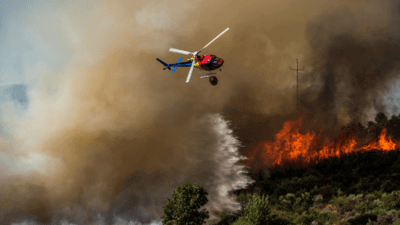
“We normally staff two of our five water-dropping helicopters each day,” explained Dan Child, Air Operations Chief Pilot for the Los Angeles City Fire Department. “When a Fire Weather Watch is issued, we staff an extra helicopter as well as aviation ground support personnel. We also contact all the pilots to see what their availability to come into work is for the next several days. When the Palisades fire started, I recalled all the pilots, even one who was 3,000 miles away on vacation.” Other departments have similar protocols in place to maximize pilot availability.
Preparation was essential for being able to draw upon and deploy assets, said Chris Niemann, General Manager of Aero-Flite and President and CEO of Conair Group Inc: “In the past, almost our entire fleet would be unavailable in January for heavy maintenance, proactively completing inspections and repairs months ahead of regulatory requirements to ensure full readiness for the fire season. But fire seasons have become fire years, and agencies now need support year round. In response, Aero Flite expanded our hangar capacity, adjusted maintenance schedules, and grew the fleet to ensure aircraft are available whenever needed. That preparation gave us the ability to deploy six large aircraft to California on very short notice last year, the largest initial attack response in the nation from a private contractor. Our full fleet was represented – RJ85 airtankers, CL-415 water scoopers, and the Dash 8-400AT, a diverse group working together to support firefighters, dropping water to cool flames and retardant to slow them.”
Wind, whether in rural or urban areas, is always a challenge in wildfire aviation. Although, wind is only one factor; smoke, debris, and extreme fire behavior also play a role
However, conditions can prove challenging and safety is always a priority, Niemann explained: “Wind, whether in rural or urban areas, is always a challenge in wildfire aviation. Although, wind is only one factor; smoke, debris, and extreme fire behavior also play a role. Under hot, dry, windy conditions, fires can create their own weather, including lightning and fire whirls, making aerial response unsafe. In extreme winds, drops also become ineffective, with water evaporating before reaching the ground and retardant dispersing too widely to form a proper containment line. Aerial firefighting is more complex than most commercial flying, with unique requirements to operate at low levels, often in unpredictable terrain and challenging environmental conditions. Safety is our number one priority and that sometimes means local conditions can keep aircraft from flying.”
Boosting resources
At the state level, the California Department of Forestry and Fire Protection (CAL FIRE) is converting seven ex-US Coast Guard C-130s to 4,000gal airtankers. Two were active during the 2024–25 fire season. Five will be based at airtanker bases around the state with two held as maintenance reserve ships. In addition to being used as initial attack ships from their assigned bases, they will be pre-positioned to areas of the state under a Fire Weather Watch. One was used on the Palisades fire.
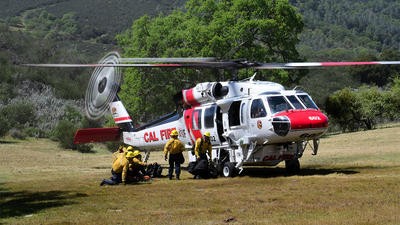
CAL FIRE recently took delivery of its 16th, and last, Lockheed S-70i Firehawk. Ten will be used at CAL FIRE’s helicopter bases. The others will be used as maintenance relief ships as well as a source of surge helicopters for large-scale emergencies anywhere in the state. They are all equipped for hoist rescues and are capable of handling rescues during floods and earthquakes. Four were sent from headquarters in Sacramento to work day and night shifts on the LA fires.
CAL FIRE recently took delivery of its 16th, and last, Lockheed S-70i Firehawk
Key to California’s efficient firefighting efforts are the mutual aid agreements established between the state’s hundreds of firefighting agencies. But, in order to be effective, all the agencies must follow the same standards. Firefighting Resources of California Organized for Potential Emergencies (FIRESCOPE) is a state-wide entity created to develop common standards of operation, communication, and training so all the fire/rescue agencies in California can work together during emergency responses seamlessly. This paid off during the fires in Los Angeles in January 2025 with dozens of different agencies, both in the air and on the ground, able to work together under the same incident command system developed by FIRESCOPE.
The next piece of the puzzle is obtaining aerial assets. In California, there are three basic ways to obtain aerial firefighting resources. First, there are pre-existing mutual aid agreements in place between government agencies. These agreements specify that a certain number of aircraft will be made available upon request. Secondly, there are the civilian fixed-wing airtankers and helicopter operators. These companies have aircraft and crews that have already been certified and trained to one common standard to drop water or retardant on a fire. Finally, the military can be requested to send the Modular Airborne Fire Fighting System (MAFFS), C-130 fixed-wing tankers. Army National Guard UH-60 Black Hawks and CH-47 Chinooks equipped with water buckets can also be requested. During the January 2025 fires in LA, all of the these resources were tapped.
“For these fires, close to 100 fixed-wing and helicopters were used,” stated Paul Karpus, the Air Operations Branch Director for the LA fires. “Managing the logistics of operating so many aircraft was a big challenge. The first step was where do you put all the aircraft. We had to find locations where the aircraft could be parked and maintained between missions. Between the Palisades and Eaton fires, we established five helicopter bases. That didn’t include the local fire agencies that had their own helicopters. They returned to their home bases between missions. So each base had to have its own logistical and operations personnel and organization. The helibase at Camarillo at one point had 40 aircraft assigned to it.
For these fires, close to 100 fixed-wing and helicopters were used. Managing the logistics of operating so many aircraft was a big challenge
“With the aircraft spread out over a large geographic area, the next challenge was how to dispatch them. Normally, the helicopter crews all meet together every morning for a briefing when there is only one helibase. We couldn’t do that on these fires. We ended up using phone and text messaging apps. After the first 48 hours, we had developed a pretty smooth process to communicate with and dispatch the helicopters.”
They were able to quickly develop a briefing system that worked well. Using the team app, day and evening briefings were held with the management of all of the helibases and airtanker bases, as well as the airborne helicopter coordinators and air tactics group supervisors who had direct control of the aircraft over the fire. All this worked well because of the standard operating procedures developed through FIRESCOPE and the many years that CAL FIRE and the local agencies with aerial firefighting assets had been working together.
Explaining the availability of some of the resources during the time of the crisis, Ray Whaley, Product Support Manager at Recoil Aerospace, said: “While Recoil didn't participate during the Palisades fires ,the USFS contracted our Tsunami Internal Aerial Fire Suppression System Tanks to be on station with a UH60 belonging to Central Copters into high fire risk area of Truckee ,CA to protect high value real estate. Our Recoil External tanks were also deployed with South Korea 119 Emergency Services as they were actively fighting fires during the same timeframe as the Palisades fires.”

Always mission ready
With the fire season stretched out much longer and major fires possible year round, it is important to not have too many aircraft undergoing major maintenance at the same time to allow for surge capabilities. CAL FIRE has changed to a phased maintenance schedule. Before, at the end of the fire season, all the aircraft would be sent to the major maintenance facility in Sacramento. Now they are using a phased schedule based on the number of hours flown by each aircraft. So, the aircraft can be flown so that their flight times are staggered and there aren’t too many needing major inspections and overhauls at the same time.
Before, at the end of the fire season, all the aircraft would be sent to the major maintenance facility in Sacramento. Now they are using a phased schedule based on the number of hours flown by each aircraft
CAL FIRE has also been using exclusive use contracts to hire commercial firefighting helicopters and positioning them around the state at certain times of the year. That includes night firefighting CH-47 Chinooks.
Many of the private contractors of airtankers and firefighting helicopters have created similar maintenance programs. Brent Keeler, CH-47 Chinook Program Manager for PJ Helicopters of Red Bluff, California, stated they tried to rotate heavy maintenance to keep some helicopters available year round. They sent two UH-60s and one night-capable CH-47 to the LA fires.
Versatility over maintenance and making the most out of available resources is highly important in time critical emergencies, said Whaley: “Tanks that are not permanently installed on aircraft give agencies the flexibility to switch the tanks between other helicopters in cases of maintenance issues. This is a benefit in a scenario where there is a maintenance issue on one aircraft that makes it unable to fly; the tank can be quickly transferred to another aircraft that is mission capable to continue aerial firefighting operations.”
The Palisades fire was the first time CAL FIRE established a 24-hour helicopter base. While CAL FIRE has been flying night water-dropping missions for several years, the night activity would cease about 03:00 hrs as the pilots timed out on allowed night flying hours. There were enough night-capable helicopters that their start and stop times could be staggered throughout the night to maintain 24-hour coverage over the fire. On one particular day when the fire took off and was burning through homes, this system allowed seven large Type 1 helicopters to attack the fire for 12 hours straight from 17:00 hrs to 05:00 hrs. So each aircraft needed two sets of flight crews and mechanics to maintain 24-hour coverage. With the helicopters flying so many hours, they had to take into account maintenance schedules and fly in relief ships to take over missions.
Tanked craft have other benefits on top of the capability of flying night operations explained Whaley: “Our Tsunami External Tanks have a 130kt Vne (never exceed speed) and our Tsunami Internal Tanks have a 140kt Vne, which puts at a significant speed advantage over buckets which have an 80kt Vne. Tanked systems have a faster fill time over buckets. Training time for pilots using tank systems is less than those using bucket (long line) systems. More accurate drop patterns are also obtained through tank systems over buckets. Regulations state that buckets cannot be flown over populated areas due to its label as ‘jettisonable cargo’. This causes crews to have to deviate around these populated areas to go to a fire or return from it. This can cause critical delays. Due to its installation, tanks are not considered ‘jettisonable cargo’, so they can be flown over populated areas reaching the fires faster. Buckets cannot be flown at night because it presents an ‘extreme high risk’ due to its inherent snag hazard. Since tanks are not considered snag hazards, they can be flown at night with proper crew training. Another advantage of tanks (especially internal ones), natural bodies of water to dip from are not necessary. Tsunami Internal Tanks can be filled on the ground using either a fire hydrant or a fire truck. This is a force multiplier in areas where lakes and rivers are scarce.”
Due to its installation, tanks are not considered ‘jettisonable cargo’, so they can be flown over populated areas reaching the fires faster
Lessons learned
This 24-hour coverage was something that was explicitly sought after by firefighters during the Palisades fire, said Whaley: “While exhibiting at the European Aerial Fire Fighting Conference and Exhibition in Bordeaux, France, we were able to listen to one of the pilots who fought during the Palisades fires. We heard him speak about the fires and the fact that agencies were learning that fighting fires at night was preferred because the winds are calmer, and the fires aren't as intense. The application of round-the-clock aerial firefighting during the Palisades fires is starting to take hold on future operations. In order to be able to fight fires 24 hours a day, technology like night vision goggles and infrared lights are being used in conjunction with tanked aircraft to mitigate the already high risk associated with fighting fires at night. This is a concept that will gain momentum as agencies will learn to benefit of having the ability to drop water from helicopters 24 hours a day versus drops in daytime only. All Recoil products have been proactively designed to give air crews the ability to fly at night.”
As a strategy to combat the advance of longer annual fire seasons, growth is a key factor for the ongoing battle against wildfires, as well as efficient and early responsiveness to outbreaks. “A fast initial attack, sending aircraft to a wildfire on detection, gives firefighters the best chance for containment, slowing the fire before it has a chance to grow. Aero-Flite continues to support wildfire agencies by growing our fleet each year, working hard to ensure agencies have a fleet available to respond when the call comes in. We expanded our fleet by two large Dash 8-400AT airtankers in 2025 and this year we will add two additional Dash 8-400ATs by spring. All to make sure the best chance for a quick response is achieved,” said Niemann.
Another lesson learned was unique to the Los Angeles area aviation infrastructure. The restricted airspace over the Palisades fire adjoined the traffic pattern of Los Angeles International Airport (LAX). There were also several other smaller airports surrounding the fire that kept operating during the fires. Some of these other airports were also firefighting helicopter bases. So, coordinating the airspace was very important for safety to avoid conflicting flight paths. There are designated CAL FIRE teams that deal with local airports to coordinate airspace deconfliction as well as ramp space for aircraft fighting the fire.
Coordinating the airspace was very important for safety to avoid conflicting flight paths
One of the main helicopters used by local fire departments in southern California for decades has been the Bell 205/UH-1 Huey. However, they are getting harder to maintain as parts are getting harder to find. In addition, local governments are loosening budget strings due to the frequency and severity of fires such as the Palisades. This is allowing fire agencies to obtain newer, more capable helicopters. Several departments have ordered Sikorsky S-70i Firehawks, including the City of San Diego, Los Angeles County (two), and Kern County. For those agencies that can’t afford a Firehawk, the Bell 412EPX is proving very popular. Kern County, San Diego County, Ventura County, and San Bernardino County (two) have ordered or taken delivery of Bell 412EPXs. In addition to having modern avionics, the 412EPX offers greater safety margins for the crews with crash-attenuating seats, dual engines and hydraulic systems, and greater reliability.
Several counties in southern California have also found a less expensive way to increase the amount of water dropped on a fire over a given time period. Water sites for filling helicopters can be hard to find close to a fire, especially in the drought conditions often seen in the area. Large open water tanks are therefore being installed in areas close to housing developments to reduce the time between water drops. They are activated by a radio signal from the helicopter and automatically refill after every load.
The key to good management of aerial firefighting resources depends on standardized policies and procedures that are used by all participants. In addition, good logistical support and communications play a huge role in successfully fighting wildland fires of any size in a safe and effective manner.
March 2026
Issue
This edition is bursting at the seams with articles from all corners of the special missions sector. We have features on the California wildfires that ravaged the state last year, what the cost–benefit analysis looks like for single-engine rotorcraft and autorotations, how the mission dictates the modification needed to the platform, and what can be done to further prevent the problems associated with inadvertent entry into instrument meteorological conditions.
Barry D Smith
Barry Smith has been an aviation and emergency services writer/photographer for over thirty years. He has published over 250 magazine articles and six books. He has also worked in emergency services as a paramedic, volunteer firefighter, and member of search and rescue teams for over 40 years.