
Fighting through the cloak of darkness

Barry D Smith speaks to aerial firefighters in California about their nighttime operations, the risks and challenges of fighting fire at night, and how they train to overcome these
The devastating fires that took place in Los Angeles in early January 2025 will have long-lasting effects, not only on the victims and their families, but also on firefighting organizations around the world. The aerial response created the most intense night firefighting effort in history. While night water-dropping helicopters have been used consistently in southern California for over the last 30 years by municipal fire departments, private contractors are now being engaged more and more as well.
In southern California, the Los Angeles County Fire Department and the US Forest Service began experimenting with using night vision goggles (NVGs) in the 1970s. By 1976, both organizations were dropping water on wildfires at night. Unfortunately, two helicopters, one from each agency, collided and crashed while approaching a water refilling site, killing one pilot and injuring the other. Both pilots were using NVGs. This set back the use of NVGs for firefighting many years.
A spokesperson from the NVG company Aviation Specialties Unlimited (ASU) added some extra context: “Night‑vision technology first entered aerial firefighting in the mid‑to late‑1970s, when the US Forest Service and Los Angeles County Fire began testing early Gen‑2, ground‑designed NVG systems that had been quickly adapted for aviation use. Although groundbreaking, these early goggles were not optimized for nighttime wildfire operations, and following an accident – later found to have multiple contributing factors – industry adoption slowed.
“Meaningful NVG‑supported operations restarted in the late 1980s and early 1990s, when the Department of Energy’s (DOE’s) aviation unit began conducting night wildfire missions with improved NVG technology. When DOE operations at the Idaho National Laboratory ceased in 1994, Mike Atwood returned to Los Angeles County Fire to help build a fully aviation‑grade goggles program. That program has since become one of the most respected and successful NVG firefighting programs in the country.
“During the late 1990s and early 2000s, Coulson Aviation broadened NVG aerial firefighting internationally through operations in Australia and Canada, further expanding real‑world use and operational maturity.”
The 1976 accident also led the Los Angeles City Fire Department (LAFD) to begin night firefighting without the use of NVGs, in the 1980s. At the time, the department had two Bell 206 Jet Rangers that were often used as command-and-control ships over a fire. They were each equipped with a Spectrolab Nightsun spotlight.
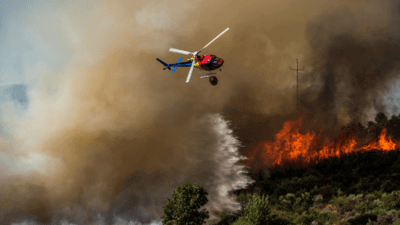
At night, one of these Jet Rangers would fly to the fire and do a detailed low-and-slow reconnaissance of the fire and the surrounding area to find the safest routes in and out, and find any power lines, towers, or other obstacles. Once it was deemed safe, the water-dropping ships would be cleared into the scene. The Jet Ranger would use its spotlight to illuminate any potential hazards while the water-dropping ships made their runs. On larger fires, the light given off by the flames eased the pilot’s job of navigating the area safely. But on smaller fires, deep in a canyon, the pucker factor was quite high for the pilots. In order to fly night fire missions, a set of conditions were put in place, such as threat to life or property, or the chance of large fire growth, to justify the risk of night flying.
Improved technology
Eventually, as the NVG technology improved, several fire departments in the Los Angeles area began using them for night firefighting.
“The third generation of NVGs, introduced in the military in the 1980s, is when we really started to see improvements in the technology and using them was better than flying unaided,” explained Dan Child, LAFD Chief Pilot. “When I first started training at night, we weren’t using goggles. When we began using them, I thought it was a real game-changer. They did have their drawbacks. You were limited to a 40° field of view, although you could look around them and use your peripheral vision. We used a combination of the goggles with our spotlights to get an overall view of the scene.”
Auto‑gating prevents image washout from sudden brightness – such as flames, strobes, landing lights, or searchlights – by continuously adjusting the gain to maintain a stable, usable outside image
The spokesperson from ASU explained some of the improvements that NVGs are now equipped with, mitigating previous problems: “E3 NVGs use auto‑gated image‑intensifying tubes, which dynamically regulate the amount of incoming light. Auto‑gating prevents image washout from sudden brightness – such as flames, strobes, landing lights, or searchlights – by continuously adjusting the gain to maintain a stable, usable outside image.
“Even when operating near very bright wildfires, the auto‑gated E3 system provides consistent performance, and, with proper training and adaptation, pilots can operate safely and effectively in high‑intensity lighting conditions.”
Assigned to LAFD Air Ops is a battalion chief and a captain, who act as the helicopter coordinator (HELCO) in the left front seat of one of the two Bell 505s that have replaced the Bell Jet Rangers. They are not pilots, but are highly experienced in wildland fire tactics and procedures. Their job is to coordinate the aerial attack on the fire with the incident commander and the ground firefighters. They are the eyes in the air for the ground fire attack.
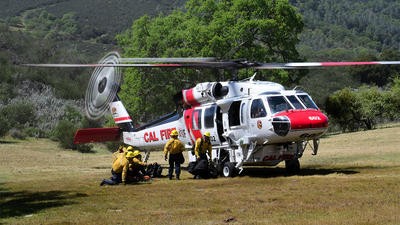
PJ Helicopters of Red Bluff, California, is one of several commercial operators of ex-military CH-47D Chinooks that have entered the field of night firefighting.
“We currently have seven flyable Chinooks with some other airframes that could be refurbished,” stated Brent Keeler, PJ Helicopters’ Chinook Program Manager. “We have four that have internal water tanks. We have two with 2,500gal tanks and two with 2,800gal tanks.
“We began night firefighting operations in 2024. We have a close working relationship with CAL FIRE and they expressed an interest in contracting for night operations. We learned a lot from them about night firefighting and how to train and become proficient. In 2025, we had three night-capable CH-47s on an exclusive-use contract with CAL FIRE.”
Keeler said they look for pilots with a combination of experience flying with NVGs and a good amount of firefighting experience. “It is a unique set of skills that is not easy to come by, so we took in pilots with a lot of NVG time but not much firefighting experience, and high-time firefighters with low NVG time. Instructors then concentrated their training in the areas where they didn’t have much experience. We took their areas of expertise and combined them into a solid training program. All of our pilots in the beginning were qualified command pilots in the Chinook. Since we fly with two pilots, we paired up the teams so their NVG and firefighting experience would complement each other.”
It is a unique set of skills that is not easy to come by, so we took in pilots with a lot of NVG time but not much firefighting experience, and high-time firefighters with low NVG time
The crew for night firefighting is two pilots and a crew chief in the cabin. The crew chief functions as a flight mechanic for any maintenance needs, as well as monitoring the helicopter’s systems. When they are hovering over the water during fill operations, the crew chief is looking for any obstacles around the helicopter and watching the snorkel to make sure it doesn’t get snagged.
“We do annual night training with CAL FIRE,” explained Keeler. “They create a helibase and all the staff positions and run it like a real fire. Many different agencies and contractors attend. The helicopter crews are briefed and dispatched to a location. Once at the scene, they check in, [and] are briefed and controlled by a HELCO, making water drops on a simulated fire. The drill usually lasts for several days to maximize the flight time and training for the individual crews. It is very realistic and very useful for training and getting to know the different players. It also helps CAL FIRE practice command, control, and communications techniques. The helicopter crews get practice filling and dropping water at night, as well as how to work with the HELCO and other helicopters over a fire. All of our NVG-qualified pilots are required to attend this drill every year.”

The quick reaction force
A unique helicopter organization located in southern California is the Quick Reaction Force (QRF). It was formed with the idea of having a task force of three CH-47 Chinook helitankers that could be used individually or as a group depending on the size and potential growth of a wildfire in three counties: Ventura, Los Angeles, and Orange. It is funded by the Southern California Edison power company. The other part of the QRF is a Sikorsky S-76 crewed and equipped as a HELCO. One of the main reasons for creating the HELCO ship was to increase the safety of night firefighting for QRF aircraft and allow the QRF to be deployed as a complete unit. Coulson Aviation has the contract to provide all four helicopters on a 24-hour-a-day, 365- day basis.
The S-76 is equipped with an electro-optical and infrared (EO/IR) sensor package consisting of a FLIR Systems 380-HD. It is also equipped with a laser designator. The HELCO is in the left front seat next to the pilot and the sensor operator is in the cabin. At night there is no air attack platform circling the fire as there are no night-flying fixed-wing airtankers. The HELCO takes on the role of controlling all the aircraft at night. They will usually circle the fire at 1,000–1,500ft above the ground. This keeps them out of the airspace being used by the helicopters and high enough to hear their radio traffic as they enter and leave the fire traffic area. It is also a good position to maintain a safety overwatch for the helicopters.
With so many local, state, and federal firefighting helicopters available in southern California, these agencies practice very aggressive initial aerial attack procedures to keep fires small. The QRF HELCO is qualified to control all the helicopters assigned to any fire, not just the QRF ships, day or night.
“One thing I found after becoming a night HELCO is that takes a lot more time to create a mental picture of the fire, the ground attack, and where the helicopters are needed most,” explained the QRF’s Fred Burris. “The ground firefighters have trouble describing their location and where they need the water to be dropped. Then I have to try to create a verbal description for the incoming helicopters on where they need to drop.
Over time, we have developed a great system working with the sensor operator using the infrared (IR) camera to quickly find the ground personnel and what they are trying to describe to us
“Over time, we have developed a great system working with the sensor operator using the infrared (IR) camera to quickly find the ground personnel and what they are trying to describe to us. I can see the IR image on my tablet. The sensor operator and I can then create a plan of action. While the IR camera doesn’t see details through the smoke, the heat of the fire does show through, so we can tell where the hotspots are that are hidden to the naked eye. There is a laser designator the sensor operator can activate, which can be seen by the NVGs of the water-dropping helicopters and point to exactly where we want a water drop. This saves time and confusion.”
Ensuring that the NVGs that aerial firefighters are equipped with can assist the pilots as best as possible, the ASU spokesperson said: “E3 NVGs are engineered specifically for high‑demand missions and offer several advantages over legacy systems like the ANVIS‑9:
Reduced weight (~30% lighter than ANVIS‑9)
Lighter goggles significantly reduce pilot fatigue and neck strain, especially during long‑duration wildfire missions.
Extended eye relief (25-32mm in design, worn at ~2–3 finger‑widths)
Greater eye relief supports a more natural look‑around capability without sacrificing field of view, improving both comfort and situational awareness.
White phosphor image‑intensifying tubes
White phosphor provides:
- Higher contrast
- Improved detail resolution
- Enhanced depth perception.
This allows pilots to better identify fire edges, terrain contours, and hotspots.
Front‑mounted eyepiece adjustments
Moving the adjustment mechanism forward removes obstructions from peripheral vision, improving comfort and visibility. Together, these features produce an NVG system that is lighter, clearer, and more operationally effective – purpose‑built for the demanding environment of nighttime aerial firefighting.”
Managing the risks
There is a continuous risk/benefit analysis going on when fighting fire at night. For initial attack on a new fire, they slow the pace of operations and gradually add more helicopters as needed. For extended attack, when a fire has been burning for a period of time, they have very distinct, standardized guidelines on when to continue night operations. There must be a threat to life or significant risk to infrastructure such as homes. Burris said you can really see how effective you are being with your drops, especially with the IR camera.
It’s important that retardant drops are overlapped or the fire can move between the retardant drops if there is a gap
“We have begun dropping retardant at night, not just water,” he commented. “It’s important that retardant drops are overlapped or the fire can move between the retardant drops if there is a gap. You can’t see the color of the retardant at night, but the IR camera can see the drops. It looks much darker than the surrounding terrain. Using the laser designator, the sensor operator can illuminate where the next drop needs to be to maintain that constant line of retardant.”
The S-76’s sensors can record a video of the fire and send it to an online chat group that is shared with the agency that has jurisdiction of the fire. The incident command team can then make decisions about tactics, as well as how and where to fight the fire by actually seeing it and not relying only on a verbal description from the scene. In their overwatch capacity, they can also advise the ground troops of any changes that may put them in danger.
“All of these situations draw on the experience of the HELCO as a ground firefighter and [is the reason] why they must have this background to be a HELCO,” explained Burris. “I always want to know where the ground teams are working so I can help keep them safe, day or night.”
January 2026
Issue
A new year and a new edition, and with it comes articles relating to special missions from all across the globe. We have features that look into the special missions in the Middle East and Africa; the benefits and differences associated with leasing helicopters; and the way that aerial firefighting is conducted at night.
Barry D Smith
Barry Smith has been an aviation and emergency services writer/photographer for over thirty years. He has published over 250 magazine articles and six books. He has also worked in emergency services as a paramedic, volunteer firefighter, and member of search and rescue teams for over 40 years.