

Event review: Advancing safety, skills, and business at Verticon

Verticon returned to Atlanta in 2026, located in the Georgia World Congress Center, and hosted 684 exhibitors, with 64 aircraft on display. Jon Adams caught up with the news and events from the show
VAI Verticon returned to Atlanta in 2026, located in the Georgia World Congress Center, and hosted 684 exhibitors, with 64 aircraft on display. A stone’s throw from the Georgia Aquarium, the World of Coca-Cola (where the secret recipe is stored in its ‘vault’), and Mercedes-Benz Stadium (home to the Atlanta Falcons NFL team), the Georgia World Congress Center welcomed almost 13,000 attendees across the week of announcements, sessions, briefings, and courses, with a strong emphasis on education and technical programming, and workforce and career development. “Verticon is where the vertical aviation community meets to do business, sharpen skills, and advance safety,” said François Lassale, President and CEO of VAI. “This year’s turnout, aircraft presence, and depth of education reinforced the strength of our industry and our shared focus on professional excellence.” Next year, Verticon will be located in Anaheim, California, across 16–18 March 2027. Some of the highlights from this year’s event are listed herein.
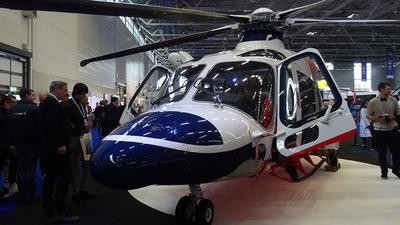
Ace Aeronautics
Helicopter Alliance signed a five-year framework agreement with SAF Aerogroup for 10 UH-60 Black Hawk helicopters. Four UH-60L helicopters have been ordered from Helicopter Alliance’s subsidiary Ace Aeronautics, with deliveries beginning in the fourth quarter of 2026. Starlite Aviation will begin operations for firefighting missions in partnership with Heli Company, a part of Helicopter Alliance, beginning summer of 2026.
The growing wildfire threat across Southern Europe, the Mediterranean, and surrounding regions has influenced this development and the increase in available assets in the area.
Aerometals
Aerometals announced the successful completion of its H225 Inlet Barrier Filter (IBF) development program. The program represents a major advancement in engine protection technology for the Airbus H225 platform and is now fully transitioned into production. Safran and Airbus supported the flight testing. Marking the initial operational deployment of the system, the first production units have already been delivered to Aerometals’ fleet customer Air Center Helicopters, which was critical in supporting the program by providing an aircraft for flight testing, with Rod Tinney, CEO, serving as the flight test pilot.
Air Ambulance Technology
Air Ambulance Technology (AAT) attended the show with its modern way for customers to experience its medical solutions without having to go to an airfield or sit in an aircraft. Its virtual reality (VR) simulation enables an interactive environment allowing potential and existing customers to explore and experience layouts that normally could only be seen as either a 3D model or a graphic. The user can shape the design of the medical fit-out in real time while fully immersed in the virtual environment, adjust the number of seats, change the stretcher setup, and instantly compare layouts. The VR experience supports multiple models and configurations.
Airbus
German helicopter emergency medical services (HEMS) operator DRF Luftrettung and Airbus Helicopters announced a new order for four H145 helicopters. “It is our mission to ensure optimal care for the benefit of our patients at all times,” said Krystian Pracz, CEO of DRF Luftrettung. “With the addition of four more H145s, we are strengthening our position as the operator of one of the largest H145 fleets in Europe and at the same time creating the conditions to position ourselves for the future. In addition, last year we took another important step towards being able to respond quickly and effectively to developments in the rescue service by deciding on the H140 and ordering 10 new aircraft. This provides our crews with a fleet that enables them to save lives every day under the best possible conditions.”
ADAC Luftrettung and Airbus Helicopters signed a strategic long-term framework contract for Airbus H135, H140, and H145 helicopters. “By investing in these new aircraft, we are deliberately embracing state-of-the-art flight technology that will significantly enhance our airborne emergency medical care over the long term,” said Frédéric Bruder, CEO of the nonprofit ADAC Luftrettung. “A diversified fleet with different helicopter types enables us to respond optimally to the specific operational requirements of emergency medical services. And with these aircraft, we are fully capable of performing rescue missions at any time – around the clock and even in darkness. This framework agreement ensures that patient and flight safety – our absolute top priorities – will continue to remain at the highest possible level in the future. And we will achieve this in a needs-based manner, with lower fuel consumption and greater cost efficiency.”
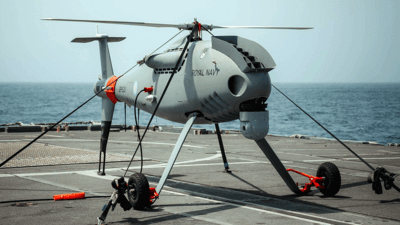
Airbus Helicopters and Garuda Technologies signed a contract for the delivery of up to 18 Flexrotor uncrewed aerial systems (UAS). Garuda will offer Flexrotor services to its customers through both dry and wet lease options for a broad spectrum of civil and parapublic missions including infrastructure (roads, railways, oil and gas pipelines, and power lines) inspection, law enforcement, search, wildfire monitoring, and disaster relief.
“Our collaboration with Airbus Helicopters to integrate the Flexrotor into our global leasing portfolio marks a significant milestone in our international expansion and investment strategy,” said Agnishwar Jayaprakash, Founder and CEO of Garuda. “Having manufactured and sold over 5,000 drones and served more than 500 enterprise and government clients globally, we are now scaling our range of services and upgrading our global product portfolio. With over one million flight hours, 30% market dominance in India’s agri-drone segment, and a diversified presence across agriculture, defense and industrial sectors, the Flexrotor’s arrival further strengthens our ability to deliver high-endurance, mission-critical unmanned solutions for the most demanding operations worldwide.”
ÖAMTC-Flugrettung and Airbus Helicopters signed a strategic long-term framework contract for Airbus H135, H140, and H145 helicopters. “For ÖAMTC-Flugrettung, staying at the cutting edge is a necessity, not an option,” said Marco Trefanitz, CEO of ÖAMTC-Flugrettung. “We are proud to have contributed our operational expertise directly into the design of the H140, ensuring it meets the real-world needs of emergency medical services and of our crews and patients. This helicopter allows us to enter a new dimension of care. With its increased performance and space, this helicopter will be beneficial for those who use it every day. Our involvement in developing this new aircraft allowed us to create our own best-in-class medical interior. We are now better equipped than ever to navigate the challenges of the Austrian landscape and save lives.”
Air Transport Europe (ATE), a HEMS operator in Slovakia, and Airbus Helicopters announced a contract for the purchase of one Airbus H135 and one Airbus H140 helicopter. “Our priority has always been to provide the highest standard of emergency medical care, which requires a fleet that is both versatile and technologically advanced,” said Milan Hoholik, CEO of Air Transport Europe. “By integrating the Helionix-equipped H135 and the H140 into our operations, we are embarking on a new level that will enhance our ability to reach patients in challenging environments and provide them with the best possible care.”
Japan’s National Police Agency (NPA) placed a follow-on order for three H135 helicopters as part of its ongoing fleet modernization program. These versatile aircraft will be deployed to the Hokkaido, Shimane, and Miyagi Prefectural Police departments, enhancing their capacity for multi-role law enforcement missions, covering patrol, search and rescue (SAR), and tactical transport. “We are honored by the National Police Agency’s continued trust in the H135,” said Jean-Luc Alfonsi, Managing Director of Airbus Helicopters in Japan. “The H135’s proven reliability and high performance make it the definitive platform for law enforcement. We remain dedicated to providing comprehensive support necessary to ensure the NPA meets its critical mission requirements across Japan.”

Astronautics
Astronautics Corporation of America is collaborating with Airbus to deliver the V2.1 upgrade to its AeroSync Max connectivity system, or what Airbus refers to as its wireless Airborne Communication System (wACS). The upgrade introduces data collection capabilities to the H225 platform, enhances in-flight connectivity functionality, and supports evolving cybersecurity requirements across the Helionix-equipped fleet. The V2.1 upgrade is available now for European Union Aviation Safety Agency (EASA)-certified H145 and H145M helicopters. Certification for the H160 will follow by the end of 2026 and the H225 in 2027.
“As connectivity expectations continue to grow, Airbus operators need solutions that are secure, scalable, and seamlessly integrated,” said Matthew Frei, Director of Connected Aircraft Solutions at Astronautics. “The AeroSync Max V2.1 upgrade builds on our proven architecture to deliver expanded data capabilities, in-flight connectivity functionality, and ongoing cybersecurity support, helping ensure these platforms are prepared for the next generation of connected operations.”
Aviation Specialties Unlimited
Aviation Specialties Unlimited (ASU), a provider of night vision solutions, took time on the trade show floor to recognize early adopters of the E3 night vision goggles (NVGs) manufactured by ASU. “We wanted to take time to recognize the companies that placed their faith and trust in us by adopting our new E3 NVGs early in the process,” said ASU Vice President of Sales Dan Meyer. “With our new E3 platform, it was vital to have early adopters who use the products in the field that can give us crucial feedback. Their input and use of the E3 enable us to maintain the high level of excellence that our customers demand while implementing ideas for the future.”
ASU presented custom-made owl awards to its early adopter customers, followed by an afternoon social. Early adopters included:
JD Pearson – OSF Aviation
Paul Julander – PHI Health
Thomas Dagnillo – Construction Helicopters Inc
Derek Spooner – PJ Helicopters
Jan Sobick – Heli-Flight JLR
Mark Onorato – Boston MedFlight
Adam Green – Hawk Heli Services
Justin Marr – Coulson Aviation Australia
Richard Collie and team – North Carolina State Patrol.
Axnes
Axnes announced the launch of the CPX Wireless Intercommunication System (WICS), a next-generation passenger address (PA) and intercommunication system, providing state-of-the-art hearing protection designed specifically for passenger transport and mission operations, like offshore, helicopter tourism, air medical and VIP. “We developed CPX to meet the highest operational, safety, and comfort standards,” said Axnes Chief Commercial Officer Klaus Fruehwirth. “This system sets a new benchmark for passenger/crew audio and hearing protection, while maintaining the rugged reliability expected in demanding aviation environments.” He continued: “We developed the new CPX system in close collaboration with operators and validated it through extensive, real-world testing to ensure uncompromising reliability. The result is a robust, fully aviation-qualified platform that significantly enhances safety, reduces cabin noise exposure, and elevates the overall passenger and crew experience.”
Becker Avionics
Becker Avionics announced the continuing expansion of its AMU6500 digital intercom system. The new addition to the AMU6500 series is the DVCS6100 Plus and DVCS6100 Compact control panels. The AMU6500 employs soft-touch keys and glass for its control screen. These new DVCS panels eliminate the glass screen and soft-touch keys of the AMU6500 and incorporate the same human–machine interface (HMI) as Becker Avionics’ traditional DVCS6100 system. As in DVCS6100, DVCS6100 Plus and DVCS6100 Compact employ a rotary knob for transmit selection and robust push buttons for monitor selection. The enhanced capabilities of the AMU6500 family are included in the DVCS6100 Plus and Compact. These features include Bluetooth functionality and 3D audio. The DVCS6100 Plus features separate monitoring and volume control for up to 14 transceivers, while the Compact handles 10 transceivers. The capabilities of the new DVCS6100 Plus and Compact offer the operator a system designed explicitly for single-pilot operations with a gloved hand in a high-tempo environment. The 3D audio can enhance the flight crew’s situational awareness, and Bluetooth capability allows for greater mission flexibility.
Beechcraft
Beechcraft, a Textron company known for its fixed-wing King Air and Denali platforms, made a surprising appearance with a booth. Showcasing its special missions aircraft, Bob Gibbs, Vice President of Special Missions Sales for Textron Aviation, explained its presence at the event, saying that many organizations operated mixed fleets of rotary- and fixed-wing craft, so Verticon was a “natural place to meet” and network with those stakeholders. Gibbs explained that having fixed-wing aircraft along with the rotary wing in one’s fleet meant that it filled a hole that would be unavailable otherwise, stating the long loiter time, the stability and comfort, and the fraction of the cost for maintenance. He also said that many vendors present were also platform agnostic, so the event was beneficial for Beechcraft as the technology could be fitted onto a King Air as easily as any helicopter.
Bell
Bell Textron announced that the Texas Department of Public Safety (DPS) had signed a purchase agreement for a Bell 407GXi. The Texas DPS Aircraft Operations Division provides statewide air patrol, criminal surveillance, and rescue support for the state of Texas. In addition to its new Bell 407GXi, the Department also utilizes a Bell 412EP. Texas DPS and Bell have a long-standing relationship that began in 1948 when the Department established its fleet with two Bell 47s. This new addition of the Bell 407GXi reflects the Department’s continued trust in Bell’s reliability and mission solutions. “Over 50 years ago, Texas DPS chose Bell as its first public safety use rotorcraft,” said Lane Evans, Managing Director, North America Commercial Sales, Bell. “Today, Bell is honored to continue that relationship with the Department as they expand their public safety mission capabilities in a Bell 407GXi across the state of Texas.”
Bell Textron also announced the purchase order for two Bell 505s by California’s Pasadena Police Department, demonstrating its commitment to public safety operations. “This investment in our new Bell 505s represents a major step forward in how the Pasadena Police Department serves and protects our community,” said Pasadena Police Chief Gene Harris. “These aircraft give our Air Operations Section the enhanced capabilities needed to support officers on the ground, improve response times, and provide critical aerial support.”
CNC Technologies is serving as the prime contractor for the program, leading the overall mission suite design and support. The mission suite includes WESCAM MX-10 electro-optical and infrared imaging systems, tactical mapping capability, NVG-compatible cockpit upgrades, high-intensity searchlight capability, and resilient real-time video transmission, delivering a mission-ready capability aligned with the Department’s operational needs. “CNC Technologies is proud to serve as the prime contractor for the Pasadena Police Department’s Bell 505 program,” said Alex Giuffrida, Managing Partner, CNC Technologies. “Our team is delivering a mission-ready capability with long-term support.”
Bell Textron and Semper Fly Helicopters announced a new Bell Certified Training Facility (CTF). This initiative represents a significant step forward in delivering additional regional training solutions for the Bell 206B and positions both organizations to collaboratively service commercial customers. “Bell’s reputation for delivering exceptional pilot training speaks for itself, and we are honored to now stand alongside them as a Bell Certified Training Facility,” said Brandi Rector, CEO, Semper Fly. “Our work together reflects a shared commitment to safety, quality, and the continuous advancement of helicopter training. Together, we are not only training pilots, we are helping shape the future of vertical aviation.”
Blueberry Aviation
Blueberry Aviation came to Verticon after publishing its Leonardo AW139 Market Report, with a booth located near the Leonardo booth. The 15-seat medium-sized twin-engine helicopter has been marketed across several segments including VIP/corporate transport, offshore transport, law enforcement, SAR, emergency medical services (EMS), disaster relief, firefighting, and military tactical transport. The report highlights the platform’s popularity in the public services sector (law enforcement and offshore SAR), and the EMS and onshore rescue sector. It also breaks down usage by region and the differentiation between the short-nose and long-nose variants. Forecast predictions about the lifespan of older craft and the cost to upgrade the avionics are analyzed, and competition from other original equipment manufacturers (OEMs) may affect the ongoing market value of the craft, but depreciation does appear to be
less rapid than with other aircraft of the same vintage.
Dallas Avionics
Dallas Avionics announced a formal exclusive agreement with Axnes to service its North American line of MP transceivers including the popular MP30 and MP50. “We are pleased to announce this formal agreement with Axnes,” said Dallas Avionics Government Agency Sales Executive Cody Klaehn, a Retired Texas DPS Aircraft Tactical Flight Officer Training Lieutenant. “I have used this equipment for years in law enforcement. Their rugged full metal housing offers reliable service in demanding environments. We realize that this equipment is vital to field operations, and getting them back in operations when they do need service is important.”
Essential Turbines
Essential Turbines Inc (ETI), a Rolls-Royce Authorized Maintenance, Repair & Overhaul Center (AMROC), announced the opening of its new Mesa, Arizona, facility, a purpose-built maintenance, repair, and overhaul (MRO) location that triples the company’s US capacity for M250 and RR300 turboshaft engines. The modern facility replaces ETI’s temporary Phoenix-area location and provides dedicated infrastructure for engine overhaul, test cell operations, and component repair. The expansion enables ETI to enhance both critical capabilities and technical expertise while delivering faster turnaround times to US and Southwest regional operators.
Leonardo
HeliKorea confirmed an order for an additional AW169 light intermediate twin-engine helicopter. With a strong expertise on operations and maintenance, the company is engaged in a wide range of aviation services, including HEMS in cooperation with the Ministry of Health and Welfare, offshore operations with Korea National Oil Corporation, aerial firefighting for local governments, cargo-lifting operations for Korea Electric Power Corporation, simulator training, and MRO services for Korea Forest Aviation, fire departments, and the Coast Guard.
Leonardo and FlightSafety International (FSI) announced the planned co-development and establishment of the first AW189 full-flight simulator (FFS) in the Americas. This partnership includes the development of a Level D FFS, which will replicate the AW189 advanced avionics and flight systems at the highest possible standard, enabling realistic offshore and SAR mission training. Additionally, the companies are developing a training collaboration to include comprehensive AW189 initial, recurrent, and specialty courses for pilots at FSI’s Lafayette Learning Center in Louisiana, strategically positioned to support operators throughout the Americas.
Norwegian company Lufttransport RW has ordered a further three newly built AW189s to deliver offshore transport services on the Norwegian continental shelf. An established AW139 operator with seven units in service today, Lufttransport is among the large number of operators that have chosen and use the AW189 worldwide for modern, long-range, high-capacity and cost-effective missions supporting the energy industry. Over the years, the company has operated ambulance aircraft, surveillance aircraft, SAR helicopters, and scheduled helicopters. In addition to the group’s aircraft in Svalbard and helicopters on the mainland, Lufttransport operates its own maintenance organization. This organization services the company’s aircraft, the Norwegian Armed Forces’ aircraft, and UiT The Arctic University of Norway’s training aircraft at Bardufoss. Lufttransport is also approved as a flight school. Lufttransport’s vision is “Sustainable Aviation” and the strategy is to deliver leading flight safety solutions.
Leonardo and Intermountain Health, Utah’s largest healthcare system, announced the delivery of the world’s first AW109 GrandNew Enhanced Training Device Virtual Extended Reality (ETD VxR). An established operator of Leonardo EMS helicopters, Intermountain Health currently has seven AW109 GrandNew aircraft and is Utah’s only instrument flight rules (IFR) EMS operator with low-level IFR infrastructure and proprietary heliport approach procedures.
Leonardo and Mitsui Bussan Aerospace, official distributor for the AW139, AW169, and AW189 types in Japan, announced an order for two more AW139 intermediate twin-engine helicopters, with deliveries expected in 2028. This contract was signed in the framework of the distributorship agreement renewal announced last year and based on a commitment to procure 11 new helicopters from all types over the 2025–27 period. This latest order comes at a time when multiple public service requirements are emerging in Japan, particularly for law enforcement and firefighting duties, market segments where this model has achieved an established presence and success in the country among several operators.
Leonardo and CAE will introduce a second AW139 FFS at Leonardo’s US Training Academy in Philadelphia. The simulator will be operated by Rotorsim, the joint venture equally owned by Leonardo and CAE, starting in 2027. The new Level D simulator will mirror the latest aircraft’s avionics suite and operational envelope at the highest possible standard, expanding domestic training capacity and reinforcing Philadelphia’s role as a center of excellence for AW139 pilot qualification and recurrent training for its reference regions.

LifeFlight Australia
Leonardo Helicopters and LifeFlight Australia revealed details of a new training academy with simulators and advanced training systems never seen before in Australia and Asia Pacific. The LifeFlight–Leonardo collaboration will create the only full-suite Leonardo immersive simulation systems outside Italy through the planned LifeFlight Academy on the Gold Coast becoming a Leonardo Authorised Training Centre. The LifeFlight Academy will be established as a purpose-built center for enhanced integrated aviation, air medical, and offshore emergency training in Australia and Asia Pacific to prepare personnel for high-risk missions. It combines Leonardo’s global leadership in helicopter and simulation technology with LifeFlight’s 46 years of frontline air medical and rescue experience. The Academy will support pilots, aircrew, doctors, nurses, paramedics, and offshore personnel training with experienced instructors in high-fidelity environments replicating real-world operational conditions. Construction is due to start this year with the Academy opening by 2028. LifeFlight Chief Executive Officer Ashley van de Velde said the announcement represented a major step forward in training people for high-risk industries. “The future of emergency response, aeromedical care, and offshore operations depends not just on how we best prepare our people for complex missions, but how well we equip our aircraft,” he said. “This partnership brings together Leonardo’s world-leading simulation technology and LifeFlight’s real-world operational expertise to create training that is immersive, integrated, and mission-ready.”
Metro Aviation
Metro Aviation highlighted several aircraft and key partnerships, including an EC145 C2 and the AW09 aircraft on display at the booth, and multiple completed aircraft featured on the Airbus exhibit. Metro showcased a refurbished EC145 C2 completed for Wellstar AirCare. The aircraft represented Metro Aviation’s ability to transform previously owned aircraft into like-new platforms equipped for modern air medical missions. It supports Wellstar’s continued expansion of critical care transport capabilities across Georgia and the Southeast USA. Zack Lancaster, Wellstar AirCare Program Director, said: “Through our partnership with Metro Aviation, AirCare was proud to add the EC145 C2 to operate alongside our EC145 C2e aircraft. This expansion strengthens Wellstar AirCare’s ability to rapidly deliver specialized care and critical transport services when and where patients need them most.”
Metro also featured an AW09 at its booth, giving attendees the opportunity to see the next-generation single-engine helicopter designed to support a wide range of missions including EMS, as well as showcasing Metro-completed aircraft at the Airbus booth, including the New York State Police (NYSP) H145 D3 and Memorial Hermann Health System’s H160. The NYSP H145 on display was equipped for a wide range of mission profiles, from tactical law enforcement to SAR, with specialized equipment including an onboard hoist, customized tactical flight officer (TFO) station, FLIR 380-HDc thermal imaging system, Trakka searchlight for nighttime operations, and more.
Pilatus
Pilatus, the Swiss manufacturer of the fixed-wing aircraft (most notably the PC-12 and PC-24 used for many special missions operations) also made an appearance at Verticon this year. The representative of Pilatus at its booth said that the larger operators in the special missions sector often had mixed fleets, and the Pilatus aircraft were perfect for covering the gaps that helicopters couldn’t fill. He cited the longer range and the larger cabin sizes afforded by the Pilatus family of craft, as well as the accessibility into the cabin, making them ideal for certain air medical missions.
Precision Aviation Group
Precision Aviation Services, a subsidiary of Precision Aviation Group (PAG), a provider of MRO and value-added services for the aerospace and defense industries, announced it had been approved as an Authorized Autopilot Installer for the Thales and StandardAero StableLight autopilot system, a next-generation four-axis autopilot designed specifically for the light rotor-wing aircraft market. “We are excited to add Thales and StandardAero StableLight to PAG’s growing portfolio of advanced avionics capabilities,” said Jordan Webber, Vice President, Component Services, Precision Aviation Group. “Becoming an Authorized Autopilot Installer allows us to deliver a truly next-level solution to our rotor-wing customers, enhancing safety, performance, and mission effectiveness while reinforcing PAG’s commitment to innovation.”
Recoil Aerospace
Recoil Aerospace announced a strategic partnership with Aero Products of Show Low, Arizona, naming the company an Authorized Service Support Center for Recoil Aerospace products. As a support center, Aero Products will perform approved maintenance and service support for Recoil Aerospace equipment in accordance with Recoil’s specifications, processes, and quality requirements, helping operators maximize their tank’s system performance. “This partnership strengthens our ability to support Recoil operators while continuing to deliver the proactive, reliable, and safety-focused service Aero Products is known for,” said President of Aero Products Mike Hannahs. Additionally, Recoil equipment was available for live demonstrations aboard Aero Products’ UH-60L demonstrator aircraft, providing operators with a firsthand look at system capability and performance.

Robinson Helicopter Company
Robinson Helicopter Company (RHC) advanced its R88 development program, integrating a new group of strategic suppliers to further enhance the aircraft’s mission readiness. Building upon the foundational partnerships established last year with Garmin and Safran Helicopter Engines, these new collaborators will introduce state-of-the-art health monitoring and datalink systems in addition to equipment designed specifically to reduce downtime.
GPMS will be the exclusive provider of a health and usage monitoring system (HUMS) for the R88. Foresight’s advanced analytics shifts maintenance from reactive to predictive and proactive, reducing unscheduled downtime and lowering operating costs.
Outerlink’s Iris system will deliver a comprehensive “connected aircraft” solution by providing real-time flight data monitoring and global communication for the R88. Iris utilizes a constant satellite link to stream over 300 flight parameters, including GPS location, engine health, and HUMS data.
Skurka Aerospace will be the provider of the R88’s advanced brushless starter-generator. For Robinson R88 owners and operators, the transition to Skurka’s brushless starter-generator translates into lower life-cycle costs and increased aircraft availability.
“With the R88, we are shifting from reactive maintenance to proactive oversight by integrating Outerlink, GPMS, and Skurka technologies as core features,” said David Smith, President and CEO of RHC. “Utilizing easier-to-maintain components and real-time data streaming ensures R88 operators have more time in the air and a clearer picture of aircraft health. These advancements reflect Robinson’s focus on ensuring the R88 is the most dependable, reliable, and economic helicopter for individual owners and parapublic missions.”
RHC announced the establishment of Robinson Unmanned, a new business unit dedicated to the development and support of a full suite of remotely piloted and autonomous aircraft. The formation of this division expands Robinson’s current business to include the broadest range of crewed and uncrewed vertical lift solutions currently available, addressing a diverse set of mission requirements across civil, commercial, and defense sectors. Robinson Unmanned integrates the industry-leading coaxial, modular, small UAS from its wholly owned subsidiary Ascent AeroSystems alongside larger uncrewed platforms built on the company’s proven R44 (into the Airtruck and Sprayhawk) and R66 (into the Turbinetruck) and powered by new strategic agreements with Rotor Technologies and Sikorsky Helicopters respectively. Through these partnerships and others to follow, Robinson Unmanned offers the broadest portfolio of open architecture platforms and technology-agnostic aircraft capable of both remotely piloted and fully autonomous operations. Paul Fermo, current President of Ascent AeroSystems, will lead the Robinson Unmanned business unit as President.
“Robinson is officially entering the ‘Era of Both’, a fundamental shift where flight is no longer a choice between human intuition and machine precision, but the seamless integration of both,” said Smith. “By folding the Rotor Technologies R44 remotely piloted solutions into our existing fleet of Ascent small and technology-agnostic, heavy-lift drones, we are creating a versatile ecosystem of certified, proven airframes capable of tackling any mission profile.
“Our goal isn’t just to build better helicopters; it’s to build smarter, safer VTOL solutions,” he added. “By fusing human expertise with autonomous reliability, we are massively amplifying mission capability while significantly reducing operational risk. In environments where the danger is highest, our technology is at its strongest, ensuring that we aren’t just protecting the pilot, but redefining what’s possible.”
Rotortrade
Rotortrade announced another year of record-breaking performance in 2025, achieving more than 50% revenue growth and a 35% year-on-year increase in the number of transactions. This marks the highest volume and total value of sales in the company’s history, significantly surpassing its 2024 results. The growth was driven by strong performance across key market segments. EMS, utility, and VIP configurations represented 87% of aircraft delivered, reflecting sustained global demand across essential and high-value mission profiles. The EMS sector, in particular, recorded exceptional expansion, with deliveries increasing more than sixfold – the strongest growth across all segments within Rotortrade’s portfolio in 2025. Sales activity was also shaped by sustained demand for light single- and light twin-engine helicopters. The Airbus H125, Airbus H145 D3, and Leonardo AW109 SP together accounted for more than 50% of the fleet sold during the year, confirming continued operator preference for versatile, cost-efficient platforms.
Commenting on the company’s performance, Philippe Lubrano, Founder and CEO of Rotortrade, said: “2025 has been a defining year for Rotortrade. Delivering record growth in both volume and value reflects the maturity of our global platform and the confidence operators place in our expertise. The acceleration in EMS and mission-driven segments demonstrates how critical reliable, well-configured aircraft are for essential operations worldwide. Our strategy remains focused on supporting customers across the full aircraft life cycle – from acquisition and financing to maintenance and asset optimization – while continuing to expand our international footprint. The market fundamentals remain strong, and we enter 2026 with solid momentum.”
It was also announced that Rotortrade MRO Latrobe had been appointed an official Garmin dealership, strengthening its certified avionics installation and integration capabilities in the USA. Under this dealership agreement, Rotortrade MRO Latrobe is authorized to provide certified installation, integration, and technical support for Garmin’s avionics portfolio. The scope includes cockpit modernizations, glass cockpit upgrades, navigation and communication systems, and integrated flight deck solutions tailored to multiple helicopter platforms. Dan Mansfield, General Manager of Rotortrade MRO Latrobe, said: “Becoming an official Garmin dealership significantly enhances our technical offering. Garmin’s avionics solutions are widely recognized for reliability and innovation in cockpit modernization. With certified in-house integration capability, we can provide operators with a seamless upgrade process, from specification to installation and ongoing support, under one roof.”
Rotortrade also announced the signing of a transaction for two Airbus H145 D3 helicopters with Dallas-based EMS operator CareFlite. The aircraft were scheduled for delivery in April 2026, with entry into service expected in September. The two 2024-built H145 D3 helicopters are configured for EMS with Airbus / Air Ambulance Technology (AAT) interiors and are designed to support advanced EMS operations including scene response, interfacility transport, and NVG missions. “This transaction demonstrates the value of strong industry relationships, market awareness, and disciplined coordination across multiple stakeholders,” said Lubrano. “By combining aircraft sales, asset trade-ins, interim leasing, and technical support through our global MRO network, Rotortrade was able to structure a solution that supports CareFlite’s fleet modernization while maintaining uninterrupted operational capability.”
Rotortrade and Skytrac Systems announced a strategic technical partnership covering Europe, the USA, and the Middle East. Under the agreement, Rotortrade MRO Tallard (France), Rotortrade MRO Latrobe (USA), and Rotortrade Helipark MRO Riyadh (Saudi Arabia) are designated as authorized Skytrac Service Centers. The partnership encompasses the authorized resale of Skytrac’s avionics portfolio, certified installation services through Rotortrade’s EASA and Federal Aviation Administration (FAA) Part 145 facilities, and the establishment of regional stocking locations for aircraft on ground (AOG)-critical spare parts and new equipment across three strategic regions.
Jeff Sherwood, Director of Business Development at Skytrac, said: “Establishing authorized service centers with Rotortrade in Europe, the United States, and the Middle East creates a robust and certified framework to support operators in key growth markets. Their EASA and FAA Part 145 capabilities, expanding regional inventory presence, and strong rotorcraft relationships provide an ideal platform to deliver satellite communication solutions efficiently and in full regulatory compliance.”
Finally, Rotortrade announced the official operational launch of RotorLease in 2026, one year after its initial unveiling at Verticon. This launch marks the opening of Rotortrade’s dedicated US leasing business. RotorLease has been established as a structured leasing platform within the USA, designed to originate, manage, and administer leasing transactions as part of Rotortrade’s broader financing strategy. RotorLease begins operations with an initial portfolio of seven aircraft, comprising Leonardo AW169, Leonardo AW139, and Airbus H145 helicopters. The company has established a medium-term objective to structure its fleet primarily around Airbus H145 and Leonardo AW139 platforms. These aircraft types have been selected based on sustained demand across EMS, offshore, utility, and governmental missions.
The company offers operating leases (dry leases) and financial leases structured as lease-to-purchase agreements, with tenures ranging from one-year to five-to-seven-year mid-term agreements. Through these solutions, RotorLease enables operators to optimize capital allocation while maintaining operational efficiency and regulatory compliance. The platform also incorporates structured financing mechanisms, including country-specific compliance frameworks aligned with the Cape Town Convention.
Commenting on the launch, Lubrano said: “One year after announcing RotorLease, we are now officially commencing operations. Establishing a dedicated US leasing entity allows us to structure transactions with financial discipline and strong compliance standards, while supporting our broader international activities. Our objective is to build a focused portfolio centered on high-demand platforms such as the H145 and AW139, and to provide operators with transparent and efficient capital solutions. RotorLease complements Rotortrade’s integrated model across sales, maintenance, and financing.”
Sikorsky
The Milestone Aviation Group and Sikorsky displayed a landmark Sikorsky S-92 helicopter, tail number 920006. As the first ever S-92 to enter commercial service in September 2004, this aircraft represents more than two decades of global operational excellence, fleet sustainment, and the enduring capability of the S-92 platform. Since entering service, the aircraft has built a distinguished operational legacy, beginning its life supporting offshore energy missions in the Gulf of Mexico (Gulf of America) before expanding its global footprint. The aircraft has flown with three operators across multiple jurisdictions and regions, transitioning seamlessly between mission types. Demonstrating the multi-mission versatility of the S-92, the aircraft transitioned into firefighting in 2024.
Pat Sheedy, President and CEO of Milestone, said: “The evolution of this S-92 stands as a clear demonstration of the value of the operating lease model in supporting the transition of aircraft through their natural life cycle. Milestone is delighted to have partnered with Helitak Fire Fighting Equipment and VIH on this project, and we are pleased to see the life of 920006 continue strongly into the future.”
Sikorsky stated that it was preparing to build the first production batch of S-92A+ helicopters, the latest variant of its flagship commercial heavy-lifter. A+ model aircraft will be manufactured and assembled in Stratford and Owego, New York, for a new head-of-state transport customer, and anticipated orders from head-of-state and offshore energy customers, marking an exciting development for current and future operators. Sikorsky is standardizing all production aircraft around the S-92A+ model. Each aircraft will feature the Phase IV main gearbox, as well as upgraded engines. The Phase IV main gearbox, which is the most technologically advanced in the commercial market, is in its final 200 hours of endurance testing. It will have a minimum operating life cycle of 6,000-plus flight hours, ensuring longer intervals between overhauls. Sikorsky has designed the gearbox with auxiliary lubrication so the helicopter can complete a flight safely even if primary oil pressure is lost.
Skytrac
Skytrac Systems announced the introduction of Skytrac Mobile, a new Android and iOS mobile flight-following app for operators using Skytrac’s flight-following software to track their aircraft and fleets. The app is available to operators using Skytrac’s flight-following platforms, including TrooTrax, SkyWeb, and WebSentinel. The current version is a complementary tool that enables operators to monitor their fleets in a simple, easy-to-use mobile interface. While operational control centers (OCCs) can use the web-based versions of their preferred Skytrac tracking software, field support personnel and team members on the go can use Skytrac Mobile to monitor aircraft directly from their handheld devices. The app has capabilities such as active and inactive aircraft tracking, flight path history, and weather layers including METARs, TAFs, radar for the US, Canada, Europe, and Australia, and USA Max Reflectivity.
“The addition of a cross-platform mobile flight-tracking app for our users is a huge milestone for Skytrac’s software portfolio,” said Iain Ronis, Director of Product Development. “The app gives users of our flight-following platforms a quick and simple view of their fleet’s flight paths, aircraft status, and more. As we gather operator feedback and learn more about how customers use the app, we plan to continue expanding its capabilities. Operators can expect additional functionality in future releases.”
Smith Myers
Smith Myers Communications and HAT.tec
announced the integration of the ARTEMIS Mobile Phone Detection & Location System (MPDLS) with the HAT.tec mission management system SCALE across the helicopter fleet of a major European law enforcement agency. The integration enables ARTEMIS mobile phone detection and geolocation data to be displayed directly within the SCALE mission system, allowing operators to view ARTEMIS outputs alongside other aircraft sensors and mission data on a single fused display.
“Integrating ARTEMIS into modern mission systems like SCALE delivers clear operational benefits,” said Andrew Munro, Managing Director of Smith Myers. “When sensor data is fused into a single operational display, operators can focus entirely on the mission rather than managing multiple independent systems.”
“Mission system integration is essential for modern airborne operations,” added Fabian Schmitt, Co-CEO and Co-Founder of HAT.tec. “By integrating ARTEMIS into the SCALE mission system, we provide operators with seamless access to mobile phone detection data alongside other mission sensors, helping crews make faster decisions based on a comprehensive operational picture.”

Technisonic
Technisonic Industries announced the launch of the DAS-9000 digital audio splitter/switch. The DAS-9000 is an all-new TDFM-9000 accessory that pairs with the TDAP line of audio controllers. The DAS-9000 utilizes the digital audio connection feature already available in TDFM-9000 series radios. This digital capability previously allowed for a simple two-wire connection to a single TDAP-650 audio controller. With the development of the DAS-9000, the two-line connection can be distributed to up to five separate TDAP-650 audio controllers. This greatly and effectively simplifies installation and set-up, while reducing weight and the wiring complexity associated with the installation of multi-module TDFM-9000 series radios. “We see utilizing digital in this manner as a significant benefit to airborne audio technology,” said Jim Huddock, Director of Business Development. “A fully loaded TDFM-9000 has six separate radios, all requiring individual mic, audio, and PTT lines – that’s 36 connections in all; times that by an average of three controllers and we are talking about over 108 individual connections wired across the airframe. The DAS-9000 now cuts that down to just 18, when including the four power/ground and intercom connections. At less than 1lb, the DAS-9000 also offers significant savings in material and wiring weight, install man hours, and system complexity over a traditional analog or existing digital audio systems.”
TRU Simulation
TRU Simulation came to the event with its Veris VR Flight Simulator. The Veris is qualified as a Level 7 device by the FAA with EASA expected soon; all the paperwork has been submitted and TRU is just waiting for the sign-off.
The REALvision image generation that TRU uses on the Veris is built around Unreal Engine, an industry standard in simulation and used for architectural visualization, automotive design, film production, and live events. The Veris simulator mirrors real-world functionality. With detailed cockpit elements including switches, knobs, levers, and instrument panels, the graphics enhance pilot immersion, making training more effective and intuitive. Visual realism is further enhanced with high-resolution terrain and dynamic weather modeling, including volumetric storms, real-time ice accretion on airframes, and particle-based effects like blowing snow and rotor-wash interaction.
The specialized visual scenes support a variety of mission-specific training. As a Textron Aviation company, TRU benefits from its close ties with the OEM, and the sense of immersion created by the exacting replication of the platforms is enhanced by unfettered access to the specifications of the aircraft in the Bell catalogue, as well as the connections with the Bell Training Academy and the data available to TRU.
The technology on the Veris is not limited to this simulator, explained Jerry Messaris, Vice President and General Manager, TRU Simulation: “REALvision was developed for the Veris particularly; now we are starting to roll it out to some of our flight training devices and looking at it for the full-flight simulators in future.”
The combination of the outside images and the inside of the cockpit being generated on the same software has improved the efficiency of the system. The success of the image generation has been “really well received by users”, said Messaris: “While I’ve been a little hesitant to put [REALvision] into other devices, I’ve got customers demanding it.”
May 2026
Issue
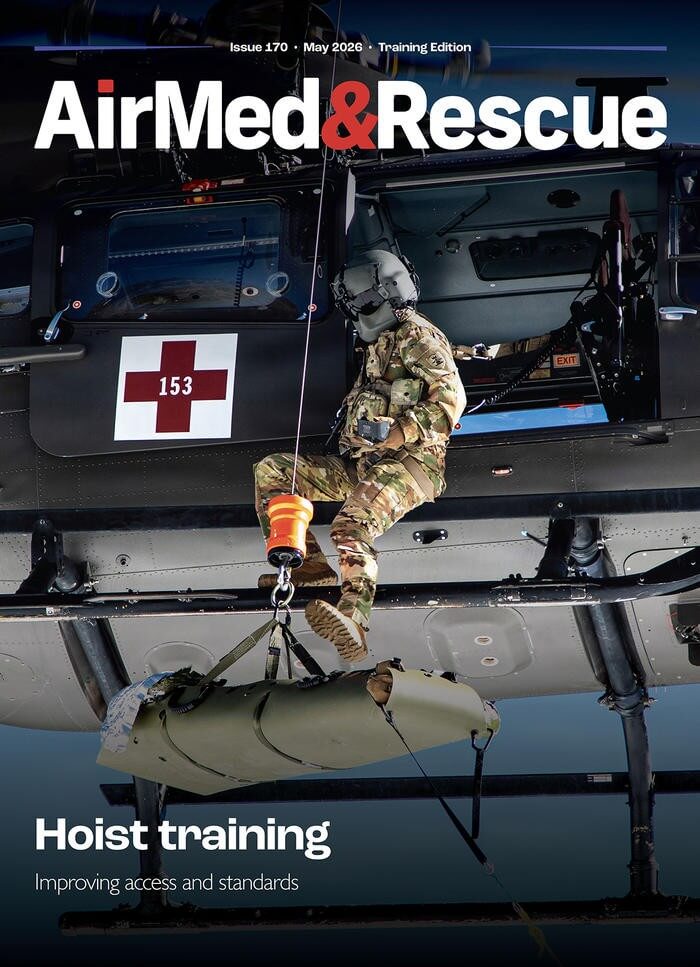
Training for special missions is on another level, so it’s a great pleasure to bring you the training edition of AirMed&Rescue for May. We have features on night flights for police aviators; the simulators for military special missions training; the systems and scenarios for hoist operations; and engineering training for airframe and powerplant mechanics.
Jon Adams
Jon is the Editor of AirMed&Rescue. He was previously Editor for Clinical Medicine and Future Healthcare Journal at the Royal College of Physicians before coming to AirMed&Rescue in November 2022. His favorite helicopter is the Army Air Corps Lynx that he saw his father fly while growing up on Army bases.