
Event review: Out in force: DSEI 2025

At the UK’s flagship defense event, DSEI 2025 occupied the Excel London conference center, bringing the world’s defense organizations and stakeholders together. Jon Adams reports on some of the highlights from the exhibiting companies in the airborne special missions sector
In a week where the London Tube service was entirely shut down by strikes called by the UK’s transport trade union, DSEI managed to be busier than ever, hosting a wealth of exhibitors and attendees from around the world. As a media partner, AirMed&Rescue was in the publication libraries in the north and south halls available to the delegates. The event filled the entire conference center and the adjacent Thames bank, cramming booths with technology, vehicles, and representatives from around the world in every available space. Here are some of the organizations that made the most of the biennial event to celebrate and present their products and services.
Airborne Technologies
Airborne Technologies, the German special missions modification company, went into DSEI high on the news that Denmark had ordered a third patrol aircraft through it.
Following the successful delivery of two customized DHC-6-300 patrol aircraft at the beginning of 2025, the Danish Home Guard ordered a third aircraft in the same proven configuration. Equipped with the Airborne LINX surveillance suite, this new platform continues the trusted collaboration between Zimex Aviation – the prime contractor – and Airborne Technologies.
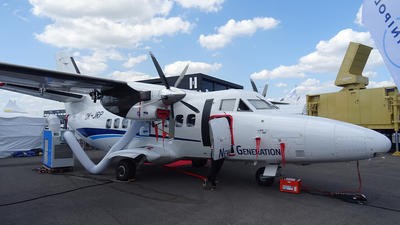
The state-of-the-art patrol platforms are designed to undertake a wide range of missions, including surveillance, search and rescue (SAR), and maritime patrol operations.
The project’s highlights include a cutting-edge operator workstation, an observer station, and a comprehensive intelligence, surveillance and reconnaissance (ISR) suite. The modifications were finalized through a collaborative cross-European effort between Altenrhein, Switzerland, and Wiener Neustadt, Austria, showcasing the expertise and dedication of all teams involved.
This operator workstation is designed for maximum efficiency, providing full control over mission systems, communication, and real-time data analysis. Ergonomic and intuitive, it integrates live data, seamless command and control, and tactical decision-making in one place – ensuring optimal situational awareness and performance.
This operator workstation is designed for maximum efficiency, providing full control over mission systems, communication, and real-time data analysis
The observer / mission commander operates from a fully equipped workstation, controlling communication and maintaining full oversight of the mission. The table can be stowed for takeoff and landing.
Integrated into the aircraft’s nose, the ViDAR system takes search and rescue missions to a whole new level. Previously reliant on the crew’s concentration, scanning of the water surface is now continuous, detecting and highlighting any changes.
Babcock and Uplift360
At the event, Babcock International Group signed a contract with Uplift360, a company that specializes in the recycling of advanced materials.
Babcock has been providing a range of special missions support for over 30 years, most recently extending contracts with the Australian Border Force and with the Hampshire and Isle of Wight Air Ambulance.
The partnership with Uplift360 will explore how composite materials from a Typhoon aircraft can be broken down and repurposed, and how this process could be applied more widely across additional defense platforms. This initiative builds on Babcock’s ongoing work to embed sustainability into its operations and collaborate with partners who share a commitment to innovation and environmental responsibility.
Chloe Barker, Managing Director of UK Aviation for Babcock, said: “By combining our operational experience with Uplift360’s specialist expertise, we’re working together to support our customers’ sustainability ambitions. This partnership is focused on delivering practical solutions that contribute to more efficient use of resources and strengthen the long-term resilience of UK defense supply chains.
“This collaboration is a great example of how we can work side by side with small and medium enterprises to deliver meaningful change.”
This collaboration is a great example of how we can work side by side with small and medium enterprises to deliver meaningful change
Sam Staincliffe, Co-Founder and CEO of Uplift360, said: “We are delighted to have signed this partnering agreement with Babcock, demonstrating the leading role that Uplift360 can play in the recycling of advanced materials from the defense industry. As we create more advanced materials, the waste challenge increases. Uplift360 offers a truly circular option to reuse them sustainably.”
Chelton and Plane Finder
Chelton, a provider of air traffic management (ATM) technology with decades of experience in both the civil and defense sectors, went into DSEI after having signed a memorandum of understanding (MoU) with Plane Finder to develop a next-generation ATM solution, RDS Advance.
As ATM continues to evolve at pace, global airspace is changing rapidly, and regulations are adapting to meet new challenges. Advancements in both civil and defense aviation demand solutions that are safe, reliable, and future-ready.
Advancements in both civil and defense aviation demand solutions that are safe, reliable, and future-ready
The RDS Advance system leverages Chelton’s RDS platform for both land and sea operations, offering a fully capable, modern ATM system built with integrated safety nets, such as short-term conflict alert, and fully supporting Aeronautical Fixed Telecommunication Network (AFTN) / Aeronautical Message Handling System (AMHS) interfaces. Designed for seamless, reliable operations, it combines legacy and future-proof connectivity to meet the evolving needs of air navigation service providers (ANSPs) globally.
“This partnership brings together our complementary strengths: Chelton’s proven ATM platform and operational experience, and Plane Finder’s extensive global tracking network and data expertise,” said Amelia Carta, Business Unit Manager for Land at Chelton. “By working closely together, we are developing a scalable, future-ready ATM solution that enhances safety, efficiency, and situational awareness for ANSPs worldwide.”
“We are excited to be partnering with Chelton on this shared vision,” added Lee Armstrong, Chief Technology Officer at Plane Finder. “Chelton’s scale and expertise combined with Plane Finder’s innovative and agile surveillance technologies create a powerful synergy that will deliver real benefit to ANSPs.”
This collaboration underscores Chelton and Plane Finder’s shared vision: equipping ANSPs worldwide with adaptable, reliable, and affordable tools to meet the challenges of tomorrow’s airspace.
Spectra Defense Technologies
At the DSEI conference, Spectra Aerospace and Defense announced its rebrand to Spectra Defense Technologies. The change marks a milestone in the company’s transformation to meet the evolving demands of defense operations. The new identity reflects Spectra’s unified focus as a provider of integrated command, control, communications, computers, cyber, intelligence, surveillance, and reconnaissance (C5ISR) mission systems that give aircraft the information needed across today’s rapidly evolving threat landscape.
With engineering and production facilities in the USA and Europe, Spectra Defense Technologies combines sovereign capability with global reach. By integrating the strengths of its three business units – Argon, Calculex, and Galleon – into a single organization, Spectra is positioned to deliver new integrated, scalable, and customizable solutions for US and allied defense forces.
“This rebrand represents more than a change to our visual identity,” said Ray Munoz, CEO of Spectra Defense Technologies. “It reflects our evolution from a product provider into a unified solutions partner. By working as ‘One Spectra’, we are breaking down internal barriers, strengthening our culture, and enabling our teams to deliver mission systems that reduce risk, accelerate deployment, and enhance mission effectiveness in the world’s harshest operational environments.”
It reflects our evolution from a product provider into a unified solutions partner
The rebrand builds on two years of transformation, which encompasses aligning enterprise systems, standardizing engineering and program management, and consolidating operations under its new One Spectra structure. These changes enable greater efficiency and faster delivery, and unlock new value for customers, partners, and end users worldwide.
The company is also investing in innovation at the edge, where mission systems must capture and process data instantly to support rapid decision-making. With modern defense platforms becoming more software-driven and data-intensive, Spectra’s open-architecture approach ensures its technologies remain adaptable to changing mission needs while supporting advanced workloads for future operations.
The rebrand is also about culture. The company is building a One Spectra identity that encourages collaboration while preserving the strengths of its three business units. By combining best practices and empowering employees, the company is fostering a culture that enhances innovation and delivers greater value to defense partners across the globe.

Tekever
Tekever attended the event showcasing its AR3 Evolution and AR5 uncrewed aerial platforms.
The Tekever AR3 Evolution (EVO) was designed to perform in the world’s most challenging environments.
- Infrastructure monitoring. Used for inspecting oil and gas pipelines across remote and hard-to-access areas, the AR3 offers low-risk, high-efficiency solution with wide-area coverage and automatic detection
- Environmental surveillance. The AR3 can detect changes in terrain and irregular human activity in real time in complex areas as forests, rivers, and conservation zones
- Wildfire prevention, detection and response. In partnership with local operators in Canada, the AR3 has been deployed for aerial wildfire surveillance, enabling early detection and supporting emergency response coordination
- Coastal monitoring and maritime security. The AR3’s ability to operate from small vessels and confined spaces, from just 5x5 meters, allows it to deliver persistent, real-time coastal surveillance
- Disaster response in remote areas. With its modular design and vertical takeoff and landing capability, AR3 EVO can be quickly deployed to assess damage, identify blocked access routes, and support ground rescue teams in real time.
The AR5, meanwhile, is Europe’s first uncrewed aerial system (UAS)-based maritime surveillance system and the most advanced medium-altitude, medium-endurance fixed-wing UAS in the market.
-
Search and rescue. Featuring next-generation sensors and fully autonomous lifeboat deployment, the AR5 has proven its value in a successful exercise with the Italian Coast Guard and European Maritime Safety Agency (EMSA). It can actively help save lives at sea
Featuring next-generation sensors and fully autonomous lifeboat deployment, the AR5 has proven its value in a successful exercise with the Italian Coast Guard and European Maritime Safety Agency
- Maritime environmental protection. In partnership with EMSA, the AR5 monitors oil spills, marine pollution, and vessel movements in protected areas like the Pelagos Sanctuary, actively contributing to ocean preservation
- Border and coastal surveillance. The AR5 is used by agencies such as the UK Home Office to patrol maritime borders, detect illegal trafficking, and protect lives along high-risk migration routes. Mission-proven in the English Channel
- Marine wildlife monitoring. With advanced deep learning capabilities, the AR5 detects and tracks marine species such as whales and dolphins, delivering critical data to support biodiversity conservation. It has detected whale pods and even a wounded whale in the Pelagos Sanctuary using onboard artificial intelligence (AI) and thermal imaging – a European first in marine mammal monitoring by drones
- Support for law enforcement. The AR5 has been used to gather evidence and support investigations into human trafficking and other illicit activities, providing real-time actionable intelligence. Footage taken by an AR5 directly contributed to the conviction of a trafficker in the UK after surveillance missions captured real-time images of smugglers piloting unidentified boats across the English Channel
- Disaster and emergency management. Its endurance, connectivity, and multi-sensor payload make the AR5 an ideal platform to assess disaster zones and support coordinated multi-agency civil response efforts.
Thales and Schiebel
Thales welcomed the British Royal Navy’s announcement at the event of the official in-service date (ISD) for its Peregrine Rotary Wing Uncrewed Air System (RWUAS) capability, a major milestone in strengthening the fleet’s ISR effectiveness. Developed in partnership with Schiebel, Peregrine provides the Royal Navy with a cutting-edge, shipborne uncrewed aerial solution that extends the eyes and ears of the fleet far beyond the horizon.
Equipped with the Thales I-Master radar, Peregrine delivers world-class, all-weather, day and night surveillance, tracking and target identification – enabling commanders to make faster and better-informed decisions in complex maritime and littoral environments. The Peregrine capability has already proven its value on the front line, having successfully deployed with HMS Lancaster on live operations.
From supporting maritime security missions to enhancing surveillance coverage, the system has demonstrated agility, persistence, and reliability in the demanding environment of naval operations. Crucially, Peregrine is a core element of the Royal Navy’s Maritime Aviation Transformation Strategy, which is introducing a new generation of both crewed and uncrewed systems to ensure the fleet maintains a decisive advantage in the face of evolving global threats.
The system has demonstrated agility, persistence, and reliability in the demanding environment of naval operations
Marie Gayrel, Vice-President in charge of the ISR activities at Thales, said: “As Thales, along with Schiebel, we are proud to partner with the Royal Navy in delivering the Peregrine capability. Its operational success aboard HMS Lancaster demonstrates the potential of rotary-wing uncrewed air systems to transform maritime operations. This milestone highlights our shared commitment to innovation, safety, and delivering critical capability to the fleet, fully aligned with the Royal Navy’s transformation agenda. With decades of experience in designing and delivering advanced uncrewed systems across air, land, and sea domains, Thales brings proven expertise and technology that ensure the Royal Navy benefits from the very best in operational capability.”
Captain Dave Gillett, Head of Navy Develop’s Maritime Aviation and Carrier Strike, said: “The introduction of Peregrine into service is a game-changer for our surface fleet. Its successful deployment with HMS Lancaster shows how uncrewed systems can deliver real operational advantage, extending our surveillance reach and enhancing our decision-making in theatre.
“With the integration of the I-Master radar, Peregrine provides exceptional surveillance capability and is a vital step for wider maritime aviation transformation, ensuring the Royal Navy remains at the forefront of innovation in naval aviation.”
The declaration of Peregrine’s ISD reaffirms the Royal Navy’s commitment to adopting advanced uncrewed technologies to safeguard national interests and contribute to global maritime security.
Zelim
Zelim has launched a new dedicated business unit to meet rapidly growing demand from the global defense sector for its advanced AI-powered safety, surveillance, and asset recovery technologies.
The move follows a year of heightened industry engagement, culminating in a technology demonstration on board a 122m-long frigate at NATO’s largest naval exercise, REPMUS. This followed a demonstration to the US Navy in Newport, Rhode Island, in August, and a recent showcase to a UK defense prime contractor for its counter-uncrewed surface vessel (USV) program.
Zelim’s new business unit consolidates all defense activities under one structure, enabling the Edinburgh-based company to respond faster to opportunities, adapt products to military requirements, and provide dedicated customer support.
“Over the past 12 months, interest in our technology from defense stakeholders has grown dramatically,” said Sam Mayall, CEO of Zelim. “We’ve had direct approaches from navies, invitations to participate in high-profile trials, and requests from prime contractors to collaborate. The defense business unit is our way of scaling up to meet demand from navies around the world.”
The defense business unit is our way of scaling up to meet demand from navies around the world
Driving demand is Zelim’s flagship product, ZOE, which was originally developed for man-overboard (MOB) detection, and delivers continuous, AI-powered surveillance of a vessel’s surrounding maritime environment. The ZOE product suite is now being expanded to include ZOE Shield, which provides 360° perimeter surveillance for detecting USVs and other threats to military assets, including passive detection in radar-denied environments; and ZOE lookout, which enhances maritime situational awareness by detecting hazards.
Andy Tipping, Zelim’s Business Development Director, said: “Defense customers want advanced solutions they can use now, not in five years. With a dedicated, experienced defense team in place, we deliver confidence to the sector that we are ready to meet its immediate requirements.”
The decision comes amid a broader shift in defense procurement towards faster adoption of mature, commercially proven capabilities. Navies worldwide are seeking solutions that can be integrated without the delays of traditional development cycles – a trend Zelim is well positioned to meet.
Mayall added: “The interest we’ve seen from the global defense sectors is not speculative; it’s concrete, and it’s growing. This new division is our response: a dedicated, fully resourced commitment to delivering maritime situational awareness and recovery capabilities wherever and whenever they are needed.

November 2025
Issue
Our November edition is packed with content relating to special missions from around the world. We have features that explore the design and engineering that go into modern rotorcraft; the interactions between ground and air teams on helitack operations; the tools and attire needed for successful water rescues; and the new onboard technology that is revolutionizing special missions by detecting and communicating with cell phones.
Jon Adams
Jon is the Editor of AirMed&Rescue. He was previously Editor for Clinical Medicine and Future Healthcare Journal at the Royal College of Physicians before coming to AirMed&Rescue in November 2022. His favorite helicopter is the Army Air Corps Lynx that he saw his father fly while growing up on Army bases.