
Event review: Tenth anniversary and a new training center for Air Rescue UK

Ten years after Air Rescue UK was founded, it has opened a brand new center in Harwich, UK, for helicopter hoist operations and safety training. Jon Adams attended the opening and was given the tour
Sentinel House, located in Harwich, Essex, UK, is the site for the brand-new training center and home for Air Rescue UK’s operations. It was officially opened by His Majesty’s Lord-Lieutenant of Essex Mrs Jennifer Tolhurst with the unveiling of a plaque to commemorate the day. As well as the Lord-Lieutenant, other dignitaries attended the event, including Councillor Bill Davidson, Chairman of the Tendring District Council.
The facility is a larger building than Air Rescue UK’s previous site, allowing space to conduct the full mission life cycle in one place, and still have room for further planned growth and expansion. Currently, on site there is the Bluedrop Training & Simulation Portable Hoist Mission Training System (HMTS), a modular static hoist tower, an XVR Simulation scenario training suite for critical incident decision-making, and a medical training room with manikins and other first response emergency care (FREC) equipment, as well as a suite of other classrooms that can be adapted for various training.
Also announced at the opening ceremony was that Ian Bonthrone, Managing Director of Air Rescue UK, was handing the reins of the role to Operations Director Trevor Abraham. As Abraham steps into the Managing Director position, effective immediately, Bonthrone will remain with the company as the Executive Chairman to oversee the Air Rescue UK group of businesses including Air Rescue Africa, Air Rescue Falkland Islands, Air Rescue Training & Simulation, and Air Rescue Equipment.
Harwich was chosen as a location for the training center as the town is also home to Trinity House (the General Lighthouse Authority for England, Wales, the Channel Islands and Gibraltar) and Harwich Haven Authority, and is within Freeport East, drawing in industry and investment in coastal operations, as well as being near the east coast’s green energy cluster, resulting in a high demand for British helicopter hoist operations (HHO).
Sentinel House is arranged in such a way that trainees can learn each segment of the training independently or as a whole, focusing on each part in a clear, trackable, auditable, and repeatable manner so that strengths can be identified and weaknesses improved.
The hoist simulator: closest to real life
The Bluedrop Portable HMTS constitutes a clear high-tech part of the training cycle. As the name suggests, the HMTS is easily packed up and shipped to locations other than Sentinel House and can help with training on site where it is more convenient to do so; it can also be seen at events and shows where Air Rescue UK and Bluedrop partner to demonstrate the technology. Air Rescue UK has worked closely with Bluedrop to make sure that the training software and scenarios cater to the unique and varying needs of the HHO sector across the world.
Furthermore, the simulator has the latest Integration of Mission Performance Analytics in Courseware, Training and Simulation (IMPACTS), which highlights and flags points of interest to the instructor, reducing the instructor’s workload and allowing them to better assess the trainee’s performance. David Bazlinton, Head of Training at Air Rescue UK, explained one of the functions of the software enhancement: “IMPACTS analyzes data for the student and shows traits and patterns in the training scenario to assist the instructor. It automatically highlights areas that the student is not looking at and also the longest period where a student was not looking at an area.” He added that, soon, a voice recognition add-on will be able to show whether a trainee has performed a task that they have verbally acknowledged and highlight when this did not occur.
Bazlinton also added that one the benefits of the HMTS was that it was a ‘classroom’ where ‘live debriefs’ could be performed while the trainee was still mid-training, helping to consolidate learning and reinforce good practice. Further, the addition of the pilot seat to the HMTS allows the trainee to verbally direct a separate ‘pilot’ as they would in a real mission, reducing workload for the instructor and improving crew resource management. There are plans to get a permanent Bluedrop system in addition to the portable version to increase capacity and also provide wider access to the various platforms and training scenarios. Bazlinton said that the training was “all about the student” and that the stress and pressure of the training in the simulator was the closest you could get to real life, as when training on live flights there has to be a briefing beforehand for certain situations, whereas the simulator allows for real surprise and reaction to an ‘in-flight’ emergency.
The stress and pressure of the training in the simulator was the closest you could get to real life
The hoist tower is the largest of the ‘classrooms’ at Sentinel House. The tower, like most of the training, is adaptable to the needs of the trainee. Its strength is in its “flexibility and simplicity”, said Bonthrone. It is modular and so can easily be disassembled and reassembled, and, as it is made from a shipping container, it can be packed away and easily transported, much like the Portable HMTS. It has sites for reconfiguration due to the bolt-on/bolt-off points and is currently configured with a single hoist on one side, but there is soon to be a dual hoist on the other side for the benefit of training teams whose aircraft have the same equipment. Bonthrone pointed out that the hoist tower was like the rest of the center where “every piece of training equipment is suitable for many things”. He explained that the tower wasn’t just able to be used for hoisting, but that it could be used for training for working at heights, technical rescues, fast roping and abseiling; also, the lower part of the tower can be used for confined space rescue training.
Bespoke scenarios and connectivity
Upstairs in the center is the XVR room, used to train the non-technical skills needed in a rescue, incident, or in any complex operation that involves many stakeholders. Also portable and able to be set up anywhere, the XVR Simulation device consists of a couple of laptops, a projector, and a communication device. What stands this system apart is in the software: there are over 100 pre-prepared scenarios, but it can quite easily generate a bespoke one if the incident requires a specific location or situation. The connectivity to other users is also a strong training factor: if someone else has built their own scenario, it can be securely shared between users. Within the system, there are other ways to modify the simulation, such as time of day and weather conditions.
Abraham and Chris Thain, UK Business Development Manager at XVR Simulation, said that the simulator was able to train the non-technical skills of the trainees, ensuring that their “human factors skills were safe, competent and confident”. Like in the Bluedrop simulator, the mission and incident recreation is recorded and auditable, with trackable, teachable, and replayable recordings that can show trainees their areas for improvement in real time. Furthermore, the system isn’t restricted to aviation; it can be used to show decisions and the consequences of decisions to all stakeholders, which can also be used for policy review and much more, explained Abraham, citing the use case of the Grenfell Tower fire, which was recreated in the system and used to highlight the lessons that can be learned from it.
The mission and incident recreation is recorded and auditable, with trackable, teachable, and replayable recordings that can show trainees their areas for improvement in real time
Lastly, there is the medical training room. Equipped with the latest manikins and other training devices, the medical training room is set up to allow trainees to practice first aid and lifesaving treatments. Along with a full-sized Laerdal manikin, there is a pediatric infant manikin and other tools to train for pre-hospital medical emergencies. As well as being integrated into the HHO courses, the training is adaptable and available for customers that are not necessarily in the HHO sector. The training course available can be separately taught to include first aid, cardiopulmonary resuscitation (CPR) and automated external defibrillator (AED), and FREC level 3 and 4 to any business or organization that needs to train its staff in these vital lifesaving skills.
Demonstrations of the equipment and tools in the center made an impact, Tolhurst said: “I starting off by watching the winch, which was impressive … I was particularly interested to see the [HMTS] simulator and fascinated that this is the future of artificial intelligence (AI). But we need human beings as well, as it’s not going to work without the human beings’ input. Delighted to come across Stephen [Lenser] and to hear that actually [the] wonderful Bluedrop machine is built in Nova Scotia, Halifax.” Tolhurst added: “The XVR suite was really again quite riveting to see what is possible and how many transferable skills are going be learned by anybody who has the privilege to become a trainee here. And I like the paramedics’ training room, of course, as well.”
The importance of using simulation in the training life cycle was a clear factor in the choice for the heavy use of the cutting-edge technology at the site, Bonthrone said: “Simulators, for sure, provide training that is safe. And I think that’s the big keyword. I can talk about cost-effectiveness and lowering the training costs, but safety is the key thing. And, in the modern world, training in [the HMTS] is a lot more environmentally friendly than firing up a helicopter.”
Simulators, for sure, provide training that is safe. And I think that’s the big keyword. I can talk about cost-effectiveness and lowering the training costs, but safety is the key thing
Working with the community has been important in the establishment of a base for Air Rescue UK in Harwich, Davidson said: “We are proud that Harwich has been chosen as the home for this vital facility. It reflects the strength, resilience and potential of our district. And I have no doubt that Sentinel House will make a lasting contribution not only to the local but the national and beyond.”
The role of Air Rescue UK is not limited to the aviation industry but also for the local community and other sectors nationally and internationally, Bonthrone said: “Opening Sentinel House has not only given us the home to call our own at last; it’s allowed us to add an integrated pilot seat into the simulator. It’s given us space for the hoist tower. It’s also given us the capability for fast roping and abseiling. Plus, there are the modern classrooms that are available for all in the local area. We’re not wrapping our hands around this; we’re quite happy to share our space, because there’re people crying out for this.”
October 2025
Issue
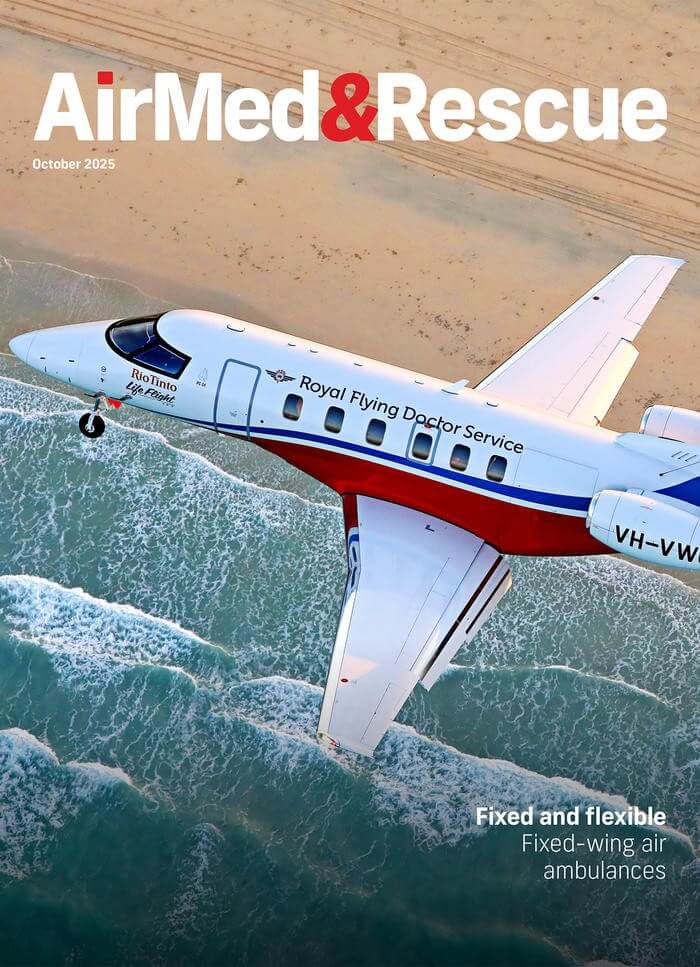
In our October edition, we bring you news, features and more showcasing special missions from around the world. We have features that focus on the fixed-wing air ambulance platforms that are enhancing air medical operations; the care and considerations when transporting children with infectious diseases at risk of deterioration; the law enforcement agencies that use aircraft to find and track persons of interest; and the challenges of treating patients with hyper- and hypothermia.
Jon Adams
Jon is the Editor of AirMed&Rescue. He was previously Editor for Clinical Medicine and Future Healthcare Journal at the Royal College of Physicians before coming to AirMed&Rescue in November 2022. His favorite helicopter is the Army Air Corps Lynx that he saw his father fly while growing up on Army bases.