
The evolution of crew resource management training

Amy Gallagher interviews a diverse set of aviation professionals highlighting crew resource management training, practices and challenges, and the evolution of this valuable part of the aircrew’s working life
Air and ground: a seamless partnership
Los Angeles, California, is the second largest city in the USA, with almost four million residents, who are supported by the Los Angeles Police Department (LAPD) Air Support Division (ASD), the largest municipal airborne law enforcement in the world. The Department is organized into three ASD operations: Air Support to Regular Operations (ASTRO), supporting the Department’s patrol mission, which requires 24/7 flights of two patrol helicopters; Special Flights Section (SFS), providing aerial support to the Department’s investigative units, and during major events; and Support, which includes all aspects of pilot and tactical flight officer (TFO) training, operational safety, and aircraft maintenance. It operates from the LAPD Hooper Heliport, the world’s busiest heliport and largest rooftop airport.
The ASD currently operates 17 helicopters, comprising 16 Airbus A-Star 350s to support the ground police, and one Bell 412 for special operations, SWAT missions and Bomb Squad; and one fixed-wing aircraft, a King Air 200, to transport witnesses, victims, prisoners and department personnel. It has a crew of 50 pilots, representing a total of 16,000 flight hours, and 26 TFOs.
For 30 years, LAPD Chief Pilot Kevin Gallagher has served the city of LA, with 25 years in the ASD and three years as a TFO, earning 7,000 flight hours, including 6,000 in rotor, instrument rating as an instructor, and an Airline Transport Pilot (ATP) rating in rotor and multi-engine aircraft.
His passion for the mission is evident. His passion for safety, even more so.
Gallagher’s early interest in law enforcement propelled him into earning a master’s degree in aviation safety, studying the evolving nature of crew resource management (CRM) and the lessons learned after the 1987 Northwest Airlines accident, in which 154 people died at Detroit Metro Airport, Michigan.
“As a young aviator, I understood safety and the importance of CRM,” said Gallagher. “It’s amazing now to see how CRM has evolved into its fifth generation with an emphasis on threat and error management (TEM) training.”
Contemporary CRM: threat and error management
Gallagher defines CRM’s primary goal as “maintaining operational safety and mission effectiveness, while the concept of TEM is a key component of contemporary CRM training”.
“TEM training emphasizes managing potential risks and mistakes, rather than just trying to avoid them, to ensure crews can recognize threats, prevent errors, and recover from situations that could lead to undesired aircraft states,” he explained. “Knowing how to discern external threats and internal errors is critical.”
An example, said Gallagher, is understanding threats as internal errors that arise from individual actions, such as skipping a procedure or entering incorrect data in the flight management system, as well as threats from external sources such as mechanical malfunctions or adverse weather.
“Threats come at a flight crew, and errors come from a flight crew,” he said. “The goal of CRM is to mitigate these external threats and reduce internal errors.
“By incorporating TEM into CRM training, flight crews are better equipped to proactively manage risks and maintain a high level of safety, combining technical knowledge with the skills to manage human and operational factors,” said Gallagher.
By incorporating TEM into CRM training, flight crews are better equipped to proactively manage risks and maintain a high level of safety, combining technical knowledge with the skills to manage human and operational factors
CRM training on mitigating threats and reducing errors is included in the Department’s 40-hour ground school for pilots, in the eight-hour ground school for TFOs, and in quarterly training for the line pilots, said Gallagher. He added that CRM training was included in quarterly check rides for pilots and was part of the ground school curriculum for both pilots and TFOs, who help manage complex situations, making critical decisions and providing tactical support during high-level incidents, coordinating with ground units, relaying information from the air, and directing officers on the ground.
Training from the outside in
In any training environment, leveraging external resources allows organizations to introduce new methodologies, offer objective perspectives, and discover insights into the industry’s best practices, while also challenging internal complacency.
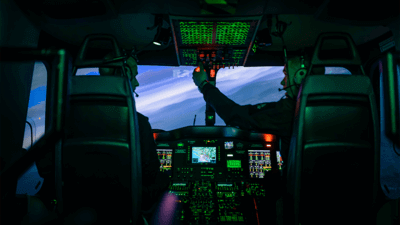
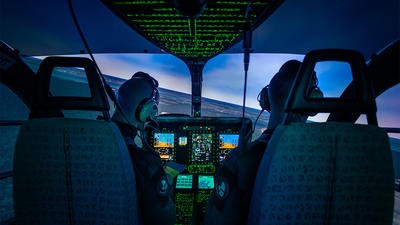
Last year, the LAPD installed a virtual reality (VR) flight simulator, becoming the first US law enforcement agency to use VR for pilot training.
“VR has been a real game-changer,” said Gallagher, adding that the training provided by Loft Dynamics instructs LAPD check pilots on how to operate the simulator’s instructor station.
The use of the VR simulator includes integrating TFOs into the VR CRM training environment, which allows for realistic emergency procedures and mission scenarios that would be difficult to replicate in conventional training, he explained.
In training scenarios for operating over a ground incident or flying over a pursuit, Gallagher said it was critical to experience a more realistic representation of low-altitude flight that incorporates simulated vehicle pursuits, engaging TFOs in particular more actively.
“The realism of VR simulators is superior compared to traditional full-motion simulators, particularly when operating close to the ground, in low-altitude scenarios,” he explained. “There’s a depth perception of low-altitude flight that differs between VR training and the traditional full-flight simulator. In the VR training environment, a 5ft hover is a 5ft hover. Visuals in the traditional full-flight simulator make it look as though it’s 30ft from the ground.”

VR CRM training: low-altitude flying
Yet another critical component of integrating the TFOs into the VR CRM flight training environment is discerning an internal threat, such as when the pilot becomes fixated on a ground pursuit, explained Gallagher.
“The VR sim allows crews to train together with an emphasis on sharing the workload,” he said.
In the above situation, he explained, “the TFO handles the police incident and assists with flight duties when the workload permits, while the pilot maintains the flight and assists the police incident when the workload permits.
“While low-altitude flying is necessary to effectively manage police incidents, it also increases operational risk,” he added.
Gallagher explained there was an “internal drive” within every police officer who becomes a police pilot to apprehend fleeing suspects, but that desire can draw a pilot’s attention toward the police incident and away from the tasks required to safely fly the aircraft.
“That internal drive doesn’t turn off when the police officer becomes a pilot,” he said. “This fixation on the police incident creates a threat that needs to be mitigated through effective CRM training, which includes techniques on task prioritization and workload management.”
While the dilemma of flying at low altitude for visibility versus the safety risks associated with such maneuvers is a constant balancing act, training plays a crucial role in achieving this balance.
“All pilots are sourced from the police department, requiring a minimum of five years of patrol experience to ensure they can effectively respond to crime situations,” said Gallagher. He highlighted the importance of comprehensive training programs for aerial police officers, which at the LAPD includes successfully completing the Department’s 44-week flight training program that emphasizes safety and CRM throughout.
Managing workload, avoiding task saturation
Each year, LAPD aircrews oversee an average of 375–400 vehicle pursuits, which can raise the adrenaline levels of everyone involved, including the aircrew, said Gallagher.
“When the crew is confronted with an in-flight emergency, their participation in the police incident is suspended and all attention is directed to handling the emergency,” he said.
The only time the job gets emotional is during a ground pursuit, said Gallagher.
“In these situations, aircrews are vulnerable to task overload, making it critical for aircrews to share the workload, and to appropriately prioritize tasks,” he said.
In these situations, aircrews are vulnerable to task overload, making it critical for aircrews to share the workload, and to appropriately prioritize tasks
At that point, the TFO is ultimately in charge of direction, engaged with ground patrol and managing the radios, said Gallagher, adding that the communications workload intensifies in the cockpit when managing radio communications with police dispatch, ground personnel, air traffic control (ATC), and other aircraft.
“We have two aviation radios and five police radios in the cockpit,” he said. “Pilots can deselect aviation radios while the TFO can deselect the radio or turn down the radio. Techniques like this help manage workload and avoid task saturation, which are incorporated into our CRM training program.”
At this point, the TFO becomes the co-pilot and picks up the checklist, he said.
“The TFO will advise the ground units of the need to disengage from the police incident and then work with the pilot to manage the emergency,” said Gallagher. “An important part of the CRM training program includes teaching TFOs how to use the emergency checklist.”
Syncing air and ground: a ‘patrol car in the sky’
Gallagher said that while the Department’s ground patrol did not attend CRM specific training, the air and ground crews synced through teamwork and communications.
“Mitigating the mission requires an intense focus on air operations supporting ground patrol as the priority,” said Gallagher.
Basically, he said, it’s about teamwork and communications while understanding tolerance for risk assessments and prioritization of task response, with a lot of transference of communications skills and workload management.
“Our primary mission is to support police on the ground while implementing the same basic police patrol principles in the helicopter as in the car,” Gallagher explained. “We use the term ‘patrol car in the sky’ to describe the seamless partnership between aerial and ground crews.”
There is a significant advantage in hiring pilots who are police patrol officers in that patrol cars have two officers who learn to work together, which translates well if they want to make their way to the air unit and into the cockpit
He added: “There is a significant advantage in hiring pilots who are police patrol officers in that patrol cars have two officers who learn to work together, which translates well if they want to make their way to the air unit and into the cockpit.
“The LAPD Department’s motto is: ‘The mission is the same; only the vehicle has changed.’ And, to reinforce this motto, the Department purposefully paints our patrol helicopters to look exactly like our patrol cars,” said Gallagher.
They have the same LAPD seal and the same color on the patrol car and the helicopter, he said.
“The transition is seamless in every detail, even to the identical external detailing on the aircraft and the patrol car,” Gallagher added.
Removing rank: the great equalizer
The safety of any aviation organization depends upon leadership and their ability to communicate effectively, while ensuring CRM makes use of all available resources – notably human resources that maximize human performance.
In the 1990s, Gallagher said the Department implemented a non-punitive safety reporting system aimed at promoting open communications among crewmembers, which is essential for effective CRM.
“This structure helps ensure that safety concerns can be addressed without fear of reprisal,” he added.
One area of concern in aerial law enforcement, however, is the interaction of rank structure and political dynamics that can impede effective CRM at times, explained Gallagher.
“We’ve learned that rank in the cockpit leads to compartmentalization when the lower-ranking pilot doesn’t speak up,” he explained. “One of the first things we did was to remove the rank. Instead, we communicate with each other using our names.”
Removing rank from cockpit interactions allows crewmembers to feel more comfortable about speaking up, and TFOs who don’t have rank are better able to direct pilots during missions, Gallagher added.
Effective leadership is also an area addressed in CRM training.
Workload can be another barrier to effective communication, Gallagher added. “A primary objective of CRM is to mitigate human error, which includes effectively managing workload and avoiding task saturation,” he said. “Workload issues are mitigated through task prioritization through leadership.”
A primary objective of CRM is to mitigate human error, which includes effectively managing workload and avoiding task saturation
While the position of Chief Pilot has ensured constant demands, despite its challenges, said Gallagher, “I’m excited about the operation and its important missions.”
Lessons in human performance
Retired US Air Force Lieutenant Colonel Tammy Barlette spent more than 20 years as a pilot, instructor, and leader across multiple platforms, including the T-37, T-38, A-10, and the MQ-1 and MQ-9 remotely piloted aircraft. Throughout her career, she served as a T-37 and T-38 instructor pilot, an A-10 attack pilot, and later as an MQ-1/9 instructor and weapons officer in the Air National Guard.
Lt Col Barlette said: “Across every aircraft and mission set, one theme remained constant: success in the cockpit was never just about skill; it was about communication, teamwork, and mindset.”
Success in the cockpit was never just about skill; it was about communication, teamwork, and mindset
‘Aviate, navigate, communicate’
While stationed at Laughlin Air Force Base in Del Rio, Texas, Lt Col Barlette was flying a formation training mission when one of her students calmly said, ‘Ma’am, we have a generator failure.’
“When I looked down and saw the light, I took control of the aircraft, assumed the lead position in the formation, and prepared to bring both aircraft through the weather for the approach,” she said. “The overcast layer sat around 700ft, with a clear pocket above.”
As they were flying above the clouds at the time, Lt Col Barlette led the formation into the weather on the descent.
“During the approach, while running the landing checklist, the landing gear failed to come down,” she said. “At that moment, I felt overloaded. But training kicked in. I fell back on the fundamentals: aviate, navigate, communicate.”
Lt Col Barlette executed a ‘go-around’, climbed back above the weather, and worked with the student to troubleshoot. “Together, we used the alternate gear extension procedure, lowered the landing gear manually, and landed safely,” she explained.

CRM: only seeing one light
A few days later, maintenance approached her, saying the issue had been traced to a gearbox failure. Lt Col Barlette responded immediately: “That can’t be right – I only saw one light. A gearbox failure would have given me two.”
Then, almost instantly, her mind replayed the panel in vivid detail – and she could suddenly see both lights.
“I ran down to find the student,” she said. “When I asked him what he saw, he said, ‘Generator light… and hydraulic light.’”
Lt Col Barlette said, that’s when the realization hit.
“I had seen what I expected to see, but my brain accepted the first report and filtered the rest out,” she said. “That’s confirmation bias. Even with experience, we’re not immune to it.”
The hidden risk in experience
By that point in her career, Lt Col Barlette said she’d been flying jets for 16 years.
The flight ended safely, but she knew the stress, the go-around, and taking a malfunctioning aircraft back into the weather could have been avoided if she had recognized the bias sooner.
“It was a clear example of how human factors affect even the most procedural environments,” said Lt Col Barlette. “Experience doesn’t erase bias; it just makes it easier to identify when it happens.”
The takeaway was simple: effective CRM requires more than technical skill or authority; it requires humility and openness to input from every crewmember.
Effective CRM requires more than technical skill or authority; it requires humility and openness to input from every crewmember
CRM and the instructor–student dynamic
For Lt Col Barlette, the instructor–student relationship provided a unique lens on CRM.
“Even though the instructor outranks the student, during the flight and debrief there’s no hierarchy,” she said. “You have to create space where both voices matter.”
Allowing the student to work through problems, she explained, builds not just technical skill but trust – trust that becomes essential when pressure mounts.
“When the workload increases and the student feels overloaded, I simply take control of the aircraft and ask them to just observe,” she said. “It gives them the mental space to start learning again.”
Lt Col Barlette believes this is one of the most overlooked areas in flight instruction.
“Many instructors think CRM is only about cockpit communication, but it’s really about emotional awareness and human performance,” she said. “It’s how we build confidence and decision-making under pressure.”
Feedback and the power of listening
Looking back at decades of CRM evolution, Lt Col Barlette sees one consistent gap: how feedback is given and received.
“If you want others to be honest with you, you have to be open and nonjudgmental on the receiving end,” she said. “Too often, people listen to respond rather than listen to understand. That’s when learning breaks down.”
The key, she said, is developing the courage to speak up and the humility to listen – no matter rank or role. “The best teams are the ones where everyone’s voice counts. That’s how safety culture actually grows.”
From CRM to cognitive readiness
In 2023, Lt Col Barlette launched Crosscheck Mental Performance, a platform dedicated to teaching pilots and aviation professionals how to train their minds with the same precision they train for procedures.
“People often assume that because I was a fighter pilot, I must be immune to doubt,” she said. “Trust me – I’m not. The difference is, I’ve learned how to manage it.”
Her approach builds on the foundations of CRM but focuses on the individual pilot’s mental system – their ability to manage stress, recover from setbacks, and stay composed in high-stakes environments.
“When something goes wrong, you can’t just pull over on a cloud,” she said. “You have to train your brain to fly through it.”
Lt Col Barlette’s program, the Aviation Performance Accelerator, provides structured mindset training designed to help pilots at every stage – from student to senior captain – build confidence, clarity, and resilience.
“The truth is, most performance breakdowns aren’t about lack of knowledge,” she said. “The performance breakdowns happen because we can’t access what we know in the moments we need it most. Mental performance training fixes that.”
The performance breakdowns happen because we can’t access what we know in the moments we need it most. Mental performance training fixes that
The bottom line
Whether flying a training mission, managing a medevac, or leading a cockpit crew, Lt Col Barlette said the principle remains the same: mental performance is foundational to everything that happens in aviation.
“The mind is the one system in the aircraft that affects every other one,” she said. “When it’s strong, communication improves, judgment sharpens, and performance stays consistent – even under pressure.”
Mental performance isn’t optional, she added. “It’s a critical part of training that too often gets overlooked, but it’s what ensures we can bring our best to every flight, every time.”
Resolving conflict by understanding ‘flavors’
Polish Medical Air Rescue (LPR) operates a national network of 23 permanent bases (of which, six operate 24/7, one is a seasonal base, and there is a patient transfer team and four aircraft on permanent duty 24/7 stationed at Warsaw Chopin Airport), serving a population of about 38 million.
Rescue Pilot Mieczysław Brzezicki has served for the past six years with LPR after working as a commercial pilot and as an instructor. He explained the organization’s operational aspects, including decision-making processes, training programs, and safety protocols.
The multi-disciplinary and multi-cultural LPR crews who serve throughout Poland include a pilot, physician, and a nurse or emergency medical technician (EMT), and are as diverse as the fleet of aircraft, which includes the Robinson R44 Raven II, EC135 P2 and P3, Learjet 75, Tecnam P2008 (MkII), and Piaggio P180 Avanti.
Working in a CRM environment where crewmembers from different regions with varying backgrounds, cultures, and political views must collaborate for extended periods, challenges can arise within the human factors realm, said Brzezicki.
“When three people spend 14 hours together within a limited space in a stressful environment, personal conflicts can and do arise,” he said.
Brzezicki explained that while crewmembers may avoid each other during personal conflicts, crews understand the importance of maintaining professionalism and adhering to protocols to ensure operational procedures remain in place.
“We’re all humans working in a stressful environment, so sometimes we may avoid each other during personal disputes; however, we must maintain professionalism and adhere to protocols per operational procedures,” said Brzezicki.
In addition, effectively managing procedural and professional conduct within a multidisciplinary crew to mitigate the approximate 900 daily calls, the pilot-in-command makes final decisions, he said.
“While we collaborate with the medical staff who provide suggestions, we focus on talking it out together to make the best decision for the mission,” said Brzezicki. “The goal of communications during times of conflict is to empower the team by listening to understand, not the other way around.”
Their practice is “respecting and accepting differences”, where each person has rights and their own set of beliefs, he added.
“Opinions are neither positive nor negative,” said Brzezicki. “Everyone is different. The point is to hold a deep respect for each individual as humans. Understanding the various ‘flavors’ is the key to understanding one another so that we can work together,” he said.
Everyone is different. The point is to hold a deep respect for each individual as humans. Understanding the various ‘flavors’ is the key to understanding one another so that we can work together
Continuous training and learning in collaboration
Emergency Management Physician and Aeromedical CRM (ACRM) Trainer Michał Sobczyk, MD, said LPR’s comprehensive CRM training was incorporated into its ground school, simulator, and aircraft training. LPR has also launched a ‘Train the Trainer’ Program, which provides interactive team-building strategies and job-shadowing opportunities, he said.
“Every year, more than 50 trainers meet in Poland for recurrent training for three days of CRM training,” said Dr Sobczyk.
Their CRM training has expanded exponentially since joining the European HEMS and Air Ambulance Committee (EHAC) in 2013. “The EHAC is a collaboration that unites and represents over 10 European helicopter emergency medical services (HEMS) organizations committed to standardizing CRM training, which has ultimately led to the formation of a European CRM Working Group,” explained Dr Sobczyk.
“Within our Working Group, we engage in shared experiences on how CRM principles maintain situational awareness, error management, teamwork, and stress management, among other CRM areas, including ‘closed-loop’ communications training,” he added.
“Through our Working Group Chairman, we can provide input to continuously improve CRM training, which includes, at times, requesting adjustments to the European Union Aviation Safety Agency (EASA) regulations,” Dr Sobczyk said.
As required by the EASA Air Operations Regulation No 965, they are currently working on detailed legislation to better define how CRM should work in the organization, he said.
“The Committee facilitates an exchange of information on safety incidents across member countries,” said Brzezicki, who added that the team was planning to attend an upcoming annual meeting in Slovakia to discuss safety lessons and resilience in handling unexpected situations.
Diverse terrain: ‘sea ops and mountain ops’
Poland is composed of northern and central areas known as the ‘lowlands’, as well as in its southern region, hills and mountains characterized by flat, low-lying terrain with numerous lakes, forests, sand dunes, and swampy areas near the Baltic coast.
Brzezicki said LPR structured its operations as sea or mountain operations.
“Our HEMS missions include interhospital patient transport and accident response in both urban and mountainous areas around the southern region in Katowice, which is the most populated area in Poland,” he said.
Brzezicki explained the importance of decision-making in rescue operations, highlighting the need to evaluate situations and make quick choices about landing locations and hospital destinations.
Lined with the Sudeten and Carpathian mountain ranges, the southern region is the most challenging terrain, with steep slopes, narrow valleys and high peaks reaching over 2,500m with strong, gusty winds and rapid weather changes.
One of the greatest geographic challenges is finding a landing zone (LZ), he added.
Resilience through reporting and resting
Maintaining focus and sustaining performance in the 14-hour HEMS environment requires standard operations such as a reporting system and creative, perhaps non-conventional strategies, such as resting.
“Crewmembers can take short naps during breaks to stay alert, a practice that was informally adopted despite not being officially part of CRM training,” said Brzezicki.
Crewmembers can take short naps during breaks to stay alert, a practice that was informally adopted despite not being officially part of CRM training
Breaks can help with mentally processing the unimaginable difficulty of working fatalities, such as a mission he cited where a mother and child did not survive a road traffic accident.
Brzezicki said one of the crew’s mental health practices as a safety protocol was to acknowledge their shared grief by “taking 20”. “We each take about a 20-minute rest to better manage our emotions,” he explained. “When we return to base is when we ‘talk, talk, talk’, knowing there’s a human story that must be honored.”
Psychologists are also provided to crewmembers for mental health assistance, Brzezicki said.
The organization has two methods of reporting crew concerns to management: anonymous physical boxes at the Warsaw hub office and the option for non-anonymous internet messages marked as in-flight or ground issues, he explained.
“There are moments, however, when a crewmember may not feel confident enough to speak up,” said Brzezicki, adding that this could be addressed “by creating a CRM environment where crewmembers receive permission proactively to resolve conflicts.
“Through ACRM training, our crews develop human factor skills by understanding how to cope within the mental state,” Brzezicki explained. “Human factors, including crew errors, contribute to 70% of accidents, which elevates the importance of ACRM in improving safety.”
In line operations, there is at least one error in every mission, he added.
“While ‘soft skills’ do not always translate to measurable skills, we can see self-confidence,” he said.
March 2026
Issue
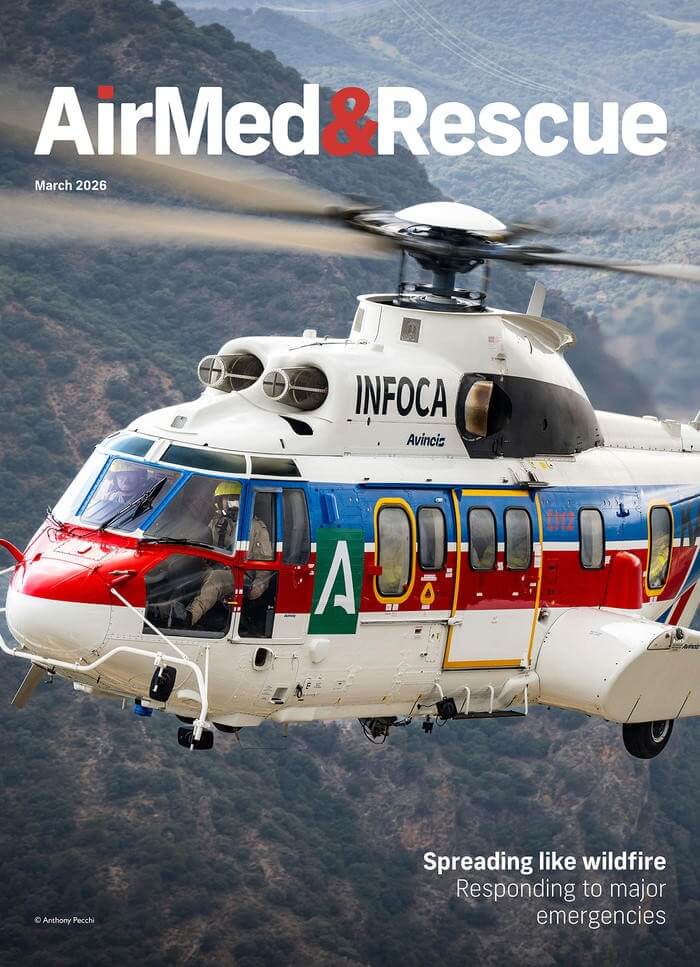
This edition is bursting at the seams with articles from all corners of the special missions sector. We have features on the California wildfires that ravaged the state last year, what the cost–benefit analysis looks like for single-engine rotorcraft and autorotations, how the mission dictates the modification needed to the platform, and what can be done to further prevent the problems associated with inadvertent entry into instrument meteorological conditions.
Amy Gallagher
Amy Gallagher is an internationally published journalist covering aviation, rescue, medical and military military topics, including training and technology, as well as evidence-based research articles. As a journalist by education and certified English instructor, Amy has worked in both agency and corporate communications, providing educational and promotional writing and training services.