
Exploring the full spectrum of simulation training

Industry specialists share with Lauren Haigh the latest advances in simulation-based training, from virtual and mixed reality systems to Level D full-flight simulators
Simulation in airborne special missions training has rapidly evolved over the past few decades, from basic flight simulators to whole mission environments that integrate virtual reality (VR), mixed reality (MR) and artificial intelligence (AI). These high-tech, immersive simulations are no longer something from the realm of sci-fi; they are an essential part of ensuring today’s crews are prepared for any and every scenario. Real-world missions are complex and the stakes are high, and there is a whole spectrum of simulation to ensure that special missions teams can safely prepare for every mission, no matter the complexity.
Inside immersive environments
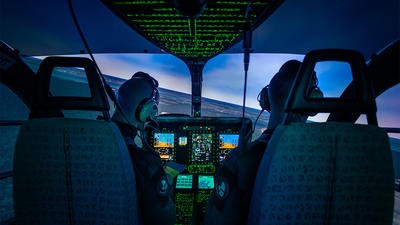
Simulation providers are driving innovation in immersion, mission-specific realism and multi-crew coordination. Loft Dynamics is at the forefront of VR training, with Federal Aviation Administration (FAA) and European Union Aviation Safety Agency (EASA) qualified devices that replicate helicopter flight with motion, haptics, and a 360° cockpit. “These simulators deliver a near-perfect replication of real-world helicopter flight,” stated Woody McClendon, North American New Business Manager at Loft Dynamics.
Coptersafety specializes in type-specific and tailored training that covers everything from initial type ratings to recurrent training. CEO and Co-Founder Hannu Marjoniemi noted that the company also develops mission-focused packages for operators, including air medical and rescue scenarios, to ensure that training reflects the real flying crews actually do.
CAE offers different levels of simulation and training, each tailored to the specific operational needs of the customer, so the balance between simulation and live flight training can vary depending on mission requirements. Moreover, through its simulation training, at CAE, simulation assists crew and maintenance personnel alike. At its Fixed Wing Search and Rescue (FWSAR) Training Centre in Comox, British Columbia, aircrew benefit from full-motion simulators, cockpit procedural trainers, sensor suite simulators, and part-task trainers to build mission readiness, while technicians practice hands-on maintenance in a full aircraft. “This ensures that aircrew are mission ready and aircraft are properly maintained and available for immediate deployment,” highlighted Abir Kazan, Senior Director of Future Aircrew Training (FAcT) and Acquisition Programs, Defense & Security Canada, at CAE.
Practice makes perfect
A focus for Entrol is on customization and crew dynamics. Its ENVISION image generator uses real terrain data to enable pilots to practice real-world missions, while the company’s MR Hoist Operator station recreates multi-crew communication during rescue ops. “We realized there was a real need for operators to train these aspects, not only the maneuvering and performance of the operation,” reported Carlota Esteban, Entrol’s Business Manager. “A mistake in communication may make the difference when it comes to saving lives.”
A mistake in communication may make the difference when it comes to saving lives
Reiser Simulation and Training has built an innovative augmented reality (AR) hoist trainer that was developed in collaboration with experienced hoist operators. “It sharpens skills to meet the challenging demands of hoist rescue missions,” stated Jonas Goercke, Reiser’s Head of Business Line (Flight Training, Data, Models).
Finally, Air Rescue UK utilizes Bluedrop’s high-fidelity Hoist Mission Training System (HMTS) for comprehensive training. “This includes voice marshalling, hoist control, and emergency procedures, up to and including high-workload hoist missions in challenging conditions,” explained Air Rescue UK’s David Bazlinton, Head of Training, and Richard Goodwill, Ops Manager.
No room for compromise
Achieving the right balance between realism, cost, ease of use, and maintenance is a central challenge in air medical simulation. High-fidelity systems can replicate the conditions of a real-life mission but often come with high costs and complicated infrastructure demands. Innovation offers a way for training providers to bridge that gap.
To address this, a key emphasis for Loft Dynamics is on making simulation accessible and realistic. “Loft Dynamics was built to solve a fundamental challenge: how to make high-quality flight training both safe and accessible without compromising realism,” said McClendon. He added that the company’s compact VR simulators were about 20 times more affordable and one-tenth of the size of traditional FFS. “Yet they deliver an incredibly immersive and realistic experience,” he explained. The systems plug into a standard power outlet and run on a workstation, reducing logistical barriers and minimizing maintenance.
They deliver an incredibly immersive and realistic experience
At Coptersafety, there is emphasis on maximizing the value of time in the simulator. As such, simulators are equipped with as many mission capabilities as possible. “Training scenarios include sinking ship, cliff rescue, forest fire and ship landing, and in-house visual modeling creates visual databases tailored to any of our customers’ needs,” highlighted Chief Operating Officer Toni Rönnberg. This customization ensures that pilots can practice real scenarios that mimic the environments they will operate in.

Safe but realistic emergencies
CAE combines realism with efficiency. “We focus on realism to make training more effective and mission ready, whether it’s basic flying, maintenance routines, or more advanced maneuvers,” stated Kazan. “We run human-machine interface studies to make things simpler for instructors and ensure training feels intuitive. Both instructors and students help shape the experience, and our adaptive learning tech adjusts to each person’s performance.” She pointed out that, by using simulation instead of live flight training, operators could reduce costs and minimize wear on aircraft.
Entrol’s ENVISION platform allows customized scenarios like heliports or confined areas to be represented with a high level of realism. “Our key goal is to provide training applicable to a pilot’s real-world duties and responsibilities in air medical and rescue operations,” Esteban said.
At Reiser Simulation and Training, the company’s in-house production and self-developed flight models minimize reliance on external suppliers, leading to more efficient and cost-effective maintenance. “We operate largely independently of original equipment manufacturers (OEMs) and external suppliers,” confirmed Goercke. This integration keeps maintenance and support under one roof, resulting in faster, more efficient, and cost-effective processes.
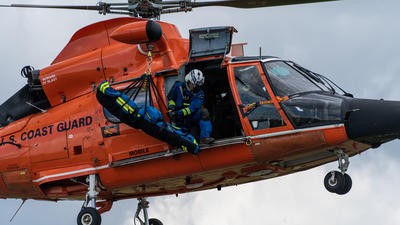
Bluedrop’s HMTS uses VR visuals and haptic cable feedback to replicate hoist dynamics under varying conditions. “It is the most realistic simulator, robust, reliable and quick to reconfigure between scenarios and roles,” said Bazlinton. Air Rescue UK Executive Chairman Ian Bonthrone added that the system allowed operators to practice emergencies that could not be safely replicated on live aircraft, while the addition of a mixed reality pilot seat enhances crew coordination and procedural accuracy.
The system allowed operators to practice emergencies that could not be safely replicated on live aircraft
Pushing the limits
Safety and realism are important benefits of simulation in air medical and rescue training, but challenges in the form of cost persist. “Training in an FFS is the safest environment for both pilot and instructor, with no risk to ground crew or the environment,” underscored Mikko Kallio, Head of Training at Coptersafety. “The realism of an FFS is a huge benefit as you can train further than you can in the real aircraft.” Indeed, by replicating complex and hazardous scenarios in a simulator, crews can push their skills to the next level.
Esteban said that the main challenge in acquiring a simulator was the cost. “Although it ensures a fast and efficient ROI, it encompasses a great effort at the beginning. It is key to understand which model best suits your training needs so you can make an informed and profitable decision,” she commented.
Although it ensures a fast and efficient ROI, it encompasses a great effort at the beginning
Bonthrone reported that other challenges were misconceptions around the importance of simulation, as well as regulatory hurdles. “Challenges still exist for helicopter hoist operator (HHO) training due to perceptions of simulation being supplementary rather than a primary training method. The other major challenge is the lack of regulatory input into HHO training. We, as an industry, need to get over the challenges and invest in safety.”
Where simulators shine
For the most effective training, air medical teams must be strategic about balancing time in the simulator with live flight hours. McClendon illustrated a clear trend: “More and more operators want to bring core training, including recurrent checks, into the simulator because it’s safer, more consistent, and a lot more cost-effective.” Safety and repeatability are the most powerful drivers of simulation training. “Where simulators really shine is in the stuff that’s dangerous or tough to replicate in the aircraft – emergency procedures, low visibility landings, hoisting, external load operations and NVG flying; even decision-making under stress. We’re giving pilots a safe, repeatable way to train for the missions they’ll actually face,” McClendon said.
Simulation is also key for maintaining proficiency in skills that aren’t used frequently in live operations, as Kallio highlighted: “If personnel are not exposed to instrument flying regularly, they need to practice in the simulator to improve and maintain their skills.”
The advantage of high-fidelity simulation lies in its ability to reduce aircraft workload and operational costs while enhancing safety and training effectiveness
Simulation is also beneficial in that it reduces costs. “The advantage of high-fidelity simulation lies in its ability to reduce aircraft workload and operational costs while enhancing safety and training effectiveness,” stated Kazan.
Importantly, simulation isn’t just about quantity of hours; it’s about quality and skill development, and, with simulators, crews can repeatedly practice extreme scenarios. “Certain operations are risky, but that could turn worse if a failure or storm suddenly took place,” Esteban said. “In this sense, simulated training enhances precision, safety, multi-crew coordination and confidence.”
Bazlinton and Bonthrone shared with AirMed&Rescue an example that demonstrates that by focusing on high-risk, high-complexity, and infrequent scenarios in the simulator, crews become better prepared to handle real missions: “One example involved training a qualified rear-crew member with no prior hoisting experience to operational status. In 25 hours of simulator time, they completed 48 sorties, 256 hoists, 86 vessel transfers, 52 open-water recoveries, and 56 emergency drills, including 11 cable cuts. Ninety per cent of the training was via simulation. These were all real-world scenario-based with no time lost to transits or turnarounds.”
Keeping it cohesive
Effective communication, teamwork, and coordination represent crucial ingredients for mission success, and simulation offers multi-crew training within a single aircraft and networked scenarios across multiple crews. McClendon shared that this type of training enabled teams to refine their coordination and decision-making under pressure. “Our dual-seat H145 simulator fully supports multi-crew training, allowing teams to rehearse realistic mission scenarios together. That includes practicing communication, task sharing, and decision-making exactly as they would in the aircraft during a real emergency.”
For larger-scale or networked operations, simulation allows multiple aircrews to participate in the same mission scenario from different stations. “Linked or networked simulation is a critical capability in modern training environments,” said Kazan. “Multiple aircrews can participate in a unified mission scenario while operating from different simulator stations. This not only enhances realism but also ensures mission cohesion and operational readiness.”
Linked or networked simulation is a critical capability in modern training environments
Ready as ever
The future of special missions simulation lies in combining technological innovation with operational realism and adaptability. Providers are continually enhancing simulators to reflect the complexities crews face in real missions. McClendon said that Loft Dynamics would be expanding scenarios and capabilities: “We’re adding more mission-specific content – things like mountain flying, sling-load work, NVG operations, and weather and additional terrain scenarios. The goal is to help pilots prepare for the real world, without the risks or expense of doing it in the aircraft.”
AI and machine learning (ML) will continue to transform training environments. “CAE is leveraging AI and ML to accelerate aircrew training and improve proficiency,” highlighted Kazan.
Mixed reality and customization will also play a key role, said Esteban. “We offer deep-end customization so that customers can practice in their own scenario. We expect that the future of simulation will lie in mixed reality, combining the best benefits of both styles.”
While technology is evolving apace, there is no replacing highly experienced instructors, who are essential to effective training. “All our instructors have extensive careers in aviation,” said Matt Presnal, Chief Theoretical Knowledge Instructor at Coptersafety. “Many still actively fly in helicopter operations such as offshore, HEMS and SAR, or work as maintainers around the world.”
Simulation has become an indispensable part of airborne special missions training and teams now have access to a spectrum of tools, including VR and MR systems and Level D full-flight simulators. These enable safe, repeatable, and mission-specific training that complements live flight hours and indispensable lessons from highly experienced instructors, resulting in crews that are as ready as they can possibly be to face the challenges of real-world missions.
December 2025
Issue
Our December edition rounds off the year with articles relating to special missions from around the world. We have features that look into the upgrades that have been integrated into special missions platforms to improve operations; the technology used to alert and support aerial firefighting tactics, helping attack fires quicker and more strategically; the simulators that are making training for special missions better and safer; and the latest updates and announcements of digital and physical technology in the last year.
Lauren Haigh
Lauren has worked in the publishing industry for eight years and reads and writes about healthcare, science and travel insurance on a daily basis. Her favourite aircraft is the plane from the title sequence of British educational children’s TV series Come Outside.