
Improving patient outcomes with blood on board

Which blood products do teams carry on board and how do they properly transport and administer this vital lifeline? Professionals from across the air medical sector discuss considerations, regulations and adaptations with Lauren Haigh
Back in 2015, a study confirmed that the growing practice of pre-trauma center (PTC) red blood cell transfusion was improving outcomes. In 2020, research conducted by a Finnish helicopter emergency medical services (HEMS) team confirmed that “a pre-hospital physician-staffed HEMS unit carrying blood products is a feasible and safe method to start transfusion roughly 30 min before arrival to the hospital”. By carrying blood products, HEMS teams can administer blood in the pre-hospital setting and improve outcomes. There is ongoing research on the benefits of carrying whole blood on board, including a 2023 study that investigated the feasibility of a pre-hospital whole-blood transfusion program. Carrying blood and blood components on board is not without its challenges, but it can save lives and that’s the bottom line.
Up against unpredictability
AirMed&Rescue asked HEMS paramedics and flight nurses about the types of missions they typically respond to and the blood products they carry. Carlie Manson, Clinical Governance & Patient Safety Officer and a Flight Nurse at LifeFlight, said that missions are a mixture of pre-hospital retrievals, interfacility transfers and international repatriations. “All rotary and road missions carry blood with them as standard (70% of our total missions – 6,025 cases). Our service currently carries four units of packed red cells (two O negative and two O positive) and 3g of fibrinogen concentrate (FibC),” she stated.
Jessica Thomas-Mourne, Specialist Paramedic in Critical Care at Devon Air Ambulance Trust, reported that the service responds to life-threatening illness and injuries. “This can vary from medical incidents such as strokes, cardiac arrests and serious allergic reactions, to trauma-related incidents such as road traffic collisions, falls from height and agricultural incidents,” she stated. “We carry blood products called LyoPlas, a freeze-dried plasma, to give to patients who are bleeding. We administer blood products to patients an average of three to four times per month.”
AirMed&Rescue also spoke with Fay Balian, Retrieval Specialist at CareFlight: “Typically, we respond to life-threatening trauma requiring procedures such as intubation, chest decompression and blood products for acute hemorrhage,” she shared. “We use blood products approximately three times per month, in the form of extended life plasma, and red blood cells.”
Finally, Maura Hughes, CEO of Boston MedFlight (BMF), in collaboration with Chief Medical Officer Jason Cohen, highlighted that there is no ‘typical’ for the service. “Our teams are prepared, trained and equipped to care for whatever the day may bring. Because of the unpredictability of the mission and patient that we will respond to, all of our response vehicles carry blood products to every patient, consisting of two units of red blood cells and two units of plasma,” they said. This underlines the truly unpredictable nature of emergencies and the need to be prepared for anything.
Tight parameters
This preparation includes being properly equipped to store and transport blood and blood products and administer them in-flight. The blood must be maintained at a suitable temperature, and fastidious checks are crucial. “We carry a blood cooler that has specific ‘ice packs’ in it which keep the blood temperature at a specific range,” said Evelyn Thompson, Flight Nurse with Native Air 29, Air Methods. “Every morning, and as needed, we change the ice packs. We continuously monitor the temperature of the blood throughout the day to ensure it stays within that safe range. While not on a call, we place the blood and ice packs back in the blood fridge at our base.”
The temperature window can be very narrow, explained Tora Hedeager, Project Manager at MEQU: “Blood is to be stored at 2–6°C prior to transfusion, as temperatures exceeding 6°C can lead to bacterial growth and temperatures below 2°C can cause hemolysis. Platelets are stored at room temperature (20–24°C) and plasma is stored frozen at -18°C or colder.”
For blood administration, Thompson said that a blood and fluid warmer called the Warrior Lite is utilized. “This device quickly warms fluid or blood to a safe temperature for the patient. This is essential in trauma and hypothermic patients.”
Erica Ley, Senior HEMS Paramedic at Lincs & Notts Air Ambulance, reported that blood is carried in Crēdo boxes. “These are prepared for us by our partners, the United Lincolnshire Teaching Hospitals NHS Trust, and delivered by Lincolnshire Emergency Blood Bikes Service. We wouldn’t be able to deliver roadside blood transfusions without them. The cooled blood is maintained at a set temperature through the use of these boxes and monitored before being given to patients,” she stated. “We also use a MEQU blood warmer, which enables the blood to be warmed to the patient’s body temperature. We are able to administer the blood at a rate of 150mL per minute through a long tube into the patient’s vein.”
Because of the unpredictability of the mission and patient that we will respond to, all of our response vehicles carry blood products to every patient

Hedeager cited the importance of a rapid ability to warm blood: “Warming blood and blood products to body temperature quickly is essential in emergency settings where every second counts. The °M Warmer System warms fluids to body temperature within seconds prior to transfusion.”
Hughes said that Boston MedFlight (BMF) receives its blood products from the blood bank at Brigham and Women’s Hospital in Boston and underlined the importance of continuous monitoring. “Throughout its processing, transport, storage and eventual transfusion, each unit is fastidiously tracked and monitored to ensure we are following the highest standards in transfusion safety,” she stated. This includes visual checks, storage in refrigerators that monitor and report the temperature, and the use of blood coolers that are validated to maintain the internal temperature for up to 72 hours. If there are any deviations in temperature, the team is alerted. “When a patient requires a blood transfusion, the products are removed from these coolers and again checked by BMF clinical staff, finally being transfused while being warmed by portable blood warmers to ensure the blood products do not contribute to any temperature drop in the patients,” Hughes explained.
Working with space limitations
A team’s aircraft platform plays a key role in influencing how blood is stored and administered. Manson specified that she works on LifeFlight’s Brisbane-based helicopter, an AW139, with a team composition of pilot, co-pilot, critical care doctor and flight nurse. “The AW139 airframe is a good workspace for in-flight management,” she said. “Working with a two-person medical team at times can be busy, and the importance of pre-flight planning and preparations is always at the forefront. The airframe offers sufficient space for blood products and blood warmers to be carried in the main cabin and easily accessible in-flight.
“When working on our fixed-wing fleet, the Challenger 604 aircraft is large and very spacious. A two-person team comprising a critical care doctor and flight nurse are easily able to carry and administer blood products in-flight.”
Balian pointed out that all pre-hospital environments must navigate the challenge of limited space. “We operate in an Airbus H145, which is an excellent pre-hospital emergency medical service aircraft and has favorable weight and performance parameters. Like all pre-hospital environments, we are limited to the amount of equipment that we can use, as once we arrive at the scene, all of our operational equipment is carried to the patient by the clinical crew,” she stated.
Throughout its processing, transport, storage and eventual transfusion, each unit is fastidiously tracked and monitored
Thompson said that she currently works on a Eurocopter EC130. “This aircraft is very spacious compared to other aircraft. This advantage gives us the ability to easily access the patient from head to toe, which comes in handy with trauma patients as it allows us to continuously reassess the patient,” she explained. “Because of the spacious interior, we can always keep the blood cooler with us in the main compartment.”
Highlighting the importance of keeping equipment small and light, Hedeager said: “The °M Warmer System’s operational weight is 820g (a rechargeable Power Pack+ and a single patient-use °M Warmer). It has a compact design and a warming capacity of 2L of cold fluids on a single charge. The low weight and compact design combined with an IP54 rating makes the °M Warmer System tailored for use in austere environments.”
Bringing forward the point of care
Another factor influencing the need to carry whole blood and blood products is geography and, depending on the location in question, there may be operational factors that exert an influence. “In Australia, the limitations around whole blood have evolved from the products available from blood banks,” Balian explained. “Splitting donated blood down into its components began many years ago as it was a more efficient way of using this precious resource. In more recent years, there has been increased interest in a return to whole blood use during resuscitation. The CareFlight Rapid Response service is designed to be a primarily metropolitan pre-hospital trauma service, and we are moving towards a trial of whole blood use to participate in this evolution.”
Hughes indicated that Boston MedFlight’s location affords relatively high levels of community hospital care compared with other parts of the USA. “That is reflected in the Boston MedFlight mission profile with predominance of interfacility transports. Additionally, a sizable percentage of our hemorrhaging patients are not bleeding from trauma, but from other sources such as gastrointestinal or aortic disease. These ‘non-traumatic’ bleeding patients have not demonstrated a significant benefit to whole blood versus component (i.e. red blood cells and plasma) therapy,” she commented.
Thompson told AirMed&Rescue that Native Air 29 is based in a rural area of New Mexico with heavy industrial traffic on narrow highways. “When traveling by ground, it is a minimum three-hour drive to a Level I Trauma Center. It is very important we carry blood with us in case of a trauma, especially because we can be dispatched to a call any time of day. When a patient is bleeding out, fluid can only do so much before it starts to harm them,” she pointed out.
Devon Air Ambulance Trust in the UK also operates in a rural location. “Having blood products in the pre-hospital setting is particularly beneficial in this context,” said Thomas-Mourne. “We can bring forward the point of care from the hospital (which may be a one-hour drive away) to the patient’s location, which can help to prevent morbidity and mortality.”
A robust team trains together
Given the unique challenges of administering blood in the pre-hospital environment, AirMed&Rescue asked whether specific training was required. Balian said: “Paramedic-led teams in Australia are certainly capable of delivering blood products; however, further training is required regarding their indications and their administration if they are required to make decisions regarding transfusion, as generally this is beyond their usual scope of practice. In addition, sourcing and managing this precious resource via blood banks is a layer of logistics that generally would not allow products to be available in every ambulance, for example. Doctors also require further training on the logistics and equipment of blood transfusions, as this is usually a role that nurses occupy in a hospital setting. Ideally, training occurs all together as a team, which includes our aircrew officers.”
Manson also said that training is done with all members of the team. “We do joint training with critical care doctors, paramedics, flight nurses, and, at times, aircrew. The benefit of this is that our doctors will at times work within a number of models of care. Regardless of the team composition you find yourself working with on the day, we should all be operating off the same standard operating procedures and guidelines,” she explained.
“In-flight emergency training through daily simulations and weekly case auditing reinforces the principles and priorities that LifeFlight wants the teams to be working towards. It doesn’t matter which doctor I find myself on shift with, we will have run through scenarios for both in-flight and on-ground emergencies that include blood administration.”
Aiming to reduce workload, and make the preparation and disposal of equipment as easy as possible, Hedeager said that the °M Warmer is a simple system: “After use, the single patient-use °M Warmer is disposed of and the Power Pack is wiped clean and recharged. If the HEMS team attends multiple incidents in one shift, they can simply apply a new °M Warmer and use the Power Pack again. If more than 2L of cold fluids are administered in one shift, an extra Power Pack is recommended.”

Navigating logistics
Transporting and administering blood comes with a unique set of challenges. Hughes asserted that these are primarily regulatory and clinical logistics. “As federal and state regulators are still developing standards around the carrying and transfusion of blood products outside of hospital settings, those regulators have relied on standards and requirements that do not adapt well from stationary buildings to a mobile intensive care unit (ICU). This forces providers of out-of-hospital blood products to invest large amounts of resources to meet hospital-based requirements that may be irrelevant to the transport environment and at the same time lack guidance towards the safe provision of transfusion medicine in this setting,” she explained. “This is compounded by the current reimbursement environment of out-of-hospital medicine, which is completely based on mileage rather than care delivered, such that transfusing a patient is not reimbursed to the air ambulance service.”
Having blood products in the pre-hospital setting is particularly beneficial. We can bring forward the point of care from the hospital (which may be a one-hour drive away) to the patient’s location
Manson said that, for LifeFlight, regulatory processes are well communicated and managed with its contracted service partner Queensland Health. “There are some minor differences in local practices statewide, but the governance on blood product administration is strong. Remote monitoring of our blood fridges by LifeFlight central coordination is a great help. For the moment, the system we have with the LifeBox Standard boxes works well. It is a relatively large carrying box (48x36cm). Potentially, as more equipment gets added to the aircraft, this may be problematic in the future, but I don’t see this as an issue at the moment within our current AW139 airframe.”
Innovations on the horizon
Looking ahead to the upcoming changes that will enhance the ability of services to deliver blood transfusions, Balian asserted that the CareFlight Rapid Response Helicopter is currently working with the Westmead Hospital blood bank on several innovations, including “plans to trial a new, more compact, cooler box, which will decrease the weight, make it easier for us to transport it, and hopefully add additional capacity for potential whole blood use”.
Manson shared that the LifeFlight service is currently engaged in the ROUGE study (Early Fibrinogen Concentrate for Major Traumatic Haemorrhage): “This is looking at the effectiveness of early administration of FibC in the pre-hospital environment. The outcomes of this project may change the way we utilize FibC. We will have to wait and see the outcomes on this one to see if it impacts our workflow.”
While the transport of whole blood on board is not commonplace, carrying components such as red blood cells, plasma and fibrinogen is increasingly common for HEMS teams and enables these lifesaving resources to be administered to patients before they reach the hospital, improving outcomes. This requires proper transportation, including careful measures to monitor and maintain temperature, suitable training for whole teams, and overcoming logistical challenges. Looking ahead, exciting developments are underway, including trials and new equipment, which will further enhance blood-giving capabilities.
August 2025
Issue
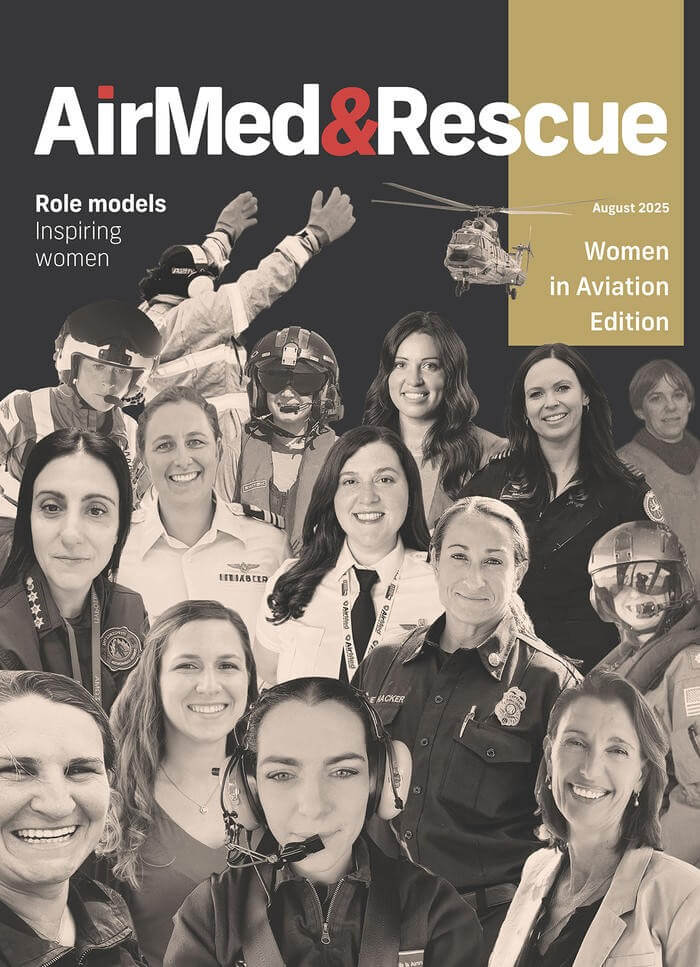
Our August magazine is the inaugural women in aviation edition, highlighting and showcasing female voices from the airborne special missions sector. We have features on blood products used in emergency medical services, challenging hoist rescues, pregnancy while flying, and portable water sources for firefighting. We also have interviews, a gallery, an industry voice, a news analysis piece, and a provider profile, as well as a review of the Paris Air Show.
Lauren Haigh
Lauren has worked in the publishing industry for eight years and reads and writes about healthcare, science and travel insurance on a daily basis. Her favourite aircraft is the plane from the title sequence of British educational children’s TV series Come Outside.