
A synergy of ground and helicopter firefighting

Helitack units talk to Barry D Smith about the tactics they use to fight wildfires, and the equipment and training that make this demanding work possible
Helicopters have been used to fight wildfires since the first commercial models were produced in the 1950s. For over 50 years, specially trained crews of firefighters have teamed with helicopters to provide highly mobile, aggressive initial attack resources that can be quickly inserted close to a fire to keep it small. These are known as helitack units.
The largest number of helitack units are found in the USA. Various agencies of the federal government operate approximately 85 helitack units with 70% of those under the jurisdiction of the US Forest Service (USFS). A vast majority of the helicopters assigned to helitack units in the USA are Airbus H125, Bell 407, and Bell 205 models. Helitack units can also be found in several Canadian provinces.
One of the oldest helitack operators is the California Department of Forestry and Fire Protection (CAL FIRE). It has 10 helitack bases throughout the state to cover 164,000mi² (424,000km²) of territory. Regardless of what agency, state or federal, operates a helitack unit, they all operate in a similar fashion.
The goal of CAL FIRE is to keep 95% of the fires it fights to 10 acres or less. The role of the helitack unit is to quickly arrive on scene, deploy the firefighters, and work with the water drops of the helicopter to maintain this goal.
“The seasonal helitack firefighter positions are highly sought after,” explained Ryan Connolly, a CAL FIRE helitack captain. “Typically, these people have two or three years of experience on a ground fire engine. They also must have an emergency medical technician (EMT) certificate so they can participate in the air rescue program.”
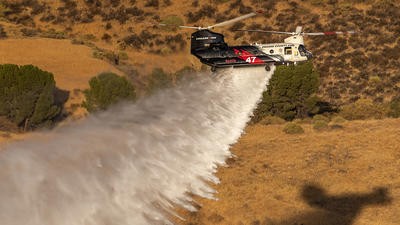
There are five firefighters that are assigned to the helicopter every day during the fire season. They are required to be proficient in a wide variety of tools such as chain saws, hand tools, and back pumps, which carry 5gal of water each. To fill the air rescue need, three firefighters are assigned to this role. There are also two fire captains assigned to the crew each day. One deploys with the firefighters at the scene and the other flies in the cockpit next to the pilot. It takes about three years to become a fully qualified helitack captain.
Every firefighter has a role assigned each day with specific duties. The senior firefighter is called the pilot’s assistance (PA) and helps coordinate the actions of the other firefighters with the ground-deployed captain. Two firefighters are designated as Tools A and Tools B and sit on opposite sides of the helicopter cabin. They are responsible for making sure all the appropriate tools are maintained and properly stowed in the helicopter. Two others are assigned to the back pumps. Each person is assigned to a specific seat in the cabin and role to fill on a fire. This way, there are no questions or confusion and the crew can deploy quickly and efficiently. The type of hand tools carried by each helitack unit can vary depending on the type of terrain and vegetation found within its response area.
Daily training
“At the beginning of every fire season, the entire helitack crew, new and returning, go through a Basic Helicopter Operations and Safety (BHOS) training course,” commented Connolly. “This is a standardized course taught at every helitack base in CAL FIRE. This involves classroom training on aviation procedures and risk management, hazard recognition, water drop safety, as well as working with other aircraft such as airtankers. Then they review and practice all the different roles the helicopter may perform, such as cargo and personnel transport, medevac procedures, as well as multiple drills on entering and exiting the helicopter on level and uneven ground, such as one-wheel or two-wheel landings. The BHOS culminates with a day of scenario-based training, with the firefighters being inserted into a wide variety of terrain and cut fire line and then extracted and moved to another location. During the fire season, we are constantly doing training missions. We do some sort of training every day to keep everyone fresh as well as physically fit.”
In addition, when a fire goes beyond initial attack into extended attack mode, the helitack crew can be assigned to several different roles at a helibase. These roles may include being the liaison between private, contract firefighting helicopters and the helibase manager, marshalling aircraft during landing and takeoff, as well as managing cargo assembly and the loading of helicopters.
For firefighting, each helitack member is issued a standardized set of personal equipment. This includes a helmet, goggles, a shroud to protect their face and neck, gloves, and fire-resistant shirts and trousers. They carry up to 40lb of gear, which includes a fire shelter, 2–3L of water, and some food. They can be self-sufficient for 24 hours. With CAL FIRE transitioning to nighttime helicopter operations, the helitack crew is prepared to fight fire at night as well.
“The helitack model is based on a fast-moving initial fire attack,” Connolly stated. “Given the large amount of weight carried, the steep terrain often encountered, and the high summer temperatures, a high state of physical fitness is extremely important for each member of the crew. They do a variety of fitness training every day that includes 3–5mi runs, as well as weight training.”
Given the large amount of weight carried, the steep terrain often encountered, and the high summer temperatures, a high state of physical fitness is extremely important


Keeping up with the helicopter
As the helicopter drops water ahead of the ground crew, they may just attack the fire where the water wasn’t enough to put it out. This allows the ground crew to move very quickly and contain the forward progress of the fire. They are most effective with small, remote fires in light fuels. In heavier fuels, such as brush or timber, the helicopter can knock down the heat so the helitack crew can get close enough to fight the fire directly by using their chain saws to cut out the fuel.
“The introduction of the Sikorsky S-70i Firehawk has changed the program in a number of ways,” Connolly explained. “The Firehawk is significantly faster than the Huey with a cruise speed of about 140kts. That, married to the greater water capacity of a maximum of 1,000gal, allows the helitack crew to safely be more aggressive in the initial attack mode. Especially in light fuels like grass, I’ve found it is sometimes difficult for the ground crew to keep up with the helicopter. The Firehawk is also much more stable when doing a hover step deployment of the firefighters. This is where the pilot hovers the ship about 2ft above the ground and the firefighters step out of the cabin to the ground.”
With a permanently mounted rescue hoist, CAL FIRE is being assigned the dedicated rescue role on extended attack fires more often. With the older Huey aircraft, the hoist had to be installed in the cabin if a rescue mission was needed, delaying its response to an ill or injured firefighter. In addition, the dual engines make for a safer rescue ship.
One of the few helitack units outside North America is located in the state of Victoria, Australia.
“The Victoria Department of Energy, Environment, and Climate Action (DEECA) initiated a helitack rappel program in the mid-1980s to enable rapid aggressive initial attack and access into remote lightning fires in the Eastern Highlands of Victoria,” explained Bryan Rees, DEECA Senior Aviation Operations Officer. “This allows firefighters to rappel near a fire where a helicopter cannot land. The goal is to keep fires small. If the fire grows beyond the rappeller’s capabilities, they will pull back and construct a helipad to allow additional firefighters to be brought in by other helicopters.
DEECA initiated a helitack rappel program in the mid-1980s to enable rapid aggressive initial attack and access into remote lightning fires in the Eastern Highlands of Victoria
“The program is currently using the Bell 412 as its preferred rappel ship,” he continued. “It meets our need to transport five rappellers and their equipment and has the performance to operate in higher elevations of 4,000–5,000ft (1,220–1,525m). The program is currently exploring using an Airbus AS332 Super Puma as a rappel ship.”
Rappel response
When a fire is detected, the local district/region determines what are the best resources to respond. A normal rappel response is a five-person crew with a pilot and a helicopter crewmember. Rappel crews are based in Ovens and Heyfield with a dedicated rappel helicopter, and can respond as quickly as 15 minutes from the time of request.
Primary hand tools are rake hoes, Pulaskis, axes, and chain saws. These are lowered by the helicopter crewmember after the rappellers are on the ground. There is also water, food, first aid supplies, and spare tools that are lowered to the ground. The crew can be resupplied by helicopter if additional supplies or equipment are needed for an extended stay. The helicopter will then work with the ground crew with water drops.
The USFS operates approximately 60 helitack bases across the country (the exact number varies from season to season). Of those, there are currently 12 rappel crews that host 15 helicopters: three Airbus AS332 Super Pumas, three Bell 412EPXs, and nine Bell 205 A1++, involving about 330 rappellers. Once on the ground, the rappel firefighters work in the same way as other helitack crews.
“Most new rappellers have three to five years of wildland firefighting experience,” stated Adam Kahler, USFS National Rappel Specialist. “The most desirable candidates have a diverse background in initial attack and large fire support, and can work independently in small groups. Physical fitness is a critical part of the job. It combines the physical demand of fighting the fire then hiking out from remote locations with 110lb or more of equipment. All new rappellers participate in the National Rappel Academy, where all crews, new and returning, participate in consolidated training. This typically involves 60–75 personnel from around the country. It consists of classroom, ground, tower, and live helicopter rappel training.
“Each rappel team includes a spotter for every mission. They are the helicopter manager during aviation operations. The spotter works with the pilot to choose a safe insertion location for the rappellers and their cargo.”
The spotter works with the pilot to choose a safe insertion location for the rappellers and their cargo
The helicopters are private commercial ships on a contract. The pilots attend a rappel training/certification event every year. Both new and returning pilots undergo annual ground training and live check rides performed by a USFS helicopter inspector pilot.
The standard rappel ship is the Bell 205 A1++. Two new types were introduced in 2024: the Bell 412EPX and the Airbus AS332 Super Puma. These new ships are an effort to introduce more modern helicopter models into the program to enhance safety and efficiency.
All wildfires start off small. Combining the speed and water-dropping ability of a helicopter with a crew of highly trained and effective ground firefighters can keep most fires so small they never make the news.
November 2025
Issue
Our November edition is packed with content relating to special missions from around the world. We have features that explore the design and engineering that go into modern rotorcraft; the interactions between ground and air teams on helitack operations; the tools and attire needed for successful water rescues; and the new onboard technology that is revolutionizing special missions by detecting and communicating with cell phones.
Barry D Smith
Barry Smith has been an aviation and emergency services writer/photographer for over thirty years. He has published over 250 magazine articles and six books. He has also worked in emergency services as a paramedic, volunteer firefighter, and member of search and rescue teams for over 40 years.