

A fine line: maintaining safe patient temperatures

Air medical services often encounter patients with hypo- or hyperthermia, whether due to environmental, intrinsic or toxicological causes. Barry D Smith asks emergency responders how they treat these patients and get them back to a normal, safe temperature
While the human body is an amazingly complex organism, it has some basic parameters that must be met for life to continue. One of the most important is a core temperature range that is rather narrow. The normal temperature range is 36.1–37.2°C or 97–99°F. Just a few degrees above or below this range can have a serious effect on how efficiently the organs can function. A few more degrees further can be fatal.
“Hyperthermia from environmental exposure complicates primary taskings in the Queensland area where we operate,” explained Dr Jeff Hooper, Medical Director for LifeFlight Australia. “Heat-related aeromedical scenarios include injured bushwalkers and hikers suffering from exposure in hot environmental conditions, motorists injured in remote road accidents, or overexerted athletes in remote endurance events.
“The intrinsic causes of hyperthermia to consider include sepsis, particularly central nervous system infections; status epilepticus; and endocrine causes, such as a thyroid storm. The most common toxicological causes in our experience include drug toxicity and serotonin syndrome.”
Each LifeFlight base keeps 2L of cooled intravenous (IV) fluids in a refrigerator, which is transferred to a cooler bag on the aircraft and infused at about 4°C. Ice packs are carried, which can be placed on the neck, groin and axilla. Water can be sprayed on the patient and allowed to evaporate as a cooling measure as well. A plastic sheet or tarp packed with ice and wrapped around the patient, known as the tarp taco technique, can be effective as well.
Core temperatures can be monitored through esophageal or rectal probes and be read on the cardiac monitor. The aim is rapid reduction in temperature to below 40°C to avoid organ injury. Cooling measures are slowed once the patient reaches a temperature below 38.5°C.
“LifeFlight works closely alongside the Queensland Ambulance Service (QAS) to maintain a ready response during the increased demand for pre-hospital care during heat waves. Queensland Health and QAS take the lead on public information and education during heatwave events, such as announcing severe weather alerts, education on first aid for heat illness, and advice to avoid heat-related illnesses.”
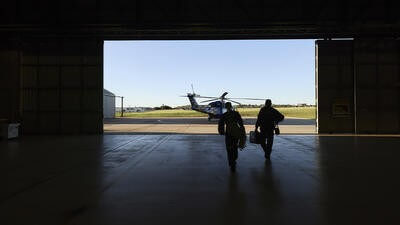
The most at-risk patient groups
“My helicopter base is located in the Mojave Desert of southern California with a response area of very arid, hot summer temperatures, including Death Valley National Park,” commented Austin Brook, a Flight Nurse with Mercy Air. “The summer brings out people doing outdoor activities such as using off-road vehicles and hiking. But it is also the hottest part of the year. We frequently see temperatures of 110–115°F (43–46°C). Death Valley holds the record for the highest recorded temperature at 134°F (56°C). We see a lot of heat illness among recreational users. However, we also have a large population of unhoused people who live in old trailers and homemade camps. They have no electricity or means of staying cool. Some of the older people in this population also have pre-existing medical problems that are exacerbated by heat.
“There are three high-risk patient populations for heat illnesses. They are the elderly, the very young, and those with chronic illnesses. All of these populations have a thermoregulation system that is impaired or not fully developed. They also may have cognitive issues where they forget to drink water or don’t feel thirsty.
“During the summer months, we consider heat-related issues on every mission we fly,” Brook continued. “That is particularly true for trauma patients, where we often see secondary heat injury due to the amount of time until they are found and we can access them. There are many times when it takes hours for trauma patients to be found in the vast desert regions if they crash their motorcycles or off-road vehicles. Many areas have no cell phone service. In anticipation of these situations, we run the air conditioning system in the helicopter at full bore en route to the scene and have ice packs ready to go. We are often the first responders on scene in these remote areas and have to search for the patient, which can take time.”
Another factor that has to be considered is the effect of the heat on aircraft performance. They may have to decrease weight by leaving some equipment behind or not fill the fuel tanks to maximum during the summer. Typically, many helicopters have a maximum temperature they can fly in of 50°C. There are times in the desert in the southwest USA that helicopters are grounded due to the ambient air temperature.
Another factor that has to be considered is the effect of the heat on aircraft performance
“Our goal with heat injury/illness is rapid cooling,” Brook emphasized. “We have found [that] ice packs placed in areas of major arteries, such as the neck, groin, and armpits, can be effective in lowering a patient’s temperature. For patients with severe heat illness, we try to transport them to a trauma center where they have equipment that can rapidly cool them both internally and externally.”
Mercy Air also uses portable electric external air conditioning units that can keep the interior of the helicopter cool between flights. This also keeps the medications and IV fluids within the manufacturer’s approved temperature range, as well as the sensitive electronic medical equipment. They constantly monitor the cabin temperature during the day in the summertime to make sure it is cold enough for the drugs and equipment. They have had times when the external air conditioner has not been adequate and the crew have had to take the meds and electronics inside their quarters.
“One of the secondary effects of heat illness can be hyponatremia,” stated Brook. “We see this in patients who are outside and drinking a lot of water but are not replacing the electrolytes they are sweating out. Again, children and the elderly are more susceptible. We can’t measure electrolytes in the field, so we go off clinical findings to diagnose and treat. We carry both normal saline, 0.9%, and hypertonic saline, 3%. We only use the hypertonic saline if the patient is experiencing seizures with heat illness. We administer the 3% saline until the seizures stop.”
A system of care for heatstroke
Travis County, Texas, has created a unique protocol for treating heatstroke.
“Heatstroke is a relatively rare situation for first responders to encounter,” explained William Hanson, a Flight Paramedic with STAR (Shock Trauma Air Rescue) Flight, the Travis County medical and rescue helicopter program. “However, when temperature and humidity conditions reach a certain level, we can see quite a few cases because people are still doing their normal outdoor work and recreational activities. In 2023, we encountered a large number.
“A system of care for heatstroke was developed due to the number of patients seen in 2023. This system includes STAR Flight, Austin–Travis County EMS ground ambulances, and the local fire departments within Travis County. The standard of care is to cool the patient before they are transported. It is critical to quickly lower a patient’s core temperature as soon as possible to prevent or minimize organ damage. It is still common in many parts of the country for emergency medical services (EMS) to transport as soon as possible to a location where the patient can be cooled. However, that transport time can lead to organ failure.”
The standard of care is to cool the patient before they are transported. It is critical to quickly lower a patient’s core temperature as soon as possible to prevent or minimize organ damage
From the end of May until the end of August, STAR Flight now carries 30lb of ice on the helicopter in a cooler and a tarp. The local first responder fire departments can create a ‘bathtub’ using tarps and three interconnected ladders laid on their side. Ideally, the makeshift tub is full of ice and water, not just ice, and the patient can be submerged from the neck down. The helicopter can’t carry enough ice and water to totally immerse a patient. They can immerse about one-third of the patient.
This is where other ground resources come into play. All the fire apparatus carry a cooler of ice for use by the crew or for heatstroke patients. In addition, fire and EMS support or command vehicles are used to collect more ice from as close to the scene as possible. Most fire stations also have ice stored in freezers. If there is a fire station close to the scene, the crew at the station set up an ice bath and the ambulance will transport them to the station, where the ice bath is waiting for the patient.
“So, all the first responders understand the protocol, the reasons behind it, and support it,” Hanson stated. “In addition, all of the medical directors of the various agencies involved support this protocol. With this system, the patient’s core temperature can be lowered dramatically in 10 to 20 minutes. The key is that a systems approach was used to create the protocol and it is working very well.”
Treating hypothermic patients
The flip side of the temperature coin is hypothermia, which can be just as deadly as hyperthermia if it is allowed to progress. Hypothermia can be insidious because patients with poor perfusion due to serious trauma or illness can experience lower core temperatures when the ambient air temperature is not uncomfortably cool.
“We use what is called a life blanket to keep patients normothermic in cold or hot environments,” commented Kimber Dameron, a Flight Paramedic with Air Idaho Rescue in Driggs, Idaho. “It is similar to a sleeping bag with handles that has a disposable liner. It is closed with snaps that can quickly be unfastened to access the patient. Even on warm days, patients with poor perfusion can get hypothermic. We may need to turn off the cabin air conditioning system to keep the patient’s temperature within a normal range on warm days.
“In the winter, if we have to shut down the helicopter on scene or at a hospital, we don’t have a way to keep the cabin warm. We will turn up the heat on the way to pick up the patient, keep the doors closed and do the best we can to preserve heat in the cabin. Our aircraft is kept in a hangar, so it is temperature-controlled between flights. We also use an electric heater placed in the cabin between flights to keep the cabin temperature at least 50°F.
“Obtaining IV access can be difficult on a hypothermic patient,” continued Dameron. “I use a heat pack placed on a thin barrier over the skin to try to make veins more visible. We don’t do central lines in our flight program. Something else I have found helpful is wearing heated gloves to keep my fingers warm helps me to start IVs. We also use inline battery-operated IV and blood-warming devices to administer warm fluids.”
Flight for Life Colorado, based in Lakewood, Colorado, has developed a very detailed and specific protocol for treating cardiac arrest patients who are hypothermic, such as victims of avalanches. It is based on the patient’s core temperature. The helicopter also carries a point-of-care blood lab testing device, which can be helpful in treating hypothermic patients.
“Speed is essential for surviving an avalanche,” explained Flight Paramedic Mark Hutchinson. “Flight for Life is part of the Colorado Rapid Avalanche Deployment program. We will transport rescuers and avalanche dogs to the scene. Once the rescuers are delivered, the helicopter will stay on scene to care for any victims.
“We can also use Ready-Heat blankets, which are chemical warming blankets to actively warm hypothermic patients. When the container is opened, the chemical elements react with the oxygen in the air and generate heat for up to eight hours without the need of an external power source.”
Maintaining a patient’s core temperature is very important to their outcome during transport from a scene, as well as from one facility to another
Maintaining a patient’s core temperature is very important to their outcome during transport from a scene, as well as from one facility to another. Complications that could be life or limb threatening can be avoided with close monitoring and quick action to keep a patient normothermic.
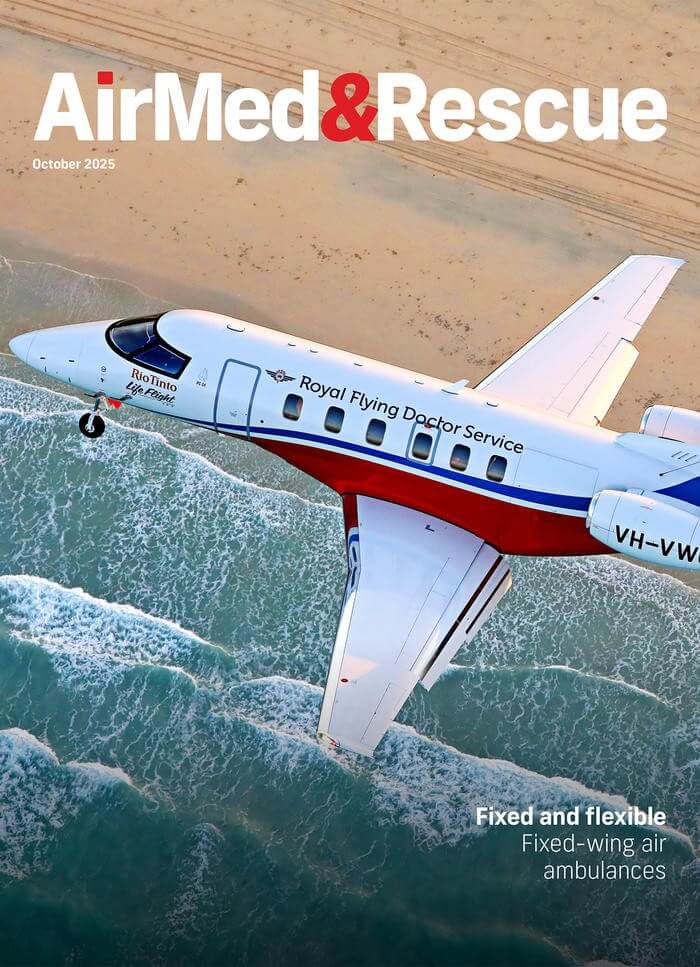
October 2025
Issue
In our October edition, we bring you news, features and more showcasing special missions from around the world. We have features that focus on the fixed-wing air ambulance platforms that are enhancing air medical operations; the care and considerations when transporting children with infectious diseases at risk of deterioration; the law enforcement agencies that use aircraft to find and track persons of interest; and the challenges of treating patients with hyper- and hypothermia.
Barry D Smith
Barry Smith has been an aviation and emergency services writer/photographer for over thirty years. He has published over 250 magazine articles and six books. He has also worked in emergency services as a paramedic, volunteer firefighter, and member of search and rescue teams for over 40 years.