

Freewheeling taken seriously: single-engine autorotations

What can be done about engine trouble when you’re in a helicopter in the middle of the sky? Jon Adams speaks to several special missions operators about the reasons for choosing to use a single-engine helicopter and the reactive and proactive decisions to improve safety as a consequence of flying these platforms
Flying without power is a threat that any aviator trains for, but none would wish for. The advances in technology and the awareness of the causes of engine and powertrain problems ensure that this is a rare occurrence, but as aviation is a vital service for police, firefighting, emergency medicine, rescue, and more, the aircraft that are used are used often and in the most demanding environments and situations. With the larger, twin-engine craft, if one of the engines becomes unusable, it is not such an issue, but in a smaller, single-engine helicopter, there is no backup.
Benefits of a single engine
Why would anyone choose a single-engine helicopter then, if the risk is so much worse than with a twin? Funding is a big determinant of the choices that organizations make when it comes to the aircraft they operate, not least if they are publicly funded outfits or smaller companies. Pasco Sheriff’s Office Chief Pilot James Collins and Captain Andrew Denbo explained that cost-effectiveness is an important consideration when it comes to purchasing and operating decisions: “While twin-engine platforms do provide a level of security in the event of an engine issue, they also come with a heavy price tag. We operate in a manner that takes taxpayer funds into account. We save the citizens of our county money by using cost-efficient aircraft and our own internal training programs to keep our pilots current on emergency preparedness.”
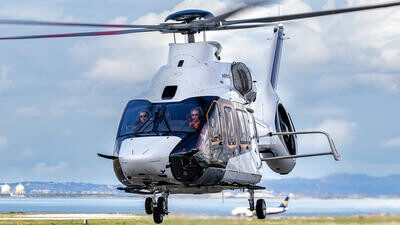
Spokane County Sheriff’s Office Regional Air Support Unit Supervisor Corporal Jeff Welton agreed, saying that “funding is the greatest obstacle”. Cpl Welton continued: “[Spokane County Sheriff’s Office] operate three aircraft, all single-engine systems: Bell 205 Super Huey, Bell OH-58, and, new to us since May, a Bell 505. We have a hoist-capable aircraft with the 205 and conduct hoist rescue and recovery operations to include [reconnaissance] and long-line/short-haul,” he said, highlighting the uses of these craft beyond standard police patrol and support.
Chief Pilot Collins and Capt Denbo also use their helicopters for a variety of missions: “The Pasco Sheriff’s Office operates two Bell 407 analog aircraft in addition to a single-engine Bell UH-1H. We conduct patrol missions, such as searching for missing persons and fleeing criminals, and security overwatch operations for high-risk situations our patrol deputies find themselves in. The UH-1H is equipped with a rescue hoist for search and rescue (SAR) missions, as well as Bambi Buckets for use in fighting wildfires.”
However, it isn’t just finances that hold operators back from buying and using bigger and heavier craft; there are also the considerations of fitness for purpose. Sergeant Dan Wiseman of the Sacramento Police Department, which operates a Bell 505 and a military surplus OH-58, said: “Based on our mission requirements, a single-engine aircraft best aligns with our operational needs and provides a reliable platform for the work we do.”
Based on our mission requirements, a single-engine aircraft best aligns with our operational needs and provides a reliable platform for the work we do
Pinal County Sheriff’s Office operates a Bell UH-1H3, an Airbus H125, and a Bell OH-58, and Sergeant Corbiere Pecora, Chief Pilot with the Pinal County Sheriff’s Office (PCSO) Aviation Unit, agreed: “We would consider moving to a twin if there was anything that could match the performance capability of our UH-1H3 in the hot, high, and heavy configurations we operate in. The majority of risk associated comes from pilot and crew error versus mechanical failure and that too is an option to weigh and train.”
There is sometimes a balance, when the costs and the benefits are quite similar one way or another, and that choice is one that has to then be reviewed regularly. Ian Richards, Pilot for Sonoma County Sheriff’s Helicopter Unit, explained that its Bell 407 GXP was used for several roles but that they had a specialty: “Our long-line rescue capability is really what makes us unique, and probably is what we are most known for.” This means that the work they do with this single-engine craft does limit their choices if they wanted to change: “Because of [the Bell 407’s] design and flight characteristics, it lends itself to be a great choice for long-line vertical refence operations, our preferred method of rescue, given our area of operations, mission set, and staffing. We are due to upgrade our current aircraft in a few years and there is a chance we end up with a twin. Most twins, however, tend to be too wide to efficiently conduct long-line operations; the 429 has proven to be a viable option though, so who knows,” said Richards.
Jodie Granley, Chief Pilot of the Edmonton Police Service Flight Operations Unit, said that it also chose a single-engine helicopter to match the needs of the missions performed: “While we understand the potential benefits of twin-engine platforms, particularly for increasing safety margins in autorotation scenarios, we have chosen the Airbus H125 for its reliability, performance, and suitability for our missions. However, we continuously evaluate the risks and consider other platforms if our operational needs evolve. We maintain a strong focus on pilot training and maintenance to mitigate any risks associated with single-engine operations.”
The versatility of a smaller, single-engine aircraft is a benefit for certain operators, explained Lieutenant Colonel Victor Spagnolo, Acting Commander of Brazil’s Federal District Fire Department (CBMDF) Operational Aviation Unit: “The CBMDF operates a twin-engine helicopter, the EC135 T2, within its fleet. However, single-engine platforms are extremely versatile due to their availability, lower operating costs, and reduced downwash, which makes them suitable for landings in many urban areas with restricted space.”
The single-engine craft at the CBMDF’s disposal are the Airbus AS350 B3 and EC130 B4, and Lt Col Spagnolo stated that they were used across many special missions profiles: “These aircraft are employed in a wide range of operations, including firefighting, aeromedical evacuation, SAR, and other emergency response missions, such as organ transport for transplant procedures, in accordance with the operational demands of the federal district.”
These aircraft are employed in a wide range of operations, including firefighting, aeromedical evacuation, SAR, and other emergency response missions, such as organ transport for transplant procedures, in accordance with the operational demands of the federal district
Also planning on working with a mixed fleet are the Ohio State Highway Patrol, whose Captain Justin Cromer, Commander of the Ohio State Highway Patrol’s Aviation Section, explained: “We operate Airbus H125 (A-Star) helicopters. These are used for transport, patrol work, support, and search missions (no rescue hoist),” but in addition, he said, “we have an H145 helicopter on order for the purpose of expanding our mission capabilities and reducing risk”.
The size of the state and the jobs that need to be accomplished mean that the Texas Department of Public Safety operates a mixed fleet as well. On top of the aerial patrol and support, SAR, and disaster relief missions that it uses its Airbus H125s for, Marcus Tomerlin, Assistant Chief Pilot at Texas Department of Public Safety, explained, “we utilize an Airbus EC145 and Bell 412 for hoist operations. Twin-engine aircraft provide a significantly higher margin of safety, especially during operations conducted in challenging environments such as high altitudes, confined areas, mountainous terrain, or over water. The added power improves overall performance, allowing crews to operate with heavier payloads, additional equipment, or extra personnel without compromising safety margins. This becomes especially important during hoist missions, where the aircraft may need to hover for extended periods while supporting the weight of a rescue basket, cable, and personnel.
“Redundancy is another major advantage. In the event of an engine failure, a twin-engine helicopter can often continue flight or maintain controlled flight long enough for the crew to execute an appropriate recovery or landing. This capability is critical for search and rescue operations, where aircraft are frequently flown in less-than-ideal weather, reduced visibility, or remote locations where immediate landing options may be limited. Additionally, twin-engine platforms often come with more robust systems, avionics, and safety features designed for demanding missions. These enhancements not only support operational reliability but also improve situational awareness and reduce pilot workload when managing complex tasks such as hoisting, night operations, or multi-agency coordination. Overall, while more expensive to operate and acquire, twin-engine helicopters offer significant benefits for agencies that regularly perform SAR, hoist operations, or missions where performance and redundancy are critical to crew and public safety,” he concluded.
Training and simulation
As has been touched on already, when an emergency does occur, there is only one person that can prevent a disaster: the pilot. Extensive training, experience, and presence of mind combine to make the pilots of these aircraft best suited to fly these vital missions.
Assistant Chief Pilot Tomerlin explained the robustness of the training and review of pilot skills in the Texas Department of Public Safety: “All of our H125 pilots complete factory or factory-equivalent training on an annual basis. Each pilot is required to hold a Federal Aviation Administration commercial certificate and instrument rating before conducting day or night solo operations in any of our helicopters. In addition to external training, all helicopter pilots undergo an annual check ride with one of our training captains, each of whom holds Airline Transport Pilot, Certified Flight Instructor, and Certified Flight Instructor – Instrument credentials and possesses a minimum of 2,000 hours of helicopter flight time.
“We seldom conduct autorotation training in a flight simulator, as the majority of our training is performed in the aircraft. However, we do use simulation for other maneuvers and emergency procedure training,” Assistant Chief Tomerlin said, adding that the external training was with Airbus Helicopters, Helicopter Institute, Metro Aviation, Flight Safety International, and CAE.
Ohio State Highway Patrol uses a mixture of training methodologies, explained Capt Cromer: “All of our pilots attend annual training for simulated emergencies, including autorotations. Half of this training is done in simulators and half is done in actual aircraft. Flight Safety International conducts the simulator training [and] Helicopter Institute conducts the actual aircraft training – pilots attend [both] annually.”
All of our pilots attend annual training for simulated emergencies, including autorotations. Half of this training is done in simulators and half is done in actual aircraft
Chief Pilot Collins and Capt Denbo also described the regularity of the training that Pasco Sheriff’s Office pilots undergo: “Our pilots train regularly for all emergency scenarios, including autorotations. We currently employ two flight instructors within our unit, with one being the designated unit instructor. The unit flight instructor routinely schedules and administers flight training for all our pilots to ensure everyone stays current in all areas of operations, including hoist operations and emergency procedures. We strive to have this internal training occur at least quarterly.” They added: “Internally, we have our own flight instructors who conduct routine training and emergency procedures. The flight instructors also conduct and coordinate rescue hoist training in the UH-1H platform. Externally, the Pasco Sheriff’s Office utilizes the Helicopter Institute to conduct annual recurrent training in emergency procedures for both day and nighttime operations.”
Spokane County Sheriff’s Office also relies heavily on internal structures and live flight training to maintain currency and familiarity with safety procedures, explained Cpl Welton: “All pilots take part annually in autorotation training and it is live training. We do not use simulations… We have a chief pilot who is a certified flight instructor. He owns his own helicopter flight instruction business and has volunteered for our agency for 20 years. He instructs on all initial trainings and annually in all systems. Every other year we hire an outside vendor to conduct annual flight reviews to include our chief pilot.”

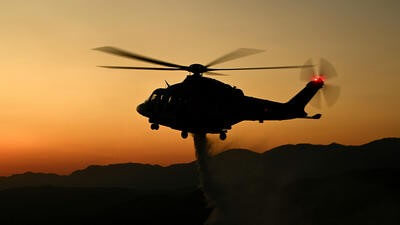
Sgt Wiseman said that the Sacramento Police Department had a mixed schedule of internal and external training: “Our pilots attend the Bell Training Academy yearly. This includes autorotations (including full-downs) and simulator time [on the Level 7 FTD] as well as night vision goggles (NVG) recertification. Additionally, we have a second OH-58 we use as a training aircraft that we utilize to train full-down autorotations quarterly.”
The Bell Training Academy is also used by Sonoma County Sheriff’s Office, said Richards: “All our pilots annually attend Bell Helicopter factory training at their headquarters in Fort Worth, Texas. It’s the standard recurrent training course they offer, although we add an additional night flight to conduct emergency procedures under NVG. Like others, we have found that it is best to go direct to the people that conduct emergency procedure training every day. As far as internal training, we are constantly training. Our crew is made up of many diverse specialties and backgrounds, so we are constantly working on recurrent and proficiency training. We are very lucky in the sense that our administration has been very gracious in allotting flight time for training. We are typically conducting some type of training evolution five days a week or more.”
PCSO doesn’t use simulation to train, but also doesn’t operate on minimums, said Chief Pilot Pecora: “PCSO has a very robust training program which features vendor training and regular in-house training. There is no limit to the amount or type of training we conduct. All of our emergency procedures are conducted during live flight training; we do not use simulators.” Sgt Pecora also explained that the training was constantly evolving, improving and not static: “Currently, PCSO utilizes Topflight in Penticton, British Columbia, Canada, for mountain, NVG, and long-line refreshers; Helistream in California for maintenance, instructor pilot, and NVG recurrency; and a few others mixed in to keep ideas incoming. We also train in-house regularly on emergency procedures, hoist work, long-line, and mountain flying techniques.”
There is no limit to the amount or type of training we conduct. All of our emergency procedures are conducted during live flight training
Topflight is also the training school of choice for the Edmonton Police Service when sharpening skills for autorotations, explained Chief Pilot Granley: “Edmonton Police Service pilots have annual training at Topflight Elite Training, provided through Canadian Helicopters. This includes autorotations for both day and night operations, as well as all the annual training and emergencies training. We are also working on some in-house training, to give our pilots the extra training needed to feel comfortable in the aircraft. Currently, we do not provide simulator time, although it is available with Canadian Helicopters.”
The Brazilian Federal District Fire Department does not yet make primary use of simulator time either, but there are plans for the continued incorporation of the flight training devices in their processes, said Lt Col Spagnolo: “Our pilots receive specific autorotation training during their initial qualification and also undergo annual recurrent training. During the progression from second-in-command pilot to pilot-in-command, a series of emergency training events is conducted, including autorotation procedures. All autorotation training is conducted exclusively in live flight by our own instructor pilots. Although some pilots have attended emergency training courses using simulators operated by the Brazilian Army, these are primarily theoretical, as the simulators are not full-flight simulators. We intend to maintain simulator-based training as part of our long-term objectives; however, at present, we do not employ simulators for this purpose. Our pilots have previously performed full autorotation training through touchdown, and it is also one of our goals to maintain this type of training on a biennial or triennial basis.”
Lt Col Spagnolo described the type of emergency procedures conducted in the training: “Pilot training is conducted by internal instructors from the CBMDF aviation unit. Recurrent training is performed at least every 12 months and includes a minimum of one flight hour, during which emergency procedures are practiced as part of the overall training syllabus. These procedures may include autorotations, power loss in the hover, engine failure, engine fire, and systems failures.”
Investment in flight training devices is occurring to improve pilot familiarity with the physical cockpit environment and the geographical area that they are working in, said Chief Pilot Collins and Capt Denbo: “We recently invested in a flight simulator built by Podium 1 Racing that uses Microsoft Flight Simulator as the flight program for the Bell 407 and UH-1H. This simulator provides familiarity with the 407 controls, such as the cyclic and collective, and incorporates motion and virtual reality for a more realistic view and cockpit feel. Using Microsoft Flight Simulator gives us the benefit of maps that closely represent our actual flight environment. We can also replicate numerous situations in our local area and train for mission-specific areas of operations.”
Systems to help
An engine failure is something to prepare for as a pilot, but there are also ways to reduce the chances of a failure from happening in the first place. Full-authority digital engine control (FADEC) systems help “to simplify pilot workload, enhance safety, and boost performance, especially in hot and high environments”, according to Assistant Chief Pilot Tomerlin, and “have an integrated engine-monitoring component for maintenance and monitoring purposes”.
Chief Pilot Granley elaborated: “It is basically the brains of the engine. It aids with the overall engine health. It automatically adjusts with pilot inputs to prevent overspeeds, over-temperatures, and engine adjustments as needed. It also aids with pilot workload with the First Limit Indicator (FLI) mode, in which the pilot only has to monitor one setting, instead of several different gauges. It monitors the engine continuously and provides diagnostics to the aircraft maintenance engineer (AME).”
It is basically the brains of the engine. It aids with the overall engine health. It automatically adjusts with pilot inputs to prevent overspeeds, over-temperatures, and engine adjustments as needed
Chief Pilot Collins and Capt Denbo added: “This system monitors engine temperature, fuel flow, and throttle control. This system helps keep the engine running efficiently without the need for manual input from the pilot.”
The workload assistance and the monitoring combine to reduce exceedances and flag when an engine could require services, an invaluable tool for safety highlighted by Sgt Wiseman: “Our Bell 505 does have a duel FADEC system, and it has in fact alerted us to issues, allowing us to address issues sooner and maintain a high safety standard.”
As well as a FADEC, some operators are able to invest in a health and usage monitoring system (HUMS) to further assist with preventative maintenance and diagnostic information to improve performance. Although not a HUMS per se, the Garmin G1000 is installed on Sonoma County Sheriff’s aircraft, Richards explained: “One of the many features the G1000 possesses is an engine indication and crew alerting system. Obviously, it provides information about pressures and temperature, fuel burn and fuel remaining, but it also has a Power Situation Indicator (PSI). The PSI is essentially a First Limit Indicator, if you are familiar with Airbus products. It is extremely helpful when conducting long-line operations. The crew alerting system is Garmin’s way of providing the crew with immediate information regarding warning, caution, advisory, and safe operating advisories. It does a really great job of alerting me of an impending limitation exceedance when my head is out the window during long-line operations.”
Sgt Pecora explained how PCSO had engaged with its HUMS: “Our UH-1H3 utilizes a HUMS system and [we] have found it to be useful in determining issues with both engine and airframe components. Eventually we will add a system to the Airbus.”
Our UH-1H3 utilizes a HUMS system and we have found it to be useful in determining issues with both engine and airframe components
Likewise, at the Texas Department of Public Safety: “We have one H125 equipped with a GPMS monitoring system,” said Assistant Chief Pilot Tomerlin. “This was added after the aircraft was put into service with our Department. This system alerts us to any unusual vibrations and engine exceedances. Our mechanics go in and review the numbers over a period of time to determine if the engine is experiencing any issues.”
Utility and safety
The choice to operate single-engine helicopters is often either due to financial constraints, or they may just be the best aircraft for the required job. Either way, the cost-benefit analyses result in several operators performing demanding missions with single-engine helicopters. Consequently, pilots go through extensive continual training in-house and with independent third parties to prepare them for the worst emergencies, but the aircraft themselves are also monitored, controlled, and maintained to reduce the chances of something drastic occurring. Options for further increasing these aspects of safety in the flight life cycle are available, but the same considerations may limit these choices for the operators performing vital work for the sake of the public.
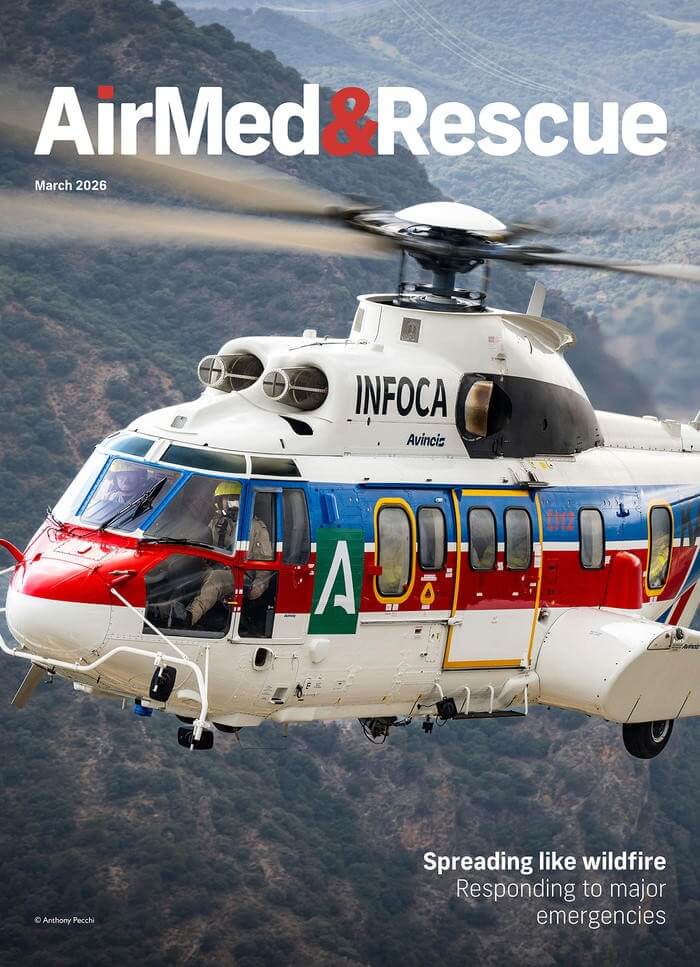
March 2026
Issue
This edition is bursting at the seams with articles from all corners of the special missions sector. We have features on the California wildfires that ravaged the state last year, what the cost–benefit analysis looks like for single-engine rotorcraft and autorotations, how the mission dictates the modification needed to the platform, and what can be done to further prevent the problems associated with inadvertent entry into instrument meteorological conditions.
Jon Adams
Jon is the Editor of AirMed&Rescue. He was previously Editor for Clinical Medicine and Future Healthcare Journal at the Royal College of Physicians before coming to AirMed&Rescue in November 2022. His favorite helicopter is the Army Air Corps Lynx that he saw his father fly while growing up on Army bases.