
Industry voice: Beyond compliance: why accreditation matters in air medical transport

Terry Palmer explains why accreditation has become a valued indicator of commitment to good practice in the air medical sector
In an industry where decisions are made in minutes and outcomes are measured in lives, the concept of ‘quality’ cannot be abstract. It must be defined, demonstrated, and sustained. In air medical transport, accreditation has become one of the clearest ways operators show that commitment, not only to regulators, but to patients, crews, and the communities they serve.
While regulations establish the baseline for safe operations, accreditation goes further. It represents a voluntary commitment to meet higher standards, undergo independent evaluation, and continuously improve. For many organizations, it is not simply a credential, it is a framework that shapes how safety and quality are embedded into daily operations.
Moving beyond minimum standards
Regulatory compliance is essential, but it is designed to ensure a minimum acceptable level of safety. Air medical operations are complex, dynamic, and often conducted in high-risk environments where minimum standards are not always enough.
Accreditation programs such as the Commission on Accreditation of Medical Transport Systems (CAMTS) address this gap by defining best practices across clinical care, aviation operations, maintenance, communications, and organizational management. More importantly, they evaluate how those standards are applied in real-world conditions.
This distinction matters. It shifts the focus from “Are we compliant?” to “Are we consistently operating at a high level of quality?”
Building an internal safety culture
One of the most significant benefits of accreditation is its impact on internal culture. Preparing for accreditation requires organizations to examine their policies, procedures, training, and decision-making processes in detail. It encourages cross-functional alignment between clinical, aviation, and operational teams.
The process often reveals gaps that may not be visible in day-to-day operations, inconsistencies in documentation, variations in training, or informal practices that have developed over time. Addressing these issues strengthens the organization as a whole.
Equally important, accreditation reinforces accountability. Standards are not static documents; they become part of how teams operate, communicate, and evaluate risk. Over time, this contributes to a culture where safety and quality are not just priorities, but expectations.
Accreditation reinforces accountability. Standards are not static documents; they become part of how teams operate, communicate, and evaluate risk. Over time, this contributes to a culture where safety and quality are not just priorities, but expectations
Demonstrating value externally
Accreditation also plays a critical role in building trust outside the organization. Patients, healthcare partners, insurers, and contracting agencies may not have direct visibility into operational practices. Accreditation provides an independent, recognized benchmark that helps bridge that gap.
For hospital systems and public agencies, selecting an accredited provider offers a level of assurance that the operator has been evaluated against established standards. In competitive environments, it can also serve as a differentiator, signaling a commitment to quality that goes beyond basic requirements.
This external validation is increasingly important as air medical transport continues to evolve, with greater scrutiny on safety, outcomes, and cost-effectiveness.
A model seen across industries
The value of accreditation is not unique to air medical transport. Similar models exist across aviation and related sectors, reinforcing the importance of independent standards and oversight.
In the helicopter tour industry, the Tour Operators Program of Safety (TOPS) provides a framework for operators to demonstrate adherence to safety standards that exceed regulatory requirements. Through audits and ongoing participation, TOPS members signal their commitment to higher levels of operational safety.
In offshore operations, organizations such as HeliOffshore and the Helicopter Safety Advisory Conference (HSAC) bring together industry stakeholders to establish recommended practices and improve safety outcomes in one of the most challenging operating environments.
While these programs differ in structure, they share a common principle: safety and quality are strengthened when organizations commit to standards that are transparent, measurable, and independently assessed.
Continuous improvement, not a one-time event
Accreditation is sometimes viewed as a milestone, something to achieve and maintain. In practice, its value lies in the ongoing process it creates.
Accreditation is sometimes viewed as a milestone, something to achieve and maintain. In practice, its value lies in the ongoing process it creates
Standards evolve as technology, operations, and risks change. Accredited organizations must adapt, reassess, and improve. This cycle encourages a proactive approach to safety, rather than a reactive one.
It also aligns closely with modern safety management systems (SMS), where data, reporting, and continuous improvement are central. Accreditation and SMS are not competing frameworks; they are complementary tools that, when used effectively, reinforce each other.

Evolving standards for a changing industry
Accreditation is not static. One of its strengths is the ability to evolve alongside the industry it serves.
Air medical operations continue to change, driven by advances in technology, new training methodologies, expanded mission profiles, and the introduction of specialized equipment. From the integration of advanced avionics and medical devices to the increased use of simulation and scenario-based training, the operating environment today is not the same as it was even a decade ago.
From the integration of advanced avionics and medical devices to the increased use of simulation and scenario-based training, the operating environment today is not the same as it was even a decade ago
Accreditation organizations recognize this and routinely update their standards to reflect current practices and emerging risks. This ensures that accreditation remains relevant, not a reflection of past operations, but a framework aligned with how missions are conducted today.
For operators, this ongoing evolution reinforces the importance of staying engaged, not just maintaining a designation, but adapting to the changing expectations of the industry.
Beyond accreditation: sharing what works
Another often overlooked aspect of accreditation programs is the role they play in sharing best practices.
While standards define expectations, accreditation bodies also serve as a hub for operational knowledge. Through guidance materials, industry engagement, and the accreditation process itself, they provide insight into what is working across a wide range of operators and environments.
This exchange of information can be as valuable as the standards themselves. It allows organizations to learn from others, adopt proven approaches, and avoid repeating known challenges.
In this way, accreditation supports not only compliance, but collaboration, helping to raise the overall level of safety and quality across the industry.

Understanding compliance: flexibility within standards
There is a common misconception that accreditation requires perfect, 100% compliance with every standard. In reality, most accreditation programs are built around the concept of substantial compliance.
This approach recognizes that no two operations are identical. Differences in geography, mission type, resources, and operational constraints can require flexibility in how standards are applied.
Accreditation evaluates whether an organization meets the intent of the standards and demonstrates a consistent commitment to safety and quality. It allows room for variation where justified, while still maintaining the integrity of the overall framework.
Understanding this distinction is important. It reinforces that accreditation is not about achieving perfection on paper, but about demonstrating a high level of performance in real-world operations.
Challenges and considerations
Accreditation does require time, resources, and organizational commitment. Smaller operators may face challenges in meeting or sustaining the standards, particularly in resource-constrained environments.
However, the process itself often delivers value, regardless of size. Even organizations that are not accredited can benefit from aligning with recognized standards and adopting elements of the framework.
Even organizations that are not accredited can benefit from aligning with recognized standards and adopting elements of the framework
The broader question is not whether accreditation is achievable for every operator, but how the principles behind it can be applied to strengthen safety and quality across the industry.
The path forward
As air medical transport continues to advance, the expectations placed on operators will only increase. Patients, partners, and regulators are looking for more than compliance; they are looking for demonstrated excellence.
Accreditation provides a structured, credible way to meet that expectation. It supports internal alignment, enhances external trust, and promotes continuous improvement in an environment where there is little margin for error.
Ultimately, the value of accreditation is not in the designation itself, but in what it represents: a commitment to doing the work, maintaining the standard, and continually striving to improve.
September 2026
Issue
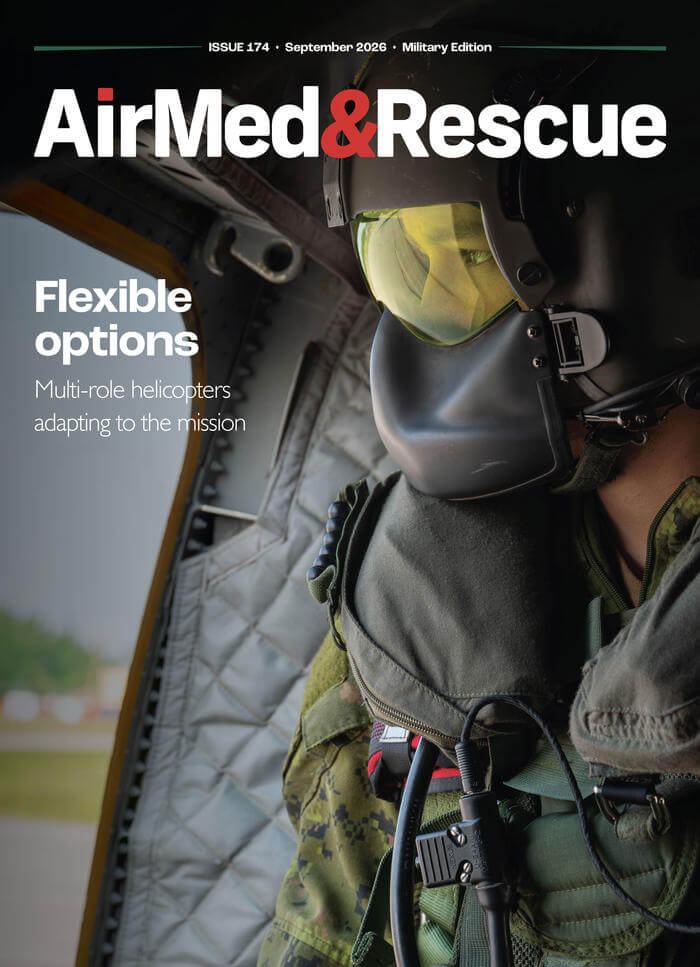
As we reach the equinox, I’m happy that we have an interesting military edition of AirMed&Rescue for you to read on those longer nights. We have features on the benefits of governmental institutions having a multipurpose helicopter; why military operators are at the forefront of exploring optionally piloted aircraft; how uncrewed aerial vehicles are serving as platforms for sensors that can operate in extreme situations; and on the equipment that is essential to carry on board an emergency medical services aircraft.
Terry Palmer
Terry Palmer is a commercial pilot with over 30 years of experience in aviation safety and training and is the recipient of numerous international awards including HAI’s Agusta Westland Safety Award and the Airbus Jim Charlson Safety Award. Palmer is Board member and aviation advisor for the Commission on Accreditation of Medical Transport Services (CAMTS). In the last twenty years, Palmer worked closely with the associations and government agencies in the effort to raise the standard of training for helicopter operations. She has been instrumental in bringing flight simulation and training programs to the air medical industry.