

Industry voice: Beyond the mountains: how China’s HEMS are learning to fly

Herbert Wu Yuxi, Senior Comms Strategist at Bell, describes China’s burgeoning helicopter emergency medical service and the changes that are transforming its viability
On 15 July, a helicopter touched down at Xi’an’s Xijing Hospital after a two-hour flight from Ningxia’s Guyuan Prefecture. Inside was a patient in need of urgent trauma care – someone who, just a few years earlier, might have faced a five-hour ground ambulance ride over unpredictable roads.
The mission wasn’t just a medical success; it was a small sign of progress in China’s efforts to build a workable helicopter emergency medical services (HEMS) system – one that’s been grappling with a challenge familiar to many countries: who pays for it.
The big HEMS hurdle: who pays?
Like HEMS sectors in other emerging markets, China’s has long struggled with the ‘payment question’. Unlike the USA, where private insurance often covers air medical transport, or Europe’s mixed public-private systems, China lacked a clear framework for who would foot the bill – patients, hospitals, insurance providers, or local governments.
For years, this ambiguity kept hospitals and aviation firms on the sidelines: investing in helicopters, crews, and maintenance was risky without knowing if costs could be recouped.
That began to shift in 2024, when China’s National Healthcare Security Administration took a small but critical step: it added ‘aeromedical transport’ to the list of services hospitals could formally bill for. This didn’t mean universal coverage – patients still pay a portion, and local governments may subsidize rural areas – but it created clarity.
Hospitals could now set fees based on their costs, and aviation companies could partner with them knowing there was a predictable revenue stream.
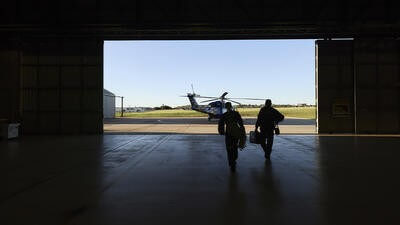
The 15 July Ningxia–Xi’an rescue was one of the first to use this new model. For operators like Qinhan General Aviation, which flew the mission, it was a signal that HEMS might finally be viable beyond small pilot projects.
Why adaptable aircraft matter
China’s geography adds another layer of complexity to HEMS – especially in regions like Shaanxi Province, where Qinhan is based.
Shaanxi isn’t just one landscape: the north is a maze of Loess Plateau gullies, the center is flat river plain, and the south is split by the Qinling Mountains, which rise sharply to over 3,000m. A helicopter that works in one area might struggle in another.
A helicopter that works in one area might struggle in another
For Qinhan, this meant choosing aircraft that could handle diversity.
The company’s fleet leans heavily on the Bell 407, a single-engine helicopter that Chinese industry observers describe as “all-around aircraft”. It’s small enough to land in tight plateau villages but roomy enough to carry a stretcher and basic intensive care unit (ICU) gear (ventilators, heart monitors).
It also has an instrument flight rules (IFR) certification – approved by China’s civil aviation authority, CAAC, in 2024 – that lets it fly through the fog common in the Qinling Mountains, when other single-engine helicopters are grounded.
Cost matters too. Shaanxi’s rural areas have limited budgets, so an aircraft that balances performance with operational expenses is key.
The 407’s fuel efficiency and lower maintenance costs make it easier to run regular missions without overcharging patients. Qinhan’s own data shows the impact: on flat terrain, the 407 cuts a 50km transport from 120mins (by ground) to 35mins. In the mountains, a 430km trip that takes 6hrs by road shrinks to 2hrs 12mins.
A 2021 mission in northern Shaanxi’s Shenmu City highlighted this.
A blizzard had shut down roads, and a villager injured by a fallen branch needed urgent care. Qinhan’s 407 flew from a nearby staging area, reached the patient in 26mins, and got him to a hospital – avoiding a four-hour ground delay.
The rescue was covered in local media, not as a ‘success story’ but as proof that HEMS could work in tough conditions. It later became part of what’s called the ‘Yulin model’, a regional system that pairs the 407 with pre-approved landing sites and trained medical crews.
The rescue was covered in local media, not as a ‘success story’ but as proof that HEMS could work in tough conditions
By mid-2025, that model had handled 90-plus missions, mostly in remote areas.

Specialized tools for specialized needs
Not all HEMS missions fit the 407’s profile. For longer distances or more complex cases – like moving a patient on an extracorporeal membrane oxygenation (ECMO) machine – operators turn to larger aircraft.
In Inner Mongolia, Bayannur Hospital, one of China’s earliest HEMS adopters, has relied on the Bell 429 for years. The twin-engine helicopter has a bigger cabin than the 407, which means more space for medical gear and crew.
Its twin engines also meet regulatory requirements for flights over the metropolis and certain terrains.
Bayannur’s 429 fleet holds a quiet record: it has logged more HEMS flight hours than any other helicopter model in China.
Unlike Shaanxi’s mixed-use 407s, Bayannur’s 429s are mostly dedicated to medical transport – a luxury made possible by years of experience and local government support.
For operators balancing both rural and urban needs, a mix of 407s and 429s has emerged as a practical approach. The 407 handles daily rural emergencies; the 429 takes on long-distance, high-acuity transfers.
It’s not a ‘one-size-fits-all’ solution, but it fits China’s patchwork of healthcare needs.
It’s not a ‘one-size-fits-all’ solution, but it fits China’s patchwork of healthcare needs
As HEMS expands, some operators are experimenting with smaller, more affordable options. The Bell 505, a light helicopter, is being trialed for tasks like moving stable patients between rural clinics or delivering medical supplies to villages with tiny landing spots. These tests are still early, but they reflect a broader trend: China’s HEMS sector isn’t copying models from other countries. It’s adapting to local constraints.
What’s next?
China’s HEMS sector is still small. There are fewer than 100 dedicated medical helicopters nationwide, compared with around 1,200 in the USA. Many rural areas still have no access to air rescue, and payment models are still being tested. But there are signs of steady progress.
China’s ‘low-altitude economy’ initiative – efforts to open up airspace below 3,000m for civilian use – could help.
Right now, getting approval for an emergency flight can take hours; reforms aim to cut that to minutes, which would make HEMS more responsive.
For patients, the progress is measured in small ways: a shorter ride to the hospital, a more predictable cost, a helicopter that can fly in fog. For operators and aircraft makers, it’s about finding a balance between what works medically and what works financially. For those involved, the goal is simple: to make sure that no patient is left waiting because the nearest hospital is too far by road.
December 2025
Issue
Our December edition rounds off the year with articles relating to special missions from around the world. We have features that look into the upgrades that have been integrated into special missions platforms to improve operations; the technology used to alert and support aerial firefighting tactics, helping attack fires quicker and more strategically; the simulators that are making training for special missions better and safer; and the latest updates and announcements of digital and physical technology in the last year.
Herbert (Yuxi) Wu
Herbert (Yuxi) is Senior Communications Strategist at Bell. He leads corporate communications for Bell in China, supporting Bell commercial business across mainland China. With nearly 15 years of experience in the Chinese aviation industry, he previously worked with Chinese aircraft and drone original equipment manufacturers (OEMs), before joining Bell.