

Industry voice: In case of emergency, call…

Search and Rescue Trainer and Lead Family Liaison Officer for the US National Park Service Moose Mutlow shares his perspective on what families need from incident command, responders, and agencies
“We don’t know what is happening”
When a family looks at a camera and expresses frustration and confusion about how an accident or response is playing out, the incident commander (IC) needs to reflect critically on their communication strategy.
Questions that need to be answered immediately are:
- Who is the primary contact for the family?
- Has the IC utilized a family liaison officer (FLO)?
- How is the investigator interacting with the family?
- Does the public information officer (PIO) have a role and have they interacted with the family?
Being proactive in thinking through potential interactions with a family, it is easy to remain operations centric, discounting the human element that lies at the heart of effective communication.
A great place to start is to understand what families have articulated as needing from incident command. In interviews and follow-ups with families, the same basic topics consistently get referenced.
Confusion
Families reported the disorientation they experienced when they first got informed about their loved one’s disappearance or death. Details were hard to process when they were still coming to terms with the key element of disappearance or death.
Recommendation for actions
Information needs to be paced around where the family is at, and allowing them the time and space to process is essential. Consider using a written narrative and maps/photos to help orient a family to what is going on and leave them with resources to review when initial contacts have finished.
Acknowledgment
Families felt their input was discounted or ignored by command staff, potentially due to their emotional delivery. Families know their family member intimately and want the chance to share insight and perspective.
Recommendation for actions
Incident command staff should take the time to listen to and acknowledge family input. When families make suggestions based on their experience or intuition, write it down, show them it has been noted, and discuss how their input will be processed. Be prepared to specifically respond to their input at the next meeting.
Incident command staff should take the time to listen to and acknowledge family input
Clues
When the IC discusses the operation to date and discloses clues or discoveries, families talked about a consistent failure to fully explain why, and what was done to pursue more information for all clues.
Recommendation for actions
The investigator should be prepared to back up decisions beyond simply stating the clue did not pan out. Details should include specific steps taken to exhaust all the potential avenues the clue might have suggested.
Jurisdiction
Families universally asked for clarity about who is in charge. If the response is multi-jurisdictional, there is naturally confusion about who is making decisions and responding.
Recommendation for actions
Prepare written material to explain the incident command system (ICS) and areas of jurisdictional responsibility to show (without names) who is in command of what. Create a diagram to explain hierarchy and where the FLO fits in. Be prepared to update the diagram as the operation progresses.
Expertise and connections
When families have connections with the armed services, government agencies, or state/province/regional/county emergency offices, families reported that their offers of assistance were often rejected. Families felt the IC failed to consider the offer before turning it down without clear explanations.
Recommendation for actions
The FLO should collect all the contact information even if the suggested resource is unlikely to help, or lacks the necessary experience in the terrain. At a minimum, a courtesy call from the IC staff should be made to the contact to gauge their expertise and availability and consider asking for a vetted reference from a previous deployment. Think how to manage the communication paths and assess if the contacted party will truthfully report out to the family your conversation. Include this conversation on any shared timeline.
At a minimum, a courtesy call from the IC staff should be made to the contact to gauge their expertise and availability and consider asking for a vetted reference from a previous deployment
Freelancers
If the IC reports that resources are sparse or have been redirected to emerging incidents, families will look for outside support. If these leads or volunteers are then rejected by the IC, this creates tension between the operation and family.
Recommendation for actions
As families move to research and recruit outside resources, the FLO should be proactive in tracking who and what is being recruited. Pull the IC in early to have a conversation about sharing information and defining areas of responsibility. Be proactive laying the groundwork prior to resources arriving that cannot be utilized due to safety issues (underwater search teams and drone operators are good examples).


Unsolicited leads
There is a long history of unsolicited leads from psychics, mediums, and self-promoters that counter the facts of the case and undermine confidence in agencies’ responses. Families expressed frustration at not being informed early on how they could be targeted by groups and individuals. During a crisis, families are particularly vulnerable to fraudulent coercion.
Recommendation for actions
The IC should consider using PIOs to help inform a family about what might happen with media. Consider using investigators to talk to families about how they might respond to unsolicited offers of help. Encourage the family to share contacts. When families share specific group names, the IC, or their designate, should do research about the group to understand if they have the capacity to help. Start to strategize with the family on responses that safeguard the integrity of the response. If there is a hint of outside coercive behavior (requesting funds to travel or asking for large amounts of money upfront), the FLO should report details to law enforcement.
Encourage the family to share contacts. When families share specific group names, the IC, or their designate, should do research about the group to understand if they have the capacity to help
Locals
As an operation scales and mainstream media starts to take a story national/international, locals start to emerge as local experts or participants. Families talked about the impact of others telling “their story” inaccurately or hijacking the narrative to fulfill their own agenda.
Recommendation for actions
The IC should consider making a proactive intervention with media to encourage responsibility in reporting. Amplified local voices can be the result of a void in information. The IC should think how to engage media on a thematic approach over the first few briefings by introducing new resources and a progression of information. Briefings could have individual focuses on incident details, timelines, terrain, weather outlook, etc. When an individual’s actions undermine the mission, utilize community contacts to help understand local individuals’ motivation and credibility.
April 2026
Issue
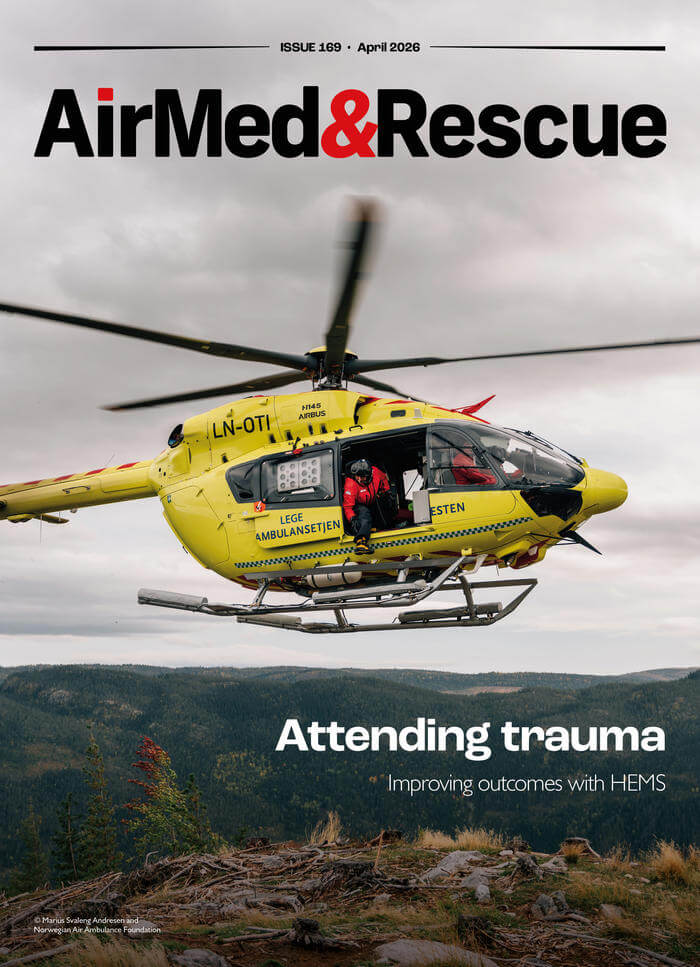
Launching into spring, we have another great edition covering the world of airborne special missions. We have features on the European approach to aerial firefighting; how maintenance, repair, and overhaul companies are still managing the complex supply chain environment; neonatal transfers in regions that are not conducive to easy ground transport; and how helicopter emergency medical services deal with attending to traumatic accidents and injuries.
Moose Mutlow
Moose has worked extensively in search and rescue as a trainer and operator. He is a Lead Family Liaison Officer for the National Park Service, and is the author of When Accidents Happen: Managing Crisis Communication as a Family Liaison Officer. More information at moosemutlow.com