
Industry voice: Hurricane Melissa: the CMAT response

Dr Anthony Fong, Chair of the Board of Directors for the Canadian Medical Assistance Teams and Clinical Associate Professor at the University of British Columbia, describes the international aid experience of responding to a natural disaster that devasted Jamaica
The shimmer of 33°C heat rose off the asphalt outside Cornwall Regional Hospital (CRH) in Montego Bay, St James Parish, Jamaica. Within a few days, the corner of its parking lot hummed with activity as it became an extension of its emergency department: two tents for assessment and treatment, folding chairs for waiting, and a steady stream of patients flowing from an overcrowded emergency department. Generators and communications gear competed with the usual sounds of hospital bustle, while construction noise carried from a building under repair.
For our Canadian medical team tasked with delivering emergency care amid a disaster, many are quick to identify doctors and nurses who are essential receivers of patients. Yet paramedics are equally critical: resilient in austere settings, accustomed to operating where safety, security and logistics cannot be taken for granted, and able to keep a medical operation functioning when infrastructure and access are fragile.
Hurricane Melissa
Hurricane Melissa, a category 5 storm when it hit Jamaica on 28 October 2025, set the stakes high. A Pan American Health Organization (PAHO) situation report recorded 45 confirmed deaths and the disruption of electricity and water, alongside heavy damage at 124 health facilities across the western half of the island nation, with impacts on 2,619 healthcare workers. At the same time, Jamaica also declared an outbreak of leptospirosis – a deadly bacterial illness that spreads in contaminated floodwaters.
Our non-governmental organization (NGO), Canadian Medical Assistance Teams (CMAT), is a volunteer-run, donation-supported organization that deploys multidisciplinary teams to support health systems during disasters. We draw volunteers from across Canada – doctors, nurses, nurse practitioners, paramedics, logisticians, and administrators. During a response, we are also supported by duty officers who work from home to assist with emergency planning and operations; this time, they coordinated with partners including Jamaica’s Ministry of Health and Wellness, PAHO, and the World Health Organization (WHO).
Supporting the hospital
Our assigned objective was explicit: support CRH by providing advanced primary care services in order to decompress its emergency department. Our answer was to implement an integrated clinic extension to the CRH accident and emergency department; not our typical roving standalone clinic. We set up in the CRH parking lot and staffed it with eight Canadian volunteers – physicians, nurses, nurse practitioners, paramedics, and logisticians – and designed it to provide urgent primary healthcare for patients triaged with lower-acuity problems.
Integration with CRH depended on a carefully designed workflow: triaged patients were referred directly from the emergency department’s triage nurse into our tents, and any patients who needed higher-level, hospital-based diagnostics or admission were referred back inside. CMAT clinicians were able to refer patients directly to specialists using the CRH’s native processes.
Integration with CRH depended on a carefully designed workflow: triaged patients were referred directly from the emergency department’s triage nurse into our tents, and any patients who needed higher-level, hospital-based diagnostics or admission were referred back inside
By late November, CMAT’s clinic was seeing considerable numbers – often 40–50% of the emergency department’s total volume.
The field team also established a reporting rhythm with operational leadership at home, including scheduled check-in calls that connected our team leaders with duty officers supporting from Canada. This structure mattered: it sustained situational awareness, accelerated logistics problem-solving, and kept a stable interface with Jamaican and PAHO regional coordination as the mission pivoted.

Medical stabilization services
For CMAT, our journey in Jamaica began with a search and rescue (SAR) mission that evolved into a fixed clinical deployment. In early November, we deployed with Burnaby Urban Search and Rescue (BUSAR) and worked alongside the Jamaica Defence Force (JDF) to provide medical stabilization services to those rescued post-hurricane as well as the rescuers themselves.
The conditions from those initial days were austere ‘hardship camping’, with a base camp and tents that demanded field discipline from day one. Air transportation within the country was initially limited, with Montego Bay’s Sangster International Airport being closest to many devastated areas, but initially closed to all but emergency flights. This forced our team and our partners to navigate treacherous roads that were just beginning to be assessed post-hurricane.
The conditions from those initial days were austere ‘hardship camping’, with a base camp and tents that demanded field discipline from day one
As immediate search needs eased, the tasks shifted to providing direct medical care to an overburdened health system. By mid-November, our center of operations had moved to CRH in Montego Bay.
Jamaica’s Ministry of Health lists CRH as a Type A hospital, a 400-bed facility that is the only hospital outside Kingston providing most specialist services. Hurricane Melissa affected that capability immensely, cutting its capacity in half and leaving CRH operating on only emergency services while repairs, in particular roof replacement and flood damage repair, were underway.
Damaged infrastructure
The hardest problems faced by the team, as is often the case in disaster medicine, were not medical. Power and water disruptions affected staff and patients alike, and CMAT’s own lodgings did not initially have power. In addition, our field team met and were supported by several staff at CRH who were rendered homeless by the hurricane – yet continued to show up to work every day despite the difficult circumstances.
Rising food insecurity and unstable housing post-hurricane also highlighted the importance of constant security in the clinic, which was well equipped to deal with medical issues but less so the social ones.
The final phase was demobilization – done with the same discipline as setup. By the end of our deployment, CMAT had run our field clinic at CRH seven days per week, treating 447 patients.
Lesson learned
For the air medical and rescue readership, the lessons we learned may be familiar: coordination and communication equals capacity. PAHO emphasized that emergency medical teams needed to integrate into local service delivery and provide standardized reporting to maintain a timely operational overview and prevent duplication and redundancy.
For the air medical and rescue readership, the lessons we learned may be familiar: coordination and communication equals capacity
Hurricane Melissa showed how quickly a deployment can pivot from supporting SAR teams working in austere conditions to integrating into the day-to-day function and overall recovery of a hospital, in this case western Jamaica’s only tertiary-care hospital. It also reinforced a core point for anyone who flies, lands, or operates in disaster environments: medicine does not happen in isolation.
In St James Parish, CMAT was able to operate because first responders, logisticians, and clinicians operated as one system. Together, we built an accessible clinic, kept it operating safely, and integrated with the most important stakeholders – the Jamaican people.
March 2026
Issue
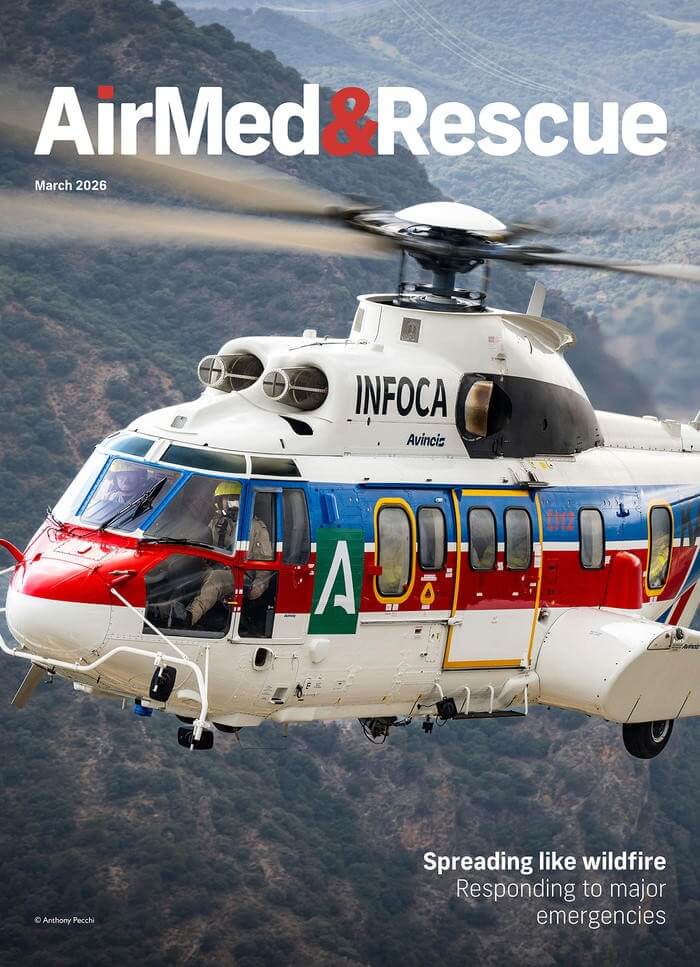
This edition is bursting at the seams with articles from all corners of the special missions sector. We have features on the California wildfires that ravaged the state last year, what the cost–benefit analysis looks like for single-engine rotorcraft and autorotations, how the mission dictates the modification needed to the platform, and what can be done to further prevent the problems associated with inadvertent entry into instrument meteorological conditions.
Dr Antony Fong
Dr Fong is an emergency physician and disaster medicine specialist based in Vancouver, Canada. He serves as Chair of the Board of the Canadian Medical Assistance Teams (CMAT), supporting domestic and international deployments, operational readiness, and training aligned with WHO Emergency Medical Team standards. Dr Fong is also a Clinical Associate Professor at the University of British Columbia and a Medical Director of Emergency Management for a core Vancouver health authority.