
Industry voice: The coordination gap: why air ambulance teams struggle to stay aligned

Fragmented workflows can slow communication and disrupt missions, when what teams need is a real-time, shared overview through a single, standardized system, explains Viktoriya Gopfauf, Business Development Manager for Avinode’s Air Ambulance segment
Delays in air ambulance missions rarely come down to clinical complexity. More often, the cause appears earlier in the process: fragmented coordination, sequential workflows, and limited real-time visibility between the parties involved.
Consider a medical assistance company tasked with organizing an urgent evacuation. An initial enquiry suggests that the earliest aircraft availability is seven days away. At face value, this looks like a capacity constraint. In reality, it is often a coordination issue. Aircraft positioning is assessed before medical feasibility is confirmed. Permit requirements are explored before routes are finalized. Each step waits on the previous one, instead of being evaluated in parallel. By the time constraints surface, valuable time has already been lost.
Across the industry, coordination teams are managing complex missions using emails, spreadsheets, and disconnected systems. Information moves slowly and sequentially between stakeholders, who operate across time zones and organizations. When no shared operational picture exists, alignment depends on manual follow-ups rather than structured processes. Over time, this results in slower decisions, duplicated work, and unnecessary strain on teams.

Visibility is not a bonus; it is the foundation for coordination
Air ambulance missions require close alignment between operators, medical assistance companies, and medical teams. Each group evaluates feasibility from a different perspective, yet decisions are often made without a shared understanding of the full picture.
A common example illustrates the problem. A medical assistance agent urgently requests an aircraft and begins calling and emailing multiple operators. One operator confirms technical availability. Another flags permit challenges. A third declines the mission after reviewing the patient’s condition. Each response is valid within its own context, yet none reflects the complete decision state. ‘Available’ means different things to different teams. Without shared visibility into operational, regulatory, and medical constraints, coordination becomes a process of reconciling conflicting answers rather than moving the mission forward.
When teams operate from a real-time, shared overview of missions, aircraft availability, and acceptance criteria, decision-making becomes clearer
When teams operate from a real-time, shared overview of missions, aircraft availability, and acceptance criteria, decision-making becomes clearer. Feasibility issues surface earlier, expectations are set more accurately, and fewer missions stall due to avoidable misunderstandings.
Manual processes limit consistency and clarity
Fragmented workflows do more than slow communication; they create rework. In many missions, a quote request may be sent by email, clarifications handled through messaging apps, and updates delivered by phone. As the mission evolves, information is split. Quotes become outdated. Documentation no longer reflects the latest decisions. Teams must repeatedly revalidate steps that have already been completed, simply to ensure nothing critical has been missed.
In an environment involving operators, medical providers, assistance companies, insurers, and families, the margin for error is small. When updates are scattered across systems, consistency becomes difficult to maintain. Misalignment does not just delay missions; it undermines confidence in the coordination process itself.

The coordination gap strains teams behind the scenes
The coordination gap doesn’t only affect timelines, it quietly increases the administrative burden on the teams running missions. When work is fragmented across platforms, agents spend excessive time tracking the latest updates manually, navigating inconsistent tools, and repeating the same tasks for every case. Organizations that centralize coordination, automate tracking, and standardize workflows reduce cognitive load significantly – not by asking teams to work harder, but by giving them a stable operational environment. That stability directly reduces administrative burnout, lowers the risk of errors, and prevents compliance gaps from emerging downstream. In practice, controlling coordination through a single, standardized system improves readiness, accelerates onboarding, and reduces operational disruption – because team strain is often a symptom of poor coordination, not insufficient staffing.
Organizations that centralize coordination, automate tracking, and standardize workflows reduce cognitive load significantly
Technology should support alignment, not compensate for its absence
At Avinode, we have spent years supporting private air charter operators by structuring how flights are sourced, evaluated, and coordinated. As air ambulance missions increasingly rely on the same level of precision, the underlying principle remains consistent: coordination improves when feasibility, availability, and constraints are evaluated in parallel rather than passed sequentially between teams.
In practice, systems that consolidate mission details, provider responses, and communication into a single shared environment make limitations visible earlier, when adjustments are still possible. This allows assistance companies and operators to assess options more realistically from the outset and reduces the need for last-minute course corrections.
Productivity in air ambulance coordination is not about moving faster at all costs. It is about removing friction from the process so teams can focus on informed decision-making rather than information management
Productivity in air ambulance coordination is not about moving faster at all costs. It is about removing friction from the process so teams can focus on informed decision-making rather than information management. When coordination is structured, transparent, and shared, missions run with greater predictability and confidence. Even under pressure.
The industry does not lack urgency. What it lacks is alignment. Closing the coordination gap starts with visibility, consistency, and systems designed to support collaboration, rather than compensate for fragmentation.
January 2026
Issue
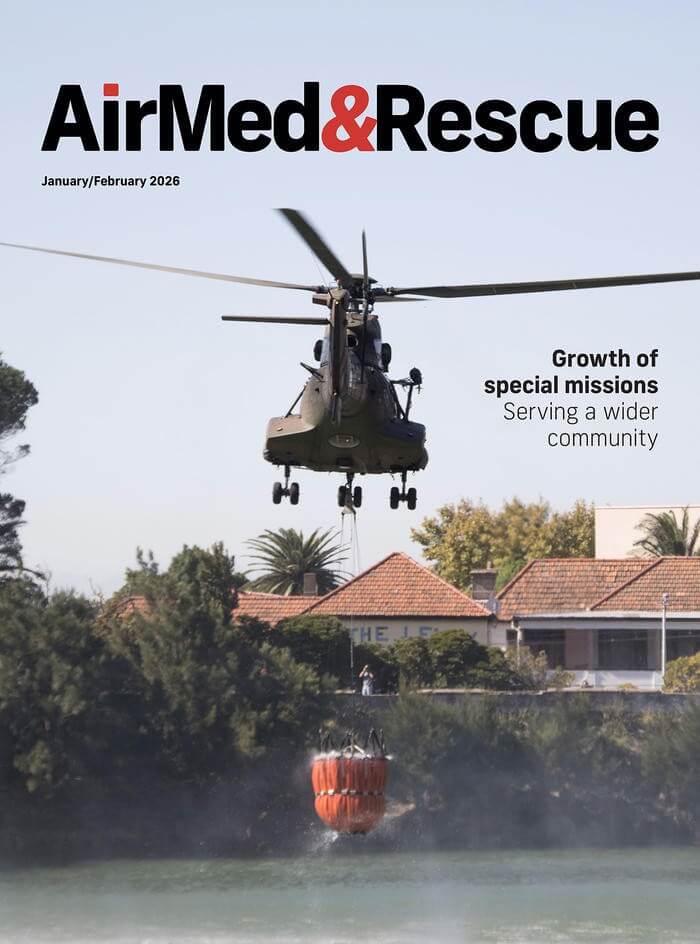
A new year and a new edition, and with it comes articles relating to special missions from all across the globe. We have features that look into the special missions in the Middle East and Africa; the benefits and differences associated with leasing helicopters; and the way that aerial firefighting is conducted at night.
Viktoriya Gopfauf
Viktoriya is the Business Development Manager for Avinode’s Air Ambulance segment, focused on identifying the right partners, understanding their operational challenges, and bringing forward solutions that create measurable impact. She cuts through assumptions, diagnoses pain points, and translates Avinode’s capabilities into outcomes that improve mission reliability and workflow efficiency.
Her role bridges strategy and execution: building new client relationships, uncovering real-world needs, and ensuring that each solution aligns with how operators actually work.